


400 cc Implants: Achieving Your Ideal Breast Size
Publish Date:26 June 2026

400 cc implants breast augmentation is a body contouring procedure to sculpt your ideal silhouette. 400 cc volume adds 400 ml of fluid mass per breast, which scales your bust up by 2.5 to 3 cup sizes. Our board-certified surgeon Dr. Engin Öcal matches this volume to your breast base width, ensuring implants blends naturally with your morphology. Evaluating skin laxity is key to ensure your body can safely support a 400 cc augmentation.
400 cc Implants Before & After

Evaluating 400 cc implants before & after photos requires looking closely at key details to distinguish high-quality surgery. Exceptional results focus on how seamlessly the implant integrates with your body rather than just adding volume. When reviewing patient transformations, pay close attention to:
- Natural Contour:Look for a smooth, gradual slope from the collarbone to the upper breast mound.
- Symmetry:The lower breast creases should align perfectly on both sides to keep the 400 cc silicone implants
- Nipple Positioning:The nipples must sit precisely on the highest point of the breast mound, pointing subtly upward and forward.
- Lateral Blending:The outer edges should transition into the chest wall without implant rippling or distinct borders.
Are You a Candidate for 400 cc Implants?
At Doku Clinic, Dr. Engin Öcal closely evaluates your body mass index (BMI), chest wall and skin elasticity to confirm if a 400 cc volume matches your anatomical limits. For your frame to be able to support a 400 cc breast augmentation, ideal candidates generally meet the following criteria:
- No smokers:Stopping smoking and nicotine for at least 4 to 6 weeks pre- and post-surgery is mandatory.
- Systemic Health Stability: Active autoimmune flare-ups or systemic infections cause immediate disqualification.
- Base Diameter:The breast base width must measure between 0 cm and 13.5 cm.
- Tissue Depth:A minimum 0 cm skin pinch test value in the upper breast pole.
- Frame Compatibility:A height typically above 165 cm or a moderate-to-broad chest circumference.
- Tissue Laxity:Sufficient skin envelope volume, highly common in postpartum patients correcting empty volume.
Ideal Breast Size and Body Proportions
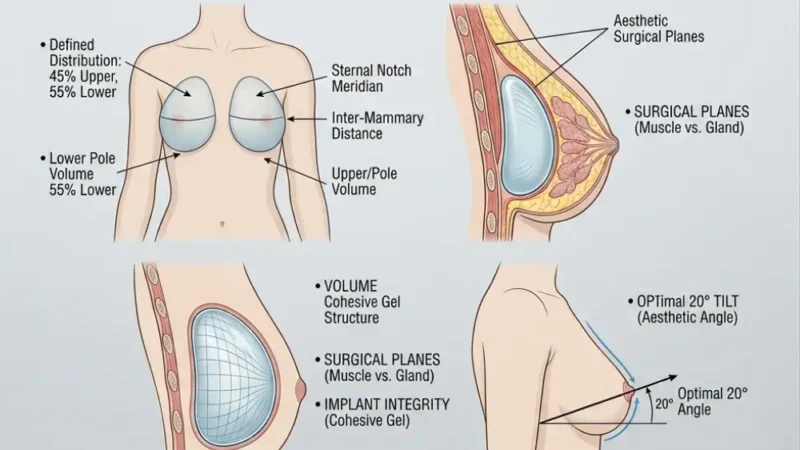
The beauty and impact of 400 cc volume depends on your height, shoulder width, and hip measurements. For instance, on a taller or broader frame, 400 cc creates a balanced, athletic curved silhouette. Conversely, on a petite or narrow frame, this exact same volume will present as a voluptuous profile. True elegance relies on balancing body proportions seamlessly.
At Doku Clinic, Dr. Engin Öcal assesses your chest wall width and inter-mammary distance before selecting the implant:
- 45:55 Distribution:Landmark clinical studies (such as Mallucci’s aesthetics metrics) show that the most natural breast features 45% of its volume above the nipple line (upper pole) and 55% of its volume below it (lower pole).
- 20° Nipple Tilt: The nipple-areola complex should have a subtle upward projection angle between20 and 30 degrees from the breast meridian.
- Sternal Notch Distance:The distance from the sternal notch (the base of the neck) to the nipple must ideally fall within a 19 to 22 cm range to ensure breast symmetry.
- Base Width:A standard 400 cc implant features a base diameter of roughly 5 to 12.5 cm. To avoid visible edges or tissue thinning, this number must be 0.5 to 1.0 cm narrower than your native breast width.
Breast Augmentation Surgery for 400 cc Implants

Breast augmentation surgery is a highly sophisticated, standardized procedure performed under general anesthesia. Inside the advanced operating suites at Doku Clinic in Istanbul, the entire operation typically takes between 60 and 90 minutes.
Our primary objective is to deliver a seamless, safe, and comfortable surgical experience. Led by board-certified plastic surgeon Dr. Engin Öcal, the procedural timeline follows a strict, multi-step clinical framework to guarantee absolute precision.
The surgery is divided into four distinct clinical phases:
- Phase 1: Pre-Operative Mapping: Engin Öcal creates detailed anatomical markings on the chest wall while you are upright. This ensures accurate pocket alignment and symmetry for the 400 cc breast implants.
- Phase 2: Anesthesia Induction:Certified anesthesiologists administer general anesthesia. This guarantees absolute patient comfort, immobility, and optimal vitals monitoring throughout the procedure.
- Phase 3: Pocket Dissection:Utilizing advanced surgical instruments, the surgeon carefully creates the tissue pocket. The surgical field is then irrigated with an antibiotic solution to minimize the long-term risk of capsular contracture.
- Phase 4: Multi-Layer Closure:The incisions are closed using advanced, absorbable multi-layered sutures. This technique reduces skin tension, promotes rapid healing, and results in a fine, discreet scar line.
Placement Techniques: Submuscular vs. Subglandular
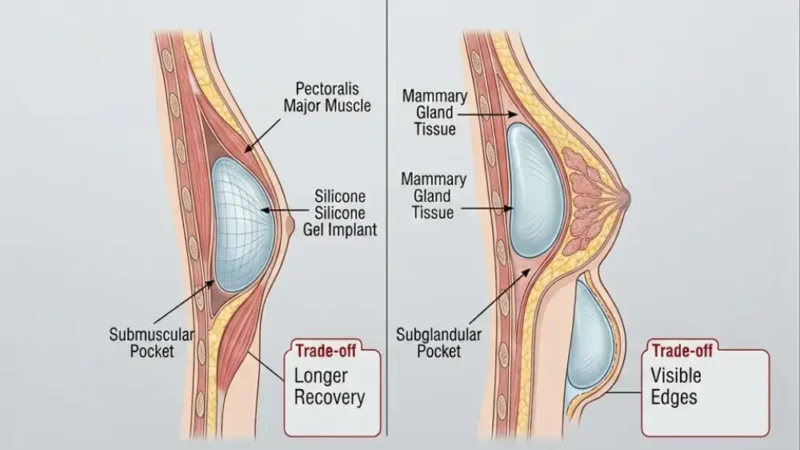
The position of a 400 cc breast implant relative to the muscle determines its long-term stability, shape, and visibility. At Doku Clinic, Dr. Engin Öcal customizes this placement strategy to ensure optimal coverage and prevent structural complications over time.
Submuscular Placement (Under the Muscle)
This technique involves placing the 400 cc implant beneath the chest muscle plane.
- Key Benefit:Provides an extra layer of cover, drastically lowering the risk of visible implant edges or palpable rippling.
- Long-Term Advantage:Decreases the risk of capsular contracture.
- Trade-off:Requires a slightly longer recovery due to muscle stretching.
Subglandular Placement (Above the Muscle)
This technique places the cohesive silicone gel implant directly behind the mammary gland but over the pectoral muscle.
- Key Benefit:Eliminates the risk of implant displacement when flexing the chest.
- Recovery: Less post-op pain and a quicker return to physical activities.
- Trade-off:Requires thicker tissue flap to mask the borders of a 400 cc volume.
Breast Implant Incisions
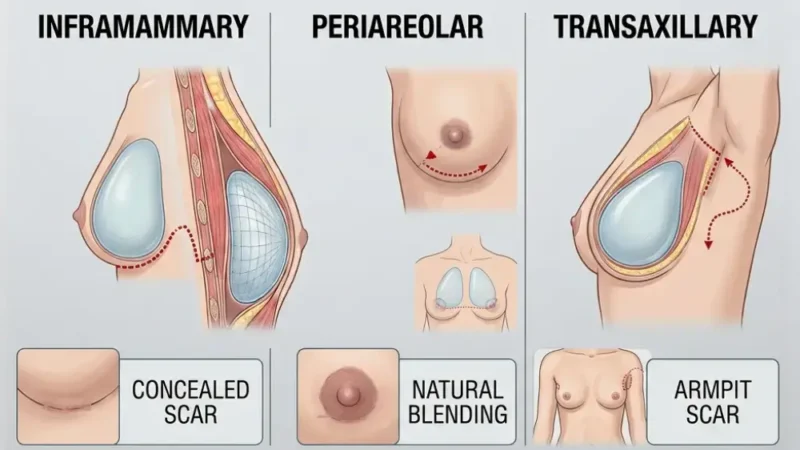
The choice of incision impacts long-term scar visibility and how precisely a 400 cc breast implant can be positioned. At Doku Clinic, our surgical team utilizes multi-layered closure techniques to promote rapid, clean healing.
- Inframammary Incision:Made within the natural crease beneath the breast (the inframammary fold). This is the most frequently used for 400 cc volumes because it offers maximum visibility and direct access for pocket creation, keeping the scar well-hidden under the breast drape.
- Periareolar Incision:Placed along the semi-circular border where the dark skin of the areola meets the lighter breast tissue. It blends remarkably well into the natural skin color transition.
- Transaxillary Incision:Located discreetly within the natural folds of the armpit. This option completely avoids scars on the breast tissue itself, utilizing specialized endoscopic instruments to guide the cohesive silicone gel implant into position.
Types of 400 cc Breast Implants
At Doku Clinic, we offer premium, FDA-approved implant to ensure safety and performance. Dr. Engin Öcal guides patients through material and shapes to find what best suits their desires and physique. Our clinic prioritizes high-cohesivity implants that maintain stable structural integrity over time.
Implant Materials
The internal composition of a 400 cc implant alters how natural the breast feels to the touch:
- Cohesive Silicone Gel (“Gummy Bear Implants”):Our favored option for a 400 cc volume. The gel behaves as a solid rather than a liquid, mimicking the exact weight and texture of natural breasts while eliminating the risk of internal leaking.
- Saline-Filled Shells:These implants are inserted empty and inflated with sterile saltwater during surgery. They allow for smaller incisions, but 400 cc implants can feel firmer with saline and carry a higher risk of rippling in patients with a low BMI.
Implant Shapes
The shape of the implant determines how the 400 ml of volume is distributed across your chest:
- Round Implants:These provide uniform fullness throughout both the upper and lower poles. They are best for creating dramatic upper-breast fullness and a prominent cleavage line.
- Anatomical (Teardrop) Implants:These are designed to mimic the natural slope of breasts, placing more volume in the lower half. They deliver subtle, sophisticated augmentation, making them ideal for thin or postpartum tissue.
Recovery Time & Post-Operative Care
Healing from a 400 cc breast augmentation requires strict adherence to your surgeon’s post-op instructions. At Doku Clinic, your recovery process is fully guided by your surgeon, personal host and private nurses. Dr. Engin Öcal provides a personalized plan including diet, exercise and fundamental do’s and don’ts.
- Days 1 to 3 (Immediate Post-Op):Expect a feeling of tightness and swelling. Patients must wear a surgical support bra 24/7 to control edema and prevent implant displacement.
- Week 1 (Initial Healing): Engin Öcal conducts your first post-operative evaluation to check incisions. Most international patients can resume light walking and desk work, but lifting objects over 5 lbs is forbidden.
- Weeks 2 to 4 (Tissue Adaptation):Acute swelling subsides, and the silicone gel begins to drop and fluff into a more natural position. Driving is permitted once medication is stoped.
- Week 6 and Beyond (Final Stabilization):The internal capsule is secure. Following a final evaluation, patients receive clearance to resume strenuous gym workouts and sleep on their stomachs.
Potential Risks & Complications of 400 cc Implants
While a 400 cc breast augmentation achieves exceptional satisfaction, understanding the surgical and long-term risks is vital. At Doku Clinic, Dr. Engin Öcal minimizes these risks following the rigorous safety guidelines that earned him his European board certification.
The most critical clinical risks associated with breast implants include:
- Capsular Contracture:The body naturally forms a capsule of scar tissue around the silicone shell. If this tissue thickens and contracts, it can cause the breast to feel firm, look distorted, or cause discomfort.
- Implant Displacement:Because a 400 cc volume carries a weight of roughly 400 grams, gravity can cause the implant to drop below the breast crease if tissue lacks thickness.
- Symmastia:A rare condition where the internal breast pockets are over-dissected near the sternum, causing the two 400 cc breast implants to merge across the center line.
- Hematoma and Seroma:An unexpected collection of blood (hematoma) or clear fluid (seroma) around the implant shell, which may require drainage.
- Implant Rupture or Leakage:Though cohesive “gummy bear” gels do not spill or alter shape if the outer shell tears, a “silent rupture” requires a routine MRI scan to diagnose and evaluate over time.
How Much Do 400 cc Implants Cost?
The total price of 400 cc implants surgery ranges from $2,150 to $15,000 in 2026. While the US and UK charge separate, out-of-pocket fees for anesthesia and facilities, Turkey provides bundled, all-inclusive packages.
United States (US) Cost
In the United States, the price of a 400 cc breast augmentation is dictated by surgeon prestige (with coastal cities commanding the highest premiums). The total cost for a 400 cc breast augmentation spans from $4,000 to $15,000.
- Saline Systems: running between$4,000 and $10,000.
- Silicone & Gummy Bear:Standard round silicone cost $5,000 to $12,000, while form-stable teardrop implants peak between $6,000 and $15,000.
- Financial Oversight:These numbers represent only the surgeon’s fee. Patients must pay separate, external invoices for operating room rentals and anesthesia.
United Kingdom (UK) Cost
Private medical fees in the UK for a 400 cc volume reflect steep local regulatory compliance and insurance overhead costs. Medical fees for 400 cc implants range from £3,500 to £9,500.
- Saline Systems:Entry-level saline average $4,500 to $9,000.
- Silicone & Gummy Bear:Standard cohesive silicone options cost $5,000 to $10,000, while advanced anatomicals run from $6,000 to $12,000.
Turkey Cost
Turkey presents the highest cost-efficiency, offering premium all-inclusive 400 cc surgical packages ranging strictly from $2,150 to $5,500.
- Saline Systems:Basic saline procedures range from $2,150 to $3,500.
- Silicone & Gummy Bear:Round silicone cost $2,500 to $4,500, while top-tier teardrop cost $3,000 to $5,500.
2026 Cost Comparison
The table below breaks down the true average cost ranges across all three nations for a 400 cc volume based on the specific implant technology selected:
| Country | Saline Implants (USD) | Standard Silicone Implants (USD) | Gummy Bear / Teardrop (USD) |
| Turkey (All-Inclusive) | $2,150 – $3,500 | $2,500 – $4,500 | $3,000 – $5,500 |
| United Kingdom (Surgery Only) | $4,500 – $9,000 | $5,000 – $10,000 | $6,000 – $12,000 |
| United States (Surgery Only) | $4,000 – $10,000 | $5,000 – $12,000 | $6,000 – $15,000 |
How Long Do Breast Implants Last?
While modern silicone gel implants are durable, they are subject to wear and changes over time. Current 2026 statistics about breast implant longevity can give you a very clear idea of what having breast implants means in terms of long-term commitment:
- Average Lifespan: between10 to 15 years before requiring surgical attention.
- The 10-Year Rule: roughly10% to 20% of patients undergo a revision procedure within the first decade due to choice or structural changes.
Long-Term Care & Maintenance
Your 400 cc breast implant will require proactive maintenance to preserve their shape. This will involve both lifestyle factors and regular checks with your doctor.
1. Lifestyle & Body Factors
Your daily habits directly influence how your tissues support the silicone gel over a 10-to-15-year period.
- Weight Stability:Patients should aim to maintain their weight within a stable 5 to 7 kg (11 to 15 lbs) range. Significant weight loss strips away the subcutaneous fat layer covering the implant, which increases the risk of visible palpable rippling. Massive weight gain overstretches the skin envelope, leading to tissue sagging (ptosis) when the weight is dropped.
- Exercise & Pectoral Care:Staying active is encouraged, but workout routines must be modified based on your implant placement. If you have submuscular implants, heavy, repetitive chest exercises (like heavy bench presses) can cause the muscle to flex aggressively. Focus instead on core, lower body, and functional resistance training.
- High-Impact Support: During high-impact cardiovascular activities like running or HIIT, gravitational forces can multiply this weight significantly. Patients must wear a high-support, encapsulated sports bra during all workouts.
- Skin Elasticity Protection:Daily hydration and topical hydration (moisturizers containing hyaluronic acid or ceramides) help keep the skin over the breast mound resilient against the constant tension of the 400 ml mass.
2. Clinical & Medical Surveillance
In addition to lifestyle management, standard screening protocols must be followed to track internal tissue and shell health.
- Routine Diagnostic Imaging:To monitor for silent ruptures in cohesive silicone gel, the FDA recommends getting a high-resolution ultrasound or breast MRI every 2 to 3 years.
- Advanced Mammography Management:Implants do not prevent breast cancer screenings, but they require specialized handling. Always inform your technician beforehand so they can utilize Eklund displacement views.
- Capsular Tracking:Perform a quick, 2-minute self-examination once a month. Check for unexpected firmness, shifting, or localized asymmetry, which are primary indicators of early-stage capsular contracture.
Breast Implant Revision (Replacement Surgery)
When a 400 cc implant reaches the end of its life or a patient desires a size change, a replacement surgery (revision) is performed. Dr. Engin Öcal specializes in complex revisions, carefully replacing older models with modern cohesive gels.
A revision surgery typically involve:
- Capsulectomy:If the breast has hardened, the surgeon removes both the old implant and the surrounding thickened scar tissue capsule.
- Pocket Refinement:The internal tissue pocket is tightened or shifted to prevent a heavy 400 cc volume from sagging or bottoming out over time.
- Surgical Recovery:Revision recovery is often faster than the primary surgery.
Best Alternatives to Breast Implants in 2026
If you desire enhanced breast volume but want to avoid foreign materials or long-term replacements, options do exist.During your consultation at Doku Clinic, Dr. Engin Öcal evaluates whether your body composition supports these alternative procedures:
- Autologous Fat Transfer (Fat Grafting):Liposuction removes fat from areas like the abdomen or thighs, which is then purified and injected into the breasts.
- The Numbers:Only about 60% to 70% of the transferred fat survives permanently.
- The Limit:It can typically only increase your bust by 1 to 1.5 cup sizes.
- Composite Breast Augmentation:A hybrid technique combining a smaller silicone implant (e.g., 250 cc) with targeted fat grafting around the edges. This delivers a soft contour without utilizing a heavy implant.
- Mastopexy (Breast Lift):For patients with volume that has sagged due to weight loss or childbirth. A lift repositions your native tissue higher on the chest wall.
FAQs
What cup size will a 400 cc implant give me?
It typically increases your bust by 2.5 to 3 full cup sizes. Your exact final cup size depends heavily on your chest wall width and natural breast tissue.
Will a 400 cc implant cause chronic back pain?
No, provided you have a healthy BMI and good posture. A 400 cc implant weighs 400 grams per side (1.76 lbs total). Healthy frames easily tolerate this weight when supported by a proper bra.
When can I sleep on my stomach again?
You must wait exactly 6 weeks. Sleeping on your chest puts severe pressure on the healing area, risking implant displacement, incision tearing, or asymmetrical shifting.
How long does it take 400 cc implants to “drop and fluff”?
It takes roughly 3 to 6 months. Initially, the pectoralis muscle holds the 400 cc volume high and tight. Over time, the tissue relaxes, settling the implant into a natural 45:55 distribution.
Will 400 cc implants stretch my skin permanently?
Yes, any major volume expansion alters the skin envelope. This is why a 2.0 cm skin pinch test is mandatory. If you choose to remove them later, a mastopexy (lift) is required to correct sagging.
Can I perform heavy chest exercises after submuscular placement?
Avoid heavy, direct pectoral lifting permanently. Repetitive heavy flexing can distort the chest over time, causing deformity or displacing the 400 cc implant outward or downward.
Do I need a breast lift along with a 400 cc implant?
Yes, if your nipples sit below your natural breast crease. If you have severe sagging from pregnancy or weight loss, adding a heavy implant alone will cause a distorted “double bubble” look without a lift.
How do I know if my cohesive silicone implant has ruptured?
Only a routine MRI or high-resolution ultrasound can confirm a silent rupture. Modern cohesive “gummy bear” gels retain their shape and do not leak into surrounding tissues, meaning they show zero physical symptoms.