


Silicone Breast Implants: The Complete Guide to All Types, Surgery & Results
Last Update:1 September 2026
Written by the Doku Clinic editorial team. Reviewed and approved by Dr. Engin Öcal, lead Plastic, Reconstructive & Aesthetic Surgeon.
Silicone breast implants achieve results that look and feel almost like natural breast tissue. They come in different shapes, sizes and surfaces – we will show them visually and detail their advantages below. Implants are the core topic, but we will go beyond them, too. Understanding breast augmentation surgery, how to verify certified implants from the best global brands, and the basics of medical safety is the best way to choose the right option.
Key takeaways from this article:
- Every certified implant comes with serial numbers, a lifetime warranty and an implant passport.
- Cohesive gel “gummy bear” implants have reduced the risk of silent ruptures and leakage.
- Chest width, skin elasticity and existing tissue decide which implants are available to you.
- Silicone implants do not last forever: routine MRIs and eventual replacement are standard practice.
Types of Silicone Breast Implants
We have already mentioned that silicone implants come in various forms. Indeed, there are models with different gel cohesivity, shape, surface and profiles. Below, we go through all the main categories giving key details about them.
1. “Gummy Bear” Silicone Implants
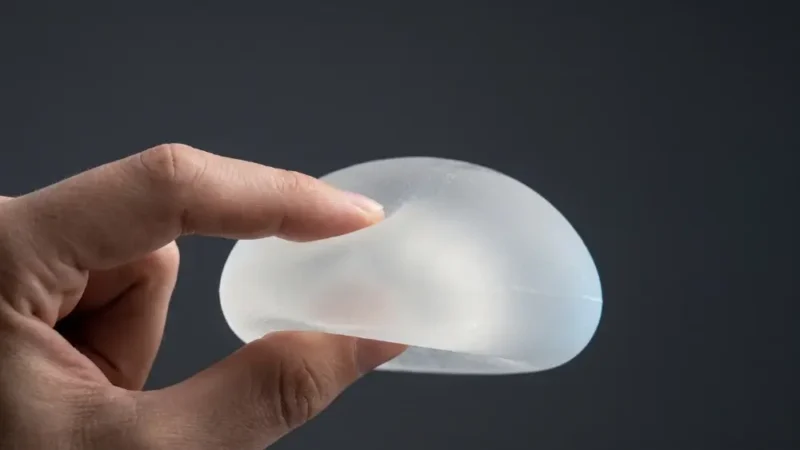
Cohesive gel implants are the greatest innovation in breast aesthetics in the last 20 years. They are made from a thick, form-stable gel, so that the silicone holds its shape and stays safely in place even if the shell is ruptured. That viscosity is why people call them gummy bear implants.
- Cohesive gel technology allows for a remarkably natural teardrop shape
- It also allows surgeons to work with greater precision, so that results feel organic long-term
2. Round vs. Teardrop Shape (Anatomical)
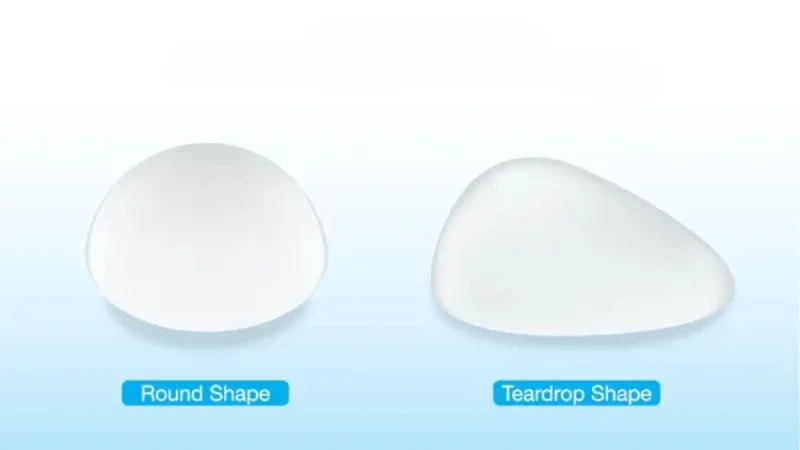
Shape decides where the volume sits. A round implant distributes it evenly above and below the nipple; an anatomical implant concentrates it in the lower pole.
- Round implants have more upper-pole projection and don’t give any rotation problems, but they don’t look as natural as teardrop.
- Anatomical implants have more volume in the lower than the upper breast pole, mimicking a natural slope. They require a tighter pocket and a textured surface.
3. Smooth vs. Textured Surfaces
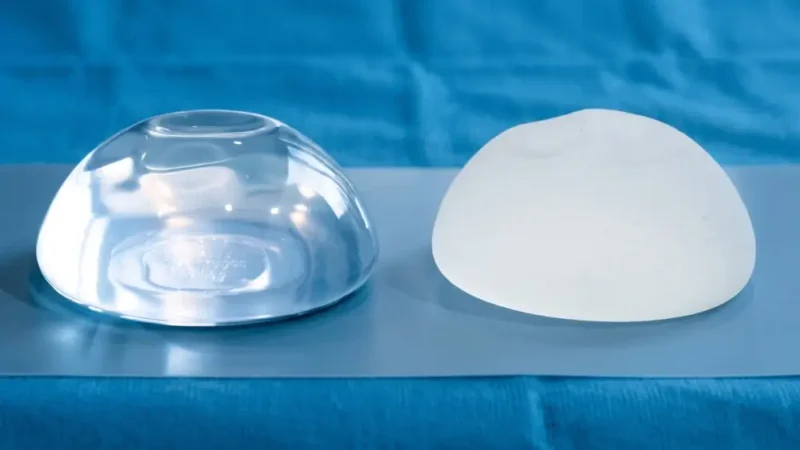
The surface determines how the implant interacts with the capsule your body forms around it.
- Smooth Textured Silicone Implants move freely within the pocket and are the most widely used today.
- Micro- and nano-textured: designed to reduce rotation and capsule formation.
- Macro-textured: withdrawn from several markets following the link with BIA-ALCL.
4. Profile and Projection
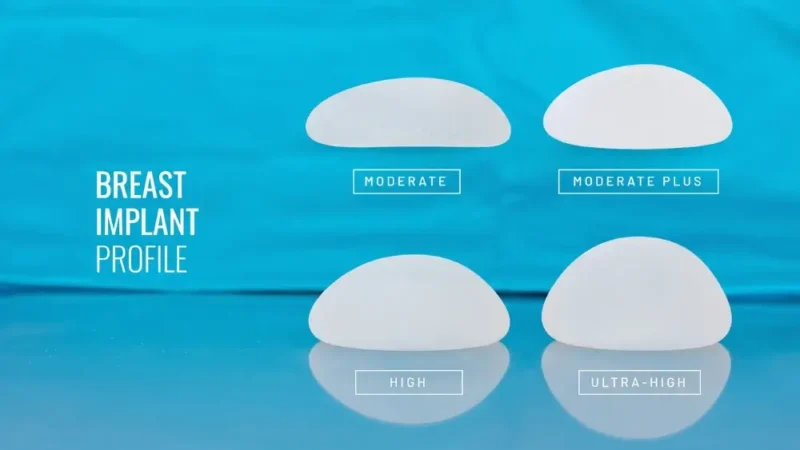
Two implants of identical volume can produce very different results. A low-profile 300cc implant spreads across a wider base; a high-profile 300cc implant sits on a narrower base and projects forward. Your chest width determines which profile is anatomically possible.
Breast Incision Options for Silicone Implants
The incision determines where the scar ends up. For pre-filled cohesive gel implants, the inframammary approach is the standard. The scar sits inside the natural crease beneath the breast, where it is hidden by the breast itself.
- Inframammary: The most reliable incision for silicone implants. It offers maximum visibility to the surgeon, ensuring the implantis positioned with precision.
- Periareolar: around the lower edge of the areola. The scar blends into the pigment border, but the incision passes through glandular tissue and carries a higher risk of sensory change and bacterial contamination.
- Transaxillary: through the armpit. No scar on the breast, but pocket control is indirect and revisions usually require a second incision elsewhere.
- Transumbilical (TUBA): through the navel. Only possible with saline implants, which are filled after insertion. Not an option for pre-filled silicone.
Where Are Silicone Implants Placed (Submuscular vs Subglandular)?
Placement is chosen according to how much natural tissue you have to cover the implant. Thin patients need muscle to disguise the implants’ edges; patients with more breast gland tissue have more freedom.
In most augmentations, a dual plane approach offers the best balance: the muscle covers the upper pole, while the lower pole is left free so the implant can settle and produce a natural slope.
- Subglandular: above the muscle. Shorter recovery, but implant edges and rippling are more visible in thin patients.
- Submuscular: minimizes visible rippling, lowers the risk of capsular contracture, and guarantees a smooth, organic slope.
- Dual plane: muscle over the upper pole, gland over the lower pole. The most common choice in cohesive gel augmentation.
- Subfascial: under the fascia covering the muscle. A middle ground offering slightly more coverage than subglandular without cutting the muscle.
Saline vs. Silicone
Patients with little natural breasts often find that saline implants can ripple or look artificial. That is the body type where silicone breast implants make sense.
- Saline implants are filled with sterile saltwater and require a smaller incision, yet they often lack the natural feel of silicone.
- Modern silicone implants are pre-filled with cohesive gel, offering a softer, lifelike texture. They require a longer incision, however.
| Feature | Saline Implants | Silicone (Cohesive Gel) Implants |
| Texture & Feel | Firmer, can sometimes feel slightly artificial | Highly natural, mimics real breast tissue closely |
| Incision Size | Smaller (implants are filled during surgery) | Slightly larger (implants are pre-filled) |
| Rupture Detection | Immediate visual change (breast deflates quickly) | Requires MRI monitoring (silent ruptures) |
| Rippling Risk | Higher, especially in very thin patients | Significantly lower, smoother finish |
| Cost Investment | Generally lower upfront cost | Higher investment, but superior aesthetic longevity |
How is Breast Implants Surgery Performed?
At Doku Clinic, Dr. Serkan Aygin and Dr. Engin Öcal structure medical protocols to analyze your chest wall, skin elasticity, asymmetry and breast volume. Pre-screening is how we can predict the way a silicone breast implant will behave inside your body.
Pre-OP Screening
A breast augmentation begins with the analysis of your body type, medical history, and the reasons and goals behind your decision. Patients are required to be both bodily and mentally healthy to undergo the operation. Thorough blood tests, EKG screenings, and 3D imaging, an operation plan is established by Dr. Engin Öcal.
Our pre-operative checklist includes:
- Blood panel and coagulation screening
- Breast ultrasound
- Baseline mammogram
- 3D simulation to visualize different implant profiles and projections
- Discussion about anesthesia and fasting requirements
The Operation Step by Step
Breast augmentation is performed under general anaesthesia and takes between 60 and 90 minutes for a primary case. Here is the surgical sequence as it is performed by Dr. Engin Öcal at Doku Clinic:
- Marking: performed with you standing upright, before anaesthesia. The surgeon maps the midline, the existing fold and the planned position of the new fold.
- Anaesthesia: general anaesthesia administered by the attending anaesthesiologist, with continuous monitoring throughout.
- Incision: a 4 to 5cm incision inside the inframammary fold, sized to allow the pre-filled implant to pass without deforming the gel.
- Pocket creation: the surgeon releases the tissue plane selected during planning, controlling the borders precisely so the implant sits centred behind the nipple.
- Haemostasis: every bleeding point is sealed before the implant enters. Blood inside the pocket is a known trigger for capsular contracture.
- Sizer trial: temporary sizers confirm volume and symmetry before the definitive implant is opened.
- Implant insertion: performed under no-touch protocol using a funnel, with a fresh glove change and antibiotic irrigation of the pocket.
- Symmetry check: you are moved to a seated position on the table to verify fold height, projection and nipple position on both sides.
- Closure: the incision is closed in layers with absorbable sutures. Drains are not routinely required in primary augmentation.
- Dressing: taping and a surgical bra are applied before you wake, to support the implants in position from the first hour.
How Much Does Breast Implant Surgery Cost?
In the US and UK, the standard cost of breast augmentation ranges from $8,000 to over $15,000. However, certified Mentor & Motiva silicone breast implants in Turkey can cost as little $4,500 at elite institutions such as Doku Clinic. These are the exact same breast implants, verified with their badge codes, performed by some of the most experienced surgeons in the world, carrying out routine operations on patients from all around the world.
| Country | Typical total cost | Usually included |
| United States | $8,000 – $15,000+ | Surgeon fee |
| United Kingdom | £6,500 – £9,500 | Surgeon, anaesthesia, one night stay |
| Canada | CAD 10,000 – 15,000 | Surgeon, facility |
| Australia | AUD 12,000 – 18,000 | Surgeon, hospital, anaesthesia |
| Turkey (Doku Clinic) | from $4,500 | Certified Mentor or Motiva implants, surgeon, anaesthesia, hospital stay, garments, transfers, accommodation, follow-up |
Recovery and Results
Waking up after surgery, it is normal to experience mood swings or anxiety. Your body is reacting to anesthesia, surgical trauma, and adjusting to the presence of silicone breast implants. Acknowledging this allows you to focus on healing.
The First 48 Hours
Expect significant swelling, moderate discomfort, and a sensation of intense pressure, especially if you chose submuscular placement. This is a standard part of healing. You will receive pain management to keep you comfortable.
Week 1
Discomfort peaks on day two or three and then declines steadily. Most patients stop taking prescription painkillers by the end of the week and manage with paracetamol alone.
- Sleep on your back, elevated at roughly 30 degrees
- Keep the surgical bra on continuously, including at night
- Short walks from day one to reduce thrombosis risk
- No lifting above shoulder height and nothing heavier than 2kg
- Desk-based work is usually possible from day five to seven
- Bruising, tightness and a burning sensation along the incision are all expected
Months 1 to 3
This is the window in which the implants become yours. As the pectoral muscle relaxes and the tissue expands, the implants descend into the pocket and the upper pole softens — the process known as drop and fluff.
- Weeks 2 to 4: swelling falls sharply and the breasts begin to soften
- Week 4 to 6: most patients return to light cardiovascular exercise
- Week 6 to 8: chest and upper-body training can usually be resumed
- Nipple sensation may fluctuate between numbness and hypersensitivity throughout this period
- Scar management begins once the incision is fully closed, typically at week three or four
- Follow-up appointments during this window catch minor complications before they escalate
Final Results
The definitive shape appears between month three and month six, and the scar continues to fade for up to eighteen months. Judging your result before month three means judging swelling, not breast tissue.
- Final position, softness and symmetry settle by month six
- Scars mature from red to pale over twelve to eighteen months
- Mild asymmetry is normal — no two breasts are identical before or after surgery
- Your implant passport, with brand and serial numbers, should be kept permanently
- Baseline imaging is scheduled to establish a reference point for future screening
Long-Term Care & Implant Replacement
Eventually, you will need revision surgery, whether due to a silicone leak, capsular contracture, or simply a desire for a size change. The reality is that all silicone implants are temporary and will eventually require replacement or removal.
As the years pass, the risk of failure naturally increases. Global medical authorities strongly advise scheduling a high-resolution MRI or specialized ultrasound every 2 to 3 years after the 5-year mark.
FAQs
How long do silicone breast implants last?
Silicone breast implants are not lifetime devices. They typically last 10 to 15 years. You must schedule routine MRI screenings every 2 to 3 years to check for silent ruptures and plan for eventual replacement or revision surgery.
Are cohesive gel (gummy bear) implants safe?
Yes, cohesive gel implants are highly safe and FDA-approved. Their thick, form-stable gel prevents liquid silicone leakage even if the outer shell breaks, drastically reducing the risk of complications like silent spreading.
Does breast implant surgery leave noticeable scars?
Minimal scarring is inevitable, but elite surgeons hide it expertly. By utilizing an inframammary incision hidden directly in the natural breast fold, the thin scar becomes virtually invisible once it is fully healed and faded.
Can I breastfeed after getting silicone implants?
Most women can successfully breastfeed after breast augmentation. Choosing a submuscular placement and an inframammary incision minimizes trauma to your milk ducts and glandular tissue, safely preserving your natural lactation capabilities.
Medical References and Sources
- S. Food and Drug Administration (FDA): “Breast Implants: Local Complications and Adverse Outcomes” – Guidelines on MRI screenings and silicone implant safety profiles.
- International Society of Aesthetic Plastic Surgery (ISAPS): Global statistical data on breast augmentation safety, surgical volume, and worldwide procedural standards.
- American Society of Plastic Surgeons (ASPS): Clinical parameters regarding capsular contracture rates, Breast Implant Illness (BII), and post-operative recovery timelines.
- European Board of Plastic Reconstructive and Aesthetic Surgery (EBOPRAS): Foundational safety standards for cohesive gel technologies and accredited hospital requirements.