


Textured Breast Implants in 2026: The Complete Safety & Results Guide
Publish Date:18 August 2026
Written by the Doku Clinic Editorial Team. Reviewed and Approved by Op. Dr. Engin Öcal, Head Plastic, Aesthetic & Reconstructive Surgeon.
Textured breast implants were an engineering fix for two problems that ruined results in the 1980s: implants that hardened inside a shrinking scar capsule, and teardrop implants that rotated until one breast pointed sideways. Roughening the shell let tissue grip it. It worked.
However, in July 2019, one phone call from the FDA pulled millions of breast implants off the world market precisely because of the texture of their shell, linked to a rare cancer of the immune system. Some textured implants disappeared overnight; others are still legally sold today, recommended by surgeons. In this guide reviewed by Dr. Engin Öcal, we give you all the key information you must know in 2026.
Key takeaways:
- Estimated lifetime risk with textured implants is 1 in 2,207 to 1 in 86,029 (ASPS)
- Always get the implant brand, model, surface class and serial number in writing before surgery
- Verify board certification, i.e. EBOPRAS or ISAPS membership
- Breast implants are not lifetime devices (reoperation risk rises with every year in place)
What Are Textured Breast Implants?
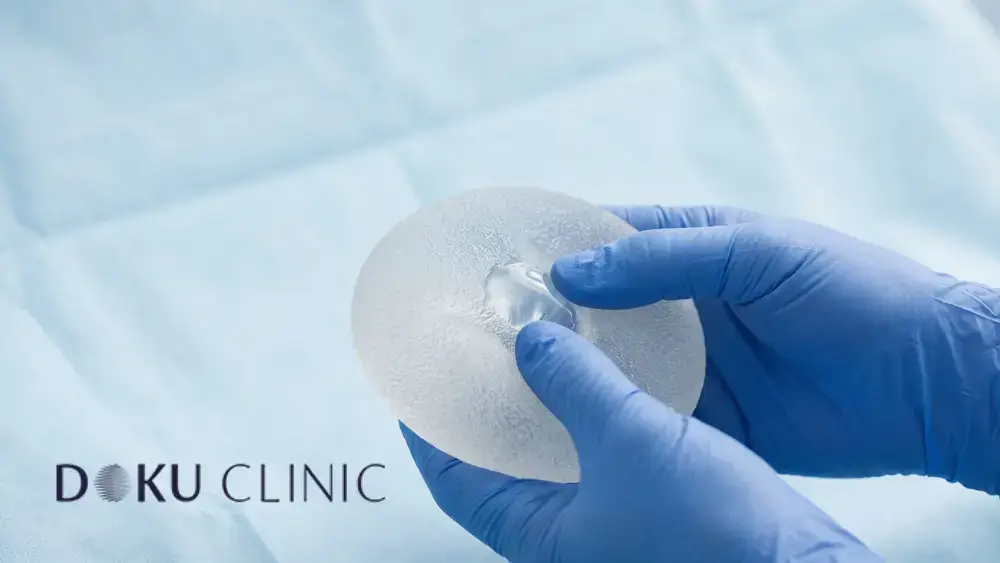
Every breast implant is a silicone shell filled with silicone gel or saline. In textured breast implants, the outer surface of that shell is roughened rather than polished. The gel inside can be identical. The shape too.
That roughness exists to provoke controlled tissue ingrowth, so the implant grips its pocket instead of floating inside it. Surgeons call this tissue adherence, and it solved two failures that plagued breast augmentation:
- Hardening of the surrounding scar capsule
- Rotation of teardrop-shaped devices
Textured Surface Types: Macro, Micro and Nano
Dr. Engin Öcal
ISO 14607:2018 defines three categories of textured breast implants based on average surface roughness (Ra).
| Surface class | Roughness (Ra) | Example products | Regulations 2026 |
| Smooth | Under 10 µm | Most modern round implants | Available worldwide |
| Microtextured | 10–50 µm | Mentor Siltex, several CE-marked lines | Available in most markets |
| Macrotextured | Above 50 µm | Allergan Biocell (withdrawn) | Banned in EU, France, Canada; recalled in US |
| Polyurethane-coated | Separate class | Polytech and others | Banned in France; restricted elsewhere |
Textured vs Smooth Implants
Which are better, textured or smooth implants? It depends on your case. Textured silicone implants buy stability at the cost of a rare but serious risk. Smooth implants remove that risk and accept others.
| Risk | Textured implants | Smooth implants |
| Capsular contracture | Lower rates | ~2.8× higher odds |
| Rotation risk | Anchored by tissue ingrowth | Can rotate (critical for teardrop shapes) |
| BIA-ALCL risk | Only known risk factor | No confirmed causal link |
| Feel and movement | Slightly firmer, less mobile | Softer, more natural glide |
| Rippling / palpability | More palpable in thin patients | Less visible rippling |
| Post-op massage | Not advised | Often recommended |
Where Textured Silicone Implants Outperform
Anatomical (teardrop) implants are the strongest remaining case for textured surfaces. A round implant looks the same at any angle; a teardrop implant that rotates 40 degrees produces visible deformity requiring revision surgery. Texture prevents that.
Textured surfaces also help in thin-tissue and reconstructive patients, where the implant sits close to the skin and needs stability rather than mobility. In these cases a surgeon may reasonably favour a micro-textured device.
Where Smooth Implants Have the Advantage
For the majority of primary augmentations with round implants placed submuscularly, smooth shells now dominate for a straightforward reason: they capture most of the aesthetic benefit while eliminating the one risk that carries mortality.
Smooth implants also feel more natural in motion, ripple less visibly, and are simpler to risk-monitor. Manufacturers have responded with smooth-surface anatomical models and laser-etched texturing that stabilises position without the aggressive roughness linked to ALCL risk.
BIA-ALCL and Textured Implants: The Real Risks
BIA-ALCL (breast implant-associated anaplastic large cell lymphoma) is a cancer of the immune system, not breast cancer. It forms in the scar tissue capsule around the implant and occurs most frequently in patients with textured surfaces.
The only known risk factor for BIA-ALCL is textured implants. Which is why regulators acted on the device rather than on surgical technique. The estimated lifetime risk is 1 in 2,207 to 1 in 86,029 for women with textured implants, based on confirmed cases and two decades of textured implant sales data.
When the manufacturer is known, approximately 91% of world cases involved exposure to a Biocell implant. At the other end, Siltex micro-textured devices showed a BIA-ALCL risk of 0.0012% in the most extensive data available. American Society of Plastic Surgeonsuspto
| Risk | Figure | Source |
| Lifetime risk, textured implants (all) | 1 in 2,207 – 1 in 86,029 | ASPS |
| Share of cases linked to one macrotextured line | ~91% of cases with known manufacturer | FDA |
| Relative risk, that line vs other US textured implants | ~6× higher | FDA |
| Reported risk, micro-textured (Siltex) | 0.0012% | Core Study data |
| Confirmed cases worldwide (Aug 2024) | 1,577 | Global reporting |
| Deaths worldwide (Aug 2024) | 63 | Global reporting |
| Typical time to onset | 8–10 years post-implantation | ASPS |
| Risk with smooth implants | No confirmed causal link | FDA |
Symptoms You Should Never Dismiss
Here is the detail that saves lives: BIA-ALCL does not usually present as a lump. It presents as fluid. Common symptoms include breast enlargement, pain, asymmetry, a lump in the breast or armpit, an overlying skin rash, hardening of the breast, or a large fluid collection.
Contact your doctor promptly if you feel any of the following:
- Sudden one-sided swelling in a breast that had fully settled months or years earlier
- Persistent asymmetry appearing long after recovery was complete
- New firmness, distortion or pain without injury or infection
- A red or scaly rash over the implant that doesn’t resolve
- A palpable mass in the breast or armpit
Diagnosis, Treatment and Outcomes
Diagnosis is neither invasive nor expensive. A provider will order imaging such as ultrasound or MRI to check whether fluid is collecting around the implant or to evaluate masses. If fluid is present, it is drained and sent for CD30 immunohistochemistry. A standard mammogram will not detect it, and a general pathology request without CD30 testing can miss it. Breast Cancer Organization
Most patients recover when the disease is caught before it spreads, and treatment is surgical: complete removal of the implant together with the entire surrounding capsule. In advanced cases that have spread beyond the capsule, chemotherapy or targeted therapy may be required.
Textured Breast Implant Cost
A micro-textured implant and a smooth implant from the same manufacturer sit within a few hundred dollars of each other. What moves the price is where you have the surgery and who performs it.
In the United States, breast augmentation typically costs between $4,800 and $12,000 in 2026, with most patients paying around $8,900. The ASPS-reported average surgeon’s fee is $5,200. UK prices run £5,000–£8,000, with Germany and other EU countries at €6,000–€10,000. All-inclusive packages in Turkey range from $2,800–$5,000.
| Cost component | Typically included? | Notes |
| Surgeon’s fee | Always | The largest single line in US quotes |
| The implants | Varies by country | Often quoted separately in the US and UK |
| Anaesthesia and facility | Varies | Frequently excluded from headline US prices |
| Hospital overnight | Usually in packages | One night is standard |
| Pre-op tests and imaging | Usually | Blood work, cardiology clearance |
| Post-op garments and medication | Usually in packages | Surgical bra worn ~6 weeks |
| Complication insurance | Mandatory in Türkiye since 2026 | Covers no-fault complications only |
| Long-term imaging surveillance | Almost never | Budget for years 5–6 onward |
| Future revision surgery | Never | Implants are not lifetime devices |
Certifications and Licences That Protect Patients
Credentials are verifiable in about ten minutes, and they are the closest thing to a guarantee available in aesthetic surgery. A board-certified plastic surgeon operating in an accredited facility produces complication rates consistent with international standards — the certification is not paperwork, it is the mechanism.
What to verify, and where:
- EBOPRAS: the European Boardqualification, earned by standardised European examination.
- ISAPS membership: signalsadherence to global ethical standards and current technique.
- Facility accreditation: JCI, orthe national equivalent.
FAQs
Are textured breast implants banned?
Partly. Macrotextured and polyurethane-coated implants are banned in France, Canada and the EU, and Allergan’s Biocell line was recalled worldwide in 2019. Micro-textured implants remain legally available in most markets, including the US, under a boxed warning.
Are textured implants safe in 2026?
Micro-textured implants carry a very low reported BIA-ALCL risk (around 0.0012%). The devices responsible for the great majority of cases have been withdrawn. Safety depends far more on surface class, surgeon and follow-up than on the word “textured”.
Should I have my textured implants removed?
Not if you are asymptomatic. No regulator recommends preventive removal. Removal is indicated for symptoms, rupture, contracture, or as a personal choice — not as a precaution.
What is the first sign of BIA-ALCL?
Usually sudden one-sided swelling from fluid collection, appearing on average 8–10 years after surgery, not a lump. It requires ultrasound and CD30 testing of the fluid, which a standard mammogram will not provide.
Do textured implants really reduce capsular contracture?
Pooled data suggests yes. Smooth implants show roughly 2.8× higher odds. But subpectoral placement reduces contracture risk substantially regardless of surface, which is why many surgeons now achieve similar results with smooth devices.
Textured vs smooth: which should I choose?
For round implants placed under the muscle, smooth is the default. Micro-texture is most defensible for anatomical implants, where rotation causes visible deformity, and in selected reconstructive or thin-tissue cases.
How long do breast implants last?
They are not lifetime devices. Complication and reoperation risk rises with each year in place. Plan for imaging surveillance from years 5–6 and the realistic possibility of revision surgery.
Does texture change the price?
Barely. Country, surgeon and package inclusions drive cost far more than surface type.
Sources & References
- S. Food and Drug Administration — Breast Implants; BIA-ALCL Questions and Answers; Biocell recall safety communication (2019); boxed warning and patient decision checklist (2021); BIA-SCC safety updates (2022, 2023).
- American Society of Plastic Surgeons (ASPS) — BIA-ALCL summary and lifetime risk estimates.
- ISO 14607:2018 — Non-active surgical implants: mammary implants, surface classification (Annex H).
- ANSM (France) — Decision withdrawing macrotextured and polyurethane-coated breast implants, April 2019.
- Health Canada — Safety review of macrotextured breast implants and BIA-ALCL.
- Aesthetic Surgery Journal Open Forum— Capsular Contracture After Breast Augmentation: A Systematic Review and Meta-Analysis (2025).
- Aesthetic Surgery Journal— Device-Specific Findings of Imprinted-Texture Breast Implants (2020).
- International Society of Aesthetic Plastic Surgery (ISAPS) — Global Survey on Aesthetic/Cosmetic Procedures.
- Regulation on International Health Tourism and the Health of Tourists, Official Gazette, 26 April 2025, Issue 32882 (Article 6/1(c)).