


Saline Breast Implants: The Full Guide by Doku Clinic
Publish Date:31 August 2026
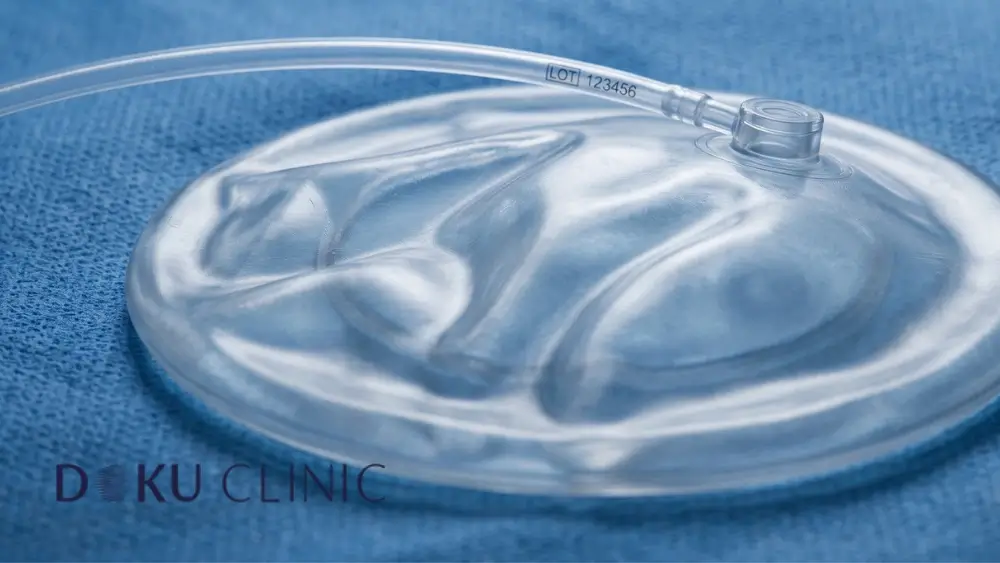
A saline implant is a silicone shell filled with sterile saltwater only once it is inside the breast. That produces the advantage of a smaller incision, and therefore a less noticeable scar. Saline breast implants are the least expensive implant on the market and produce the smallest scar.
For patients who want the option of hiding the scar in the armpit or the areolar border, that is often the deciding factor.
This guide is drawn from the surgical practice and pre- and post-operative protocols of Doku Clinic, and medically reviewed by Dr. Engin Öcal, Plastic, Reconstructive and Aesthetic Surgeon.
Key takeaways:
- Saline implants are inserted empty, allowing incisions typically around 3–4 cm
- They are available in round shapes across low, moderate, moderate-plus and high profiles
- Their cost in 2026 sits at roughly $3,500–$8,000 operation included (below silicone)
- They have a clear disadvantage: ten-year capsular contracture sits at 17.5–20.8% for saline vs 12.1% for modern gel
SALINE BREAST IMPLANTS AT A GLANCE
| What it is | Silicone shell, filled with sterile saltwater after insertion |
| Typical incision | 3–4 cm (smaller than pre-filled silicone) |
| Shapes available | Round only: low, moderate, moderate-plus and high profiles |
| Fill volumes | Roughly 120–800 cc |
| FDA age approval | 18+ for augmentation (silicone: 22+) |
| 2026 cost | ~$3,500–$8,000, operation included |
| Rupture detection | Visible deflation within 24–48 hours |
| Main drawback | Firmer feel, more rippling, 17.5–20.8% ten-year capsular contracture |
What Are Saline Breast Implants?

Dr. Engin Öcal
Saline breast implants arrive in the operating room as flat, folded silicone shells, like little deflated water balloons. The surgeon places the empty shell through the incision, positions it, and only then fills it with sterile saline solution (medical-grade saltwater, identical to what runs through an IV drip).
The Saltwater Fill
A saline implant has a self-sealing fill valve. The surgeon connects a tube, adds saline until the target volume is reached, then removes the tube and the valve closes behind it.
Why the fill-after-insertion design matters:
- Smaller incision: Typical saline incisions run 3–4 cm.
- More incision options: That smaller opening makes transaxillary (armpit) and periareolar (areolar border) approaches practical.
- Adjustable volume on the table: With saline, your surgeon can put 340 cc on one side and 365 cc on the other to balance asymmetrical breasts.
- Self-evident failure: If the shell tears, saline is absorbed by the body harmlessly and the breast visibly deflates.
Saline Implant Sizes, Shapes and Profiles
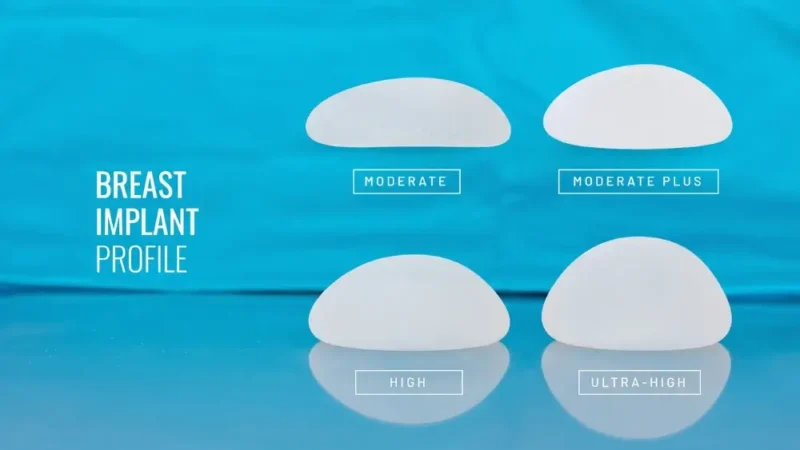
Saline breast implants come in round shapes only. A round implant placed under the muscle in a natural breast still produces a sloped result, looking natural. Fill volumes span roughly 120 cc to 800 cc, the majority land somewhere between 250 and 450 cc.
Profiles
| Profile | Base width | Projection | Typically suits |
| Low | Widest | Lowest | Broader chest, subtle enhancement |
| Moderate | Wide | Moderate | Natural-looking results, most common request |
| Moderate-plus | Medium | Higher | Balanced fullness with visible upper-pole shape |
| High | Narrowest | Highest | Narrow chest, or patients wanting obvious projection |
Saline vs Silicone Implants
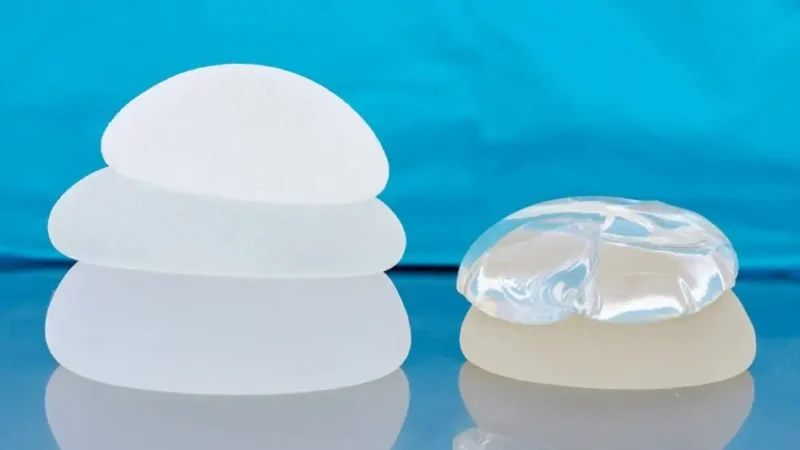
Most patients decide by squeezing two implants on a desk. The four aspects that matter are: scar, feel, failure, price. Saline wins two of them outright.
· Feel, Rippling and Natural Movement: Silicone gel wins here. Gel behaves like tissue. Saline behaves like liquid: firmer to the touch, with more movement.
· Rippling: the specific risk of saline implants. A single chamber of saltwater can fold at the edges, and in patients with thin soft tissue those folds become visible or palpable, usually at the upper or outer pole.
· Rupture Detection: Saline Failure Is Visible. A saline shell tears, the saltwater is absorbed by your body within hours, and the breast visibly deflates within 24–48 hours.
Comparison Table
| Saline | Silicone gel | Structured saline | |
| Incision size | 3–4 cm | Larger (pre-filled) | 3–4 cm |
| Feel | Firmer | Most tissue-like | Between the two |
| Rippling risk | Higher | Lower | Lower than standard saline |
| Rupture detection | Visible | Silent — needs imaging | Visible |
| Routine imaging | Not required | MRI/US from year 5–6 | Not required |
| 10-yr capsular contracture | 17.5–20.8% | 12.1–18.9% | 6.6% |
| FDA age minimum | 18 | 22 | 18 |
| Volume adjustable in surgery | Yes | No | Yes |
| Relative cost | Lowest | +$1,000–$1,500 | Mid |
How Much Do Saline Breast Implants Cost?
The average cost of saline breast implants runs $3,500 to $8,000 all-inclusive in the US, rising to $15,000 in premium markets. That is the rough all-inclusive cost of a breast augmentation with saline implants. Saline runs roughly $1,000–$1,500 below silicone gel.
Am I a Candidate for Saline Breast Augmentation?
The FDA approves saline for augmentation at 18+. Silicone gel requires 22+. Both are approved for reconstruction at any age.
The pinch test at the upper pole is the most predictive measurement of success:
- Under 2 cm: high rippling risk: silicone is usually the better call
- 2 cm or more: saline is a reasonable option, especially submuscular
- Very low BMI or athletic build: proceed with caution regardless of the number
When Saline Is the Wrong Choice
- Thin tissue with minimal breast volume
- Revision after capsular contracture
- Feel is your stated top priority
- You want an anatomical shape
The Saline Breast Augmentation Procedure, Step by Step
Below, we give all key information that must be decided pre-op: incisión options and breast implant placement, once the size and projection has been agreed. The duration of the operation is between 1–2 hours. Anesthesia is general. Discharge takes place in the operation day or after one overnight stay at the hospital.
The sequence from pre-op to surgery end:
- Markings made while you are standing
- Incision at the agreed site
- Pocket created above or below the pectoral muscle
- Empty shell inserted, positioned, filled through the valve
- Volume checked with you sat upright mid-procedure, adjusted for symmetry
- Closure in layers; surgical bra fitted
Incision Options
Because the shell goes in folded, 3–4 cm is enough o fan incision. Mature scars at 12 months are typically a fine pale line. Sun exposure and smoking are the two variables you control for best results.
| Incision | Location | Scar visibility | Notes |
| Inframammary | Breast crease | Hidden in the fold | Most common; best surgical access |
| Periareolar | Areolar border | Camouflaged by pigment | Slightly higher contracture risk |
| Transaxillary | Armpit | Off the breast entirely | Saline’s advantage: no breast scar at all |
Implant Placement: Above or Below the Muscle
For saline implants, submuscular placement is the default at Doku Clinic unless anatomy argues otherwise. Here is a quick comparison of their main pros and cons for both methods:
Submuscular (under the pectoral):
- More tissue cover: less rippling
- Lower capsular contracture
- Slightly longer, more uncomfortable recovery
- Interferes less with mammography
Subglandular (above the muscle):
- Easier recovery, no muscle animation
- Higher rippling and contracture risk
- Generally reserved for patients with substantial existing tissue
Saline Implant Recovery Timeline: Week by Week
Submuscular placement adds roughly a week of discomfort at the front end. In our personal experience at Doku Clinic, it is absolutely worth it.
| Stage | When | What to expect |
| Day 0 | Surgery | 1–2 hours under general anesthesia; discharge same day or next morning |
| Days 1–3 | Peak discomfort | Tightness and pressure rather than sharp pain; surgical bra worn continuously |
| Days 4–7 | Turning point | Most patients off prescription painkillers; desk work resumes |
| Weeks 2–4 | Settling | Swelling subsides; light cardio cleared |
| Weeks 6–8 | Release | Full exercise and upper-body training resume |
| Months 3–6 | Final shape | Implants “drop and fluff” into position; scars begin fading |
| Month 12 | Scar maturity | Final scar appearance |
Pre-Operative Protocols That Lower Your Risk
- Stop smoking 4 weeks before
- Stop blood thinners and anti-inflammatories as directed
- Baseline mammogram if you are over 40 or have family history
- Antibiotic prophylaxis and no-touch technique
Post-Operative Care and When Results Settle
Judge nothing before month three. Implants sit high and firm initially. The final shape emerges as swelling resolves and the implant settles.
- Surgical bra 24/7 for 4–6 weeks, then supportive bras only
- No underwire until cleared: typically 6–8 weeks
- Sleep elevated for the first 1–2 weeks
- Scar care from week 3: silicone sheets or gel, strict sun protection for 12 months
- No heavy lifting or chest exercise for 6 weeks
How Long Do Saline Breast Implants Last?
There is no expiry date printed on the box, and no surgeon can give you a number. What the data supports is this: implants are not lifetime devices, and the odds of needing a second operation rise steadily after year six.
Manufacturer Core Studies put any reoperation at 20–25% by ten years across implant types. That includes size changes, lifts, and elective revisions alongside genuine complications.
What shortens implant life:
- Underfilling, which allows repeated folding at the same crease
- Capsular contracture, itself a risk factor for shell failure
- Significant weight change, pregnancy and breastfeeding
- Trauma to the chest
What extends it:
- Filling toward the upper end of the manufacturer’s range
- Submuscular placement
- A stable weight
- Turning up to follow-ups
Warning Signs Your Saline Implant Has Deflated
Deflation is not subtle. It is fast and sudden. Yet there is no medical emergency. Saline is absorbed harmlessly. But do not wait months: the empty capsule contracts over time, which complicates replacement.
See your surgeon if you notice:
- Visible volume loss on one side over 24–48 hours
- New asymmetry where there was none
- A change in shape: flattening, or the implant edge becoming palpable
- Wrinkling or rippling that appeared suddenly
Your Long-Term Monitoring Schedule
Saline implants carry no FDA surveillance imaging requirement. Silicone gel does: MRI or ultrasound at five to six years, then every two to three years thereafter.
| When | What |
| Weeks 1, 4 | Post-operative reviews |
| Months 3 and 12 | Result assessment and scar review |
| Annually | Self-examination and clinical check |
| From age 40 | Routine mammography — tell the radiographer you have implants |
| Rupture imaging | Not required for saline |
FAQs
Are saline breast implants safer than silicone?
Neither is categorically safer. Saline fill is harmless if the shell tears: the saltwater is absorbed by your body. Silicone gel stays put but ruptures silently. Both carry the same FDA boxed warning, and shell texture, not fill, is the factor linked to BIA-ALCL risk.
What happens if a saline implant ruptures?
The breast deflates visibly within 24–48 hours and the saline is absorbed with no health consequence. Replacement is a shorter, simpler operation than the original augmentation.
Do saline implants look and feel natural?
They look natural. They feel firmer than silicone gel. Submuscular placement and adequate soft-tissue cover close most of the gap. Patients with a pinch test under 2 cm will notice the difference more.
How much do saline breast implants cost?
Roughly $3,500–$8,000 all-inclusive in 2026, and up to $15,000 in premium markets. That is typically $1,000–$1,500 below silicone. Always request an itemised quote: anesthesia and facility fees add $1,500–$3,000 when omitted.
Can saline implants be adjusted after surgery?
Volume is adjusted during surgery, not after. Once the valve seals and you are closed, changing size requires another operation. The intraoperative flexibility is the advantage — it lets your surgeon correct asymmetry on the table.
Do saline implants affect mammograms or breastfeeding?
Implants can obscure breast tissue on imaging, so always tell the radiographer — displacement views compensate. Breastfeeding is usually unaffected, though periareolar incisions carry slightly more risk to milk ducts than inframammary or transaxillary approaches.
What size saline implant should I choose?
Not a cup size: a base width and profile matched to your chest. Most augmentations land between 250 and 450 cc. Two women with identical 350 cc implants can look entirely different depending on profile height.
Will I need surgery again in ten years?
Possibly. Reoperation rates run 20–25% at ten years across implant types, including elective size changes. Budget for one exchange within your lifetime rather than assuming permanence.
How soon can I fly after saline breast augmentation?
Most patients are cleared at 5–7 days, once the initial swelling settles and mobility returns. Confirm with your surgeon before booking, and move around the cabin on long flights.
Sources & References
- U.S. Food and Drug Administration — Types of Breast Implants and Breast Implants device information portal (approval ages, labeling, screening recommendations).
- U.S. FDA — Breast Implants: Certain Labeling Recommendations to Improve Patient Communication (2020 guidance; boxed warning and patient decision checklist).
- U.S. FDA — Update: Reports of Squamous Cell Carcinoma (SCC) in the Capsule Around Breast Implants, Safety Communication, March 2023.
- American Society of Plastic Surgeons — Breast Implant Safety and national procedural statistics (average surgeon fee; BIA-ALCL case counts).
- International Society of Aesthetic Plastic Surgery (ISAPS) — Global Survey 2024 (procedure volumes and patient age distribution).
- Mentor / Johnson & Johnson — Common Risks and Complications, 10-year Core Study data for saline and MemoryGel breast implants.
- Spear SL, Murphy DK, et al. — Natrelle Round Silicone Breast Implants: Core Study Results at 10 Years, Plastic and Reconstructive Surgery.
- Hamas RS, et al. — Structured saline implant Core Study 10-year outcomes, Plastic and Reconstructive Surgery, 2023.
- Eisenberg T. — Does Overfilling Smooth Inflatable Saline-Filled Breast Implants Decrease the Deflation Rate? Experience with 4,761 Augmentation Mammaplasty Patients, Aesthetic Plastic Surgery, 2021.
- Mayo Clinic — Breast implants and cancer: any connection? (BIA-ALCL and BIA-SCC patient guidance).