


Open Rhinoplasty: Advanced Nasal Reshaping by Dr. Engin Öcal
Last Update:11 June 2026
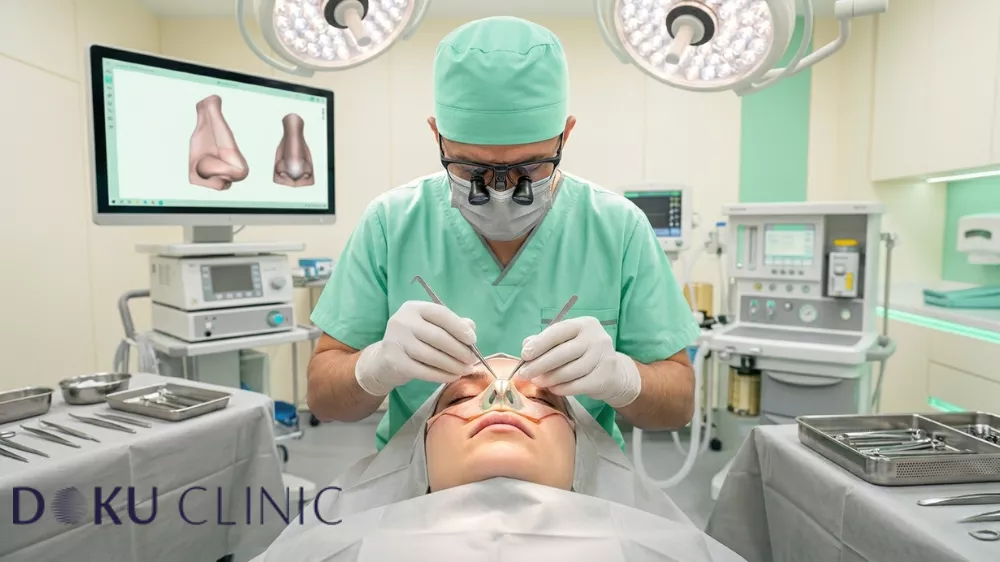
Open rhinoplasty offers a clear vision of the internal nasal structures. This technique performs a small incision across the columella (the narrow strip of tissue separating the nostrils), which allows the plastic surgeon to gently lift the nasal skin, providing direct, unobstructed access to the underlying cartilage and nasal bones.
At Doku Clinic, we prioritize this approach for cases requiring substantial modifications, tip refinement, or airway corrections.
The Main Benefit of Open Rhinoplasty: Visual Access
By operating under direct vision, our plastic surgeons minimize the margins of error through open rhinoplasty. The technique is recommended for patients with complex nasal deformities, septal deviations, or compromised breathing. Patients benefiting most from the approach include:
- Severe Septal Deviation:Direct access allows straightening of the deep osteocartilaginous framework.
- Asymmetrical Nasal Tip:Precise suturing of the lower lateral cartilages achieves optimal symmetry.
- Revision Rhinoplasty:Crucial for correcting scar tissue and structural deficiencies from previous failed surgeries.
- Crooked Nose Syndrome:Requires comprehensive osteotomies under direct, unhindered vision.
The Main Disadvantage: Columellar Incision
Open rhinoplasty is performed with a trans-columellar incision, typically shaped as an inverted ‘V’. This shape ensures that the scar heals along natural skin tension lines, becoming virtually invisible within months.
While the scar is a drawback, it is worth considering that the most impressive rhinoplasty results usually require this degree of exposure, which is impossible to replicate with closed rhinoplasty.
Open vs. Closed Rhinoplasty: Which is Best?
Global clinical metrics gathered by the American Academy of Facial Plastic and Reconstructive Surgery (AAFPRS) indicate that rhinoplasty remains the most requested facial cosmetic surgery globally, with the open approach dominating more than 55% of primary interventions due to its structural predictability.
In complex scenarios, the closed approach introduces mechanical limits. Conversely, the open approach allows to assess the un-tensioned nasal framework in real time, making it the definitive choice for structural grafting.
When is Open Rhinoplasty Recommended?
At Doku Clinic, we employ the open rhinoplasty when the integrity of the nose requires direct visibility. For patients, this method is highly advised under the following scenarios:
- Complex Tip Deformities: Treating bulbous, drooping, or severely asymmetrical nasal tips requires microscopic suture reshaping and direct grafting.
- Revision Rhinoplasty: Secondary surgeries present severe scar tissue, altered anatomy, and depleted septal cartilage. Direct visualization is crucial to rebuild the nasal framework.
- Severe Septal and Structural Deviations: When a crooked nose impacts both facial balance and respiratory function, the bony and cartilaginous septum must be fully exposed.
- Substantial Dorsal Hump Reductions: The open approach ensures the middle vault is reconstructed perfectly under direct sight, preventing long-term valve collapse.
Open Rhinoplasty Surgery in 5-Steps
At Doku Clinic, from your initial digital analysis to your final recovery, every stage is managed to maximize your physical comfort and ensure the best possible surgery.
- Consultation & 3D Modeling: Your journey begins with a detailed facial mapping session. Dr. Engin Öcal evaluates your skin thickness, measures airway resistance, and simulates potential outcomes to align your cosmetic goals.
- Screening & Anesthesia: On the morning of your procedure, you undergo complete blood panels and a pre-anesthesia clearance check. The operation is performed under general anesthesia to guarantee absolute safety.
- Columellar Micro-Incision: The surgical entry is made via a tiny, inverted-V incision across the columella. This microscopic technique ensures that the resulting scar completely fades into the natural skin contour under the nose.
- Direct Nose Reshaping: The tissue is gently lifted to give the surgeon a clear, undistorted view of the nasal vault. Dr. Engin Öcal then refines the nose and stabilizes the new profile using non-absorbable sutures.
- Edema & Protective Splinting: Once surgery is completed, internal silicone splints are placed to support the septum without blocking breathing. A protective thermoplastic splint is then applied externally to secure the nose.
Post-OP Recovery and Healing
At Doku Clinic, our medical team provides every patient with highly detailed post-op care to accelerate tissue repair and protect the newly reconstructed nose. Adhering strictly to clinical instructions during this period ensures that the delicate cartilage grafts settle into their precise positions without distortion.
The First 2 Weeks Post-OP
The first 7 to 10 days post-surgery represent the acute healing phase, during which keeping your head elevated is essential to minimize swelling. Around day 7, patients return to Doku Clinic for a follow-up appointment. During this visit, both the external thermoplastic splint and the internal silicone splints are painlessly removed.
| Timeline | Clinical Care Instructions | Expected Symptoms |
| Days 1–3 | Apply cold compresses to cheeks; sleep with head elevated at 45°. | Peak swelling and minor periorbital bruising. |
| Days 4–7 | Use prescribed nasal saline sprays; clean incisions gently. | Nasal congestion; initial skin healing. |
| Days 8–14 | Avoid blowing the nose; stick to light walking only. | Bruising fades; stitches begin to dissolve. |
When Can I Resume Normal Activities Post-Surgery?
Resuming your daily routine requires a gradual approach. For the first 3 months, your absolute priority is to protect healing from accidental impact or blood pressure spikes. The timeline below outlines the safe resumption of activities under medical guidelines:
- Desk Work & Travel:Clinically safe to return to remote work and board commercial flights 7 to 10 days post-surgery.
- Light Exercise:Casual walking can begin immediately. Light jogging and low-impact gym sessions are allowed after 3 to 4 weeks.
- Heavy Workouts:Weightlifting, intense cardio, and swimming must be avoided for a full 6 weeks.
- Contact Sports:Activities like basketball or soccer require a minimum of 3 to 6 months to prevent structural displacement.
Will There Be Any Scars Left?
No. All external and internal signs of surgery will disappear completely, leaving a natural, un-operated look. To understand exactly how and when these surgical signs resolve, you can follow this timeline:
| Timeframe | Visual Sign |
| Day 7 | Heavy swelling is present; nose looks generalized. |
| Day 14 (2 Weeks) | Periorbital bruising and yellowish skin signs disappear completely. Incision line looks pink but flat. |
| Week 6 | 80% of all surgical swelling disappears. The nasal bridge becomes sharp and defined; incision line begins to fade to skin tone. |
| Month 6 | Internal scar tissue completely softens. Asymmetry caused by uneven fluid retention balances out entirely. |
| Months 12–14 | 100% of surgery signs disappear. The final 10% of microscopic fluid retention leaves the nasal tip, revealing its permanent, sharp, and natural definition. |
How Much Does Open Rhinoplasty Cost?
While open rhinoplasty costs $8,000+ in London or New York, exceeding standard budgets, many surgeons offer competitive alternatives. Often, traveling for plastic surgery abroad allows patients to access top-tier surgery at the lowest cost.
- United States (New York / Los Angeles):$9,500 – $16,000+ USD (Surgeon fee only; excludes anesthesia and hospital overhead).
- United Kingdom (London):£7,500 – £12,500 GBP (Varies heavily by private hospital provider).
- Western Europe (Germany / Switzerland):€8,000 – €14,000 EUR (Excludes extended post-operative follow-up care).
- Doku Clinic Istanbul (Turkey):$3,500 – $5,500 all-inclusive packages (hotel, transport, accommodation, all surgical costs)
Risks Associated with Open Rhinoplasty
Open rhinoplasty is very safe when performed by board-certified specialists. However, potential medical risks exist.
- Persistent Post-OP Edema:Post-op swelling can occasionally persist longer in patients with thick skin.
- Asymmetrical Tissue Healing: If one side of the nasal vault heals faster than the other, temporary visual asymmetries may appear during the first six months.
- Temporary Columellar Numbness:The trans-columellar incision temporarily disrupts nerve pathways at the base of the nose. This results in a normal sensation of numbness that gradually resolves.
- Minor Epithelial Scarring:Improper wound care or genetic predisposition to keloids can lead to a slightly visible or raised scar line at the nasal base.
Risk Management at Doku Clinic
Minimizing surgical risks requires advanced intraoperative techniques and strict adherence to post-op guidelines. At Doku Clinic, Dr. Engin Öcal and the medical team employ rigorous safety measures designed to prevent complications before they occur.
- Hemostasis Control:Utilizing precise micro-dissection and advanced bipolar electrocautery during surgery minimizes blood loss and tissue trauma. This directly reduces post-operative periorbital bruising and limits initial swelling.
- Sterile Field Maintenance:All surgical procedures are executed within positive-pressure, ultra-clean operating suites that exceed European safety standards. Proactive intravenous antibiotic therapy is administered pre-operatively to eliminate infection risks.
- Biocompatible Internal Splints:By utilizing modern, medical-grade silicone splints with built-in airways rather than obsolete fabric packing, the clinic prevents septal hematomas while maintaining immediate post-op respiratory function and minimizing mucosal irritation.
- Comprehensive Follow-Up Monitoring:Digital check-ups are systematically scheduled over a 12-month period. This allows our clinical team to continuously monitor scar maturation, track tissue remodeling, and provide real-time guidance on scar therapies.
All-Inclusive Medical Tourism Packages at Doku Clinic
Doku Clinic provides all-inclusive treatment plans for rhinoplasty in Turkey. These packages manage every aspect of your medical travel from the moment you land in Turkey. By coordinating your accommodation, private transport, and clinical appointments together, we allow you to focus entirely on your recovery and well-being.
- Premium Accommodation:5-star hotel stays located near our center to ensure total comfort during your initial post-operative healing phase.
- Private VIP Transfers:Dedicated luxury transport covering all your travel logistics between the airport, hotel, and our private clinic.
- Comprehensive Post-Op Care:All necessary prescription medications, protective splints, nasal saline sprays, and follow-up clinical evaluations included.
- Multilingual Patient Coordinators:Personal, dedicated translators who accompany you during all medical consultations to guarantee clear, fluid communication.
How to Choose the Best Surgeon for Open Rhinoplasty
Selecting the right specialist for an open rhinoplasty is the most critical decision. At Doku Clinic, led by board-certified Dr. Engin Öcal, our team ensures that every surgery achieves the desired results. When vetting a plastic surgeon for your procedure, prioritize the following essential criteria:
- Board Certification and Specialized Training:Ensure the surgeon is certified by national and international plastic surgery boards, such as ISAPS and EBOPRAS.
- High Volume of Cases:Choose a specialist who focuses heavily on facial plastic surgery. A surgeon who performs hundreds of rhinoplasties annually possesses a deeper understanding of complex anatomical variations.
- A Solid Portfolio of Long-Term Results:Evaluate “before and after” photos of actual patients, focusing specifically on cases with a 12 to 14-month follow-up. This allows you to see how the nose looks after all structural swelling has completely disappeared.
- Operating in Accredited Hospital Facilities:The surgeon should only operate in state-of-the-art medical centers equipped with advanced intensive care units and modern diagnostic tools to ensure absolute intraoperative safety.
FAQs
What is the primary l benefit of open rhinoplasty over the closed approach?
The primary benefit is absolute structural visibility and precision. Open rhinoplasty allows Dr. Engin Öcal to elevate the soft tissues completely, providing direct exposure to the underlying cartilage framework. This is critical for complex structural modifications, asymmetric tip corrections, and revision rhinoplasty where tactile guessing could compromise the long-term results.
How long does the swelling last after an open nasal surgery?
Acute post-operative edema and bruising resolve significantly within 7 to 14 days, allowing most patients to confidently return to work. Approximately 80% of the swelling vanishes within 6 weeks. However, because the skin envelope is lifted, minor fluid retention in the nasal tip takes 12 to 14 months to completely resolve and reveal the final aesthetic definition.
Will there be a visible scar left on my nose?
The trans-columellar incision is designed to aligns with skin tension lines. Closed with microscopic sutures, it heals remarkably well. Under proper post-op scar care, it becomes a virtually invisible faint line hidden within a few months.
Is open rhinoplasty painful?
Surgery is performed under general anesthesia, so its entirely painless. Patients report nasal congestion and pressure post-op. At Doku Clinic, we use internal silicone splints with built-in airways. This ensures you can breathe comfortably while medications keep discomfort controlled.
Can open rhinoplasty fix breathing issues?
Yes, this procedure is known as a septorhinoplasty. The exposure provided by the open approach allows specialists to simultaneously straighten a deviated septum, reduce enlarged turbinates, and reconstruct the nasal valves while refining the external bridge and tip contours.