


Rhinoplasty in Turkey 2026: Medical Guide to Best Surgeon, Techniques & Safety
Last Update:13 July 2026
Written by the Doku Clinic editorial team. Medically reviewed by Dr. Engin Öcal — Plastic, Reconstructive & Aesthetic Surgeon specialized in rhinoplasty.
Spectacular before-and-after nose job photos, prices that seem too good to be true, and horror stories that give you chills. Both realities exist. A rhinoplasty in Turkey is a safe bet, but only if you know exactly what you’re paying for: the right diplomas, the right clinic and technology, and the insider knowledge that ensures you choose a world-class surgeon.
In this guide, you will find precisely that insider knowledge along with the information that international patients ask about:
- Rhinoplasty cost in Turkey: $3,000–$5,500 for primary surgery, while revision rhinoplasty in Turkey costs $5,000–$8,500 (2026, all-inclusive)
- Turkey welcomed~1.5 million health tourists in 2024 (USHAŞ official data)
- New 2026 regulation: clinics must arrange medical insurance to cover all patients
- 6–7 days in Istanbul is the minimum required stay; final results take over 12 months
What is Rhinoplasty?
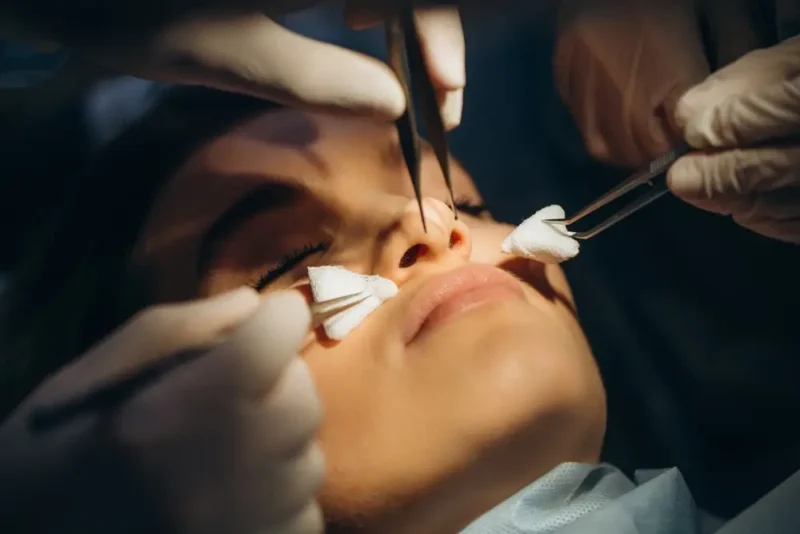
Rhinoplasty (commonly called a “nose job”) is a nose reshaping surgery aiming to improve the appearance, the function of the nose, or both. Nose plastic surgeons can refine the tip, straighten the bridge, narrow the nostrils, or correct structural problems that make breathing difficult.
Nasal reshaping has the following two goals in aesthetic surgery:
- Aesthetic rhinoplasty reshapes the nose to create better balance with the rest of the face.
- Functional rhinoplasty corrects internal problems, such as a deviated septum, that obstruct airflow. When both are done together, the procedure is called a septorhinoplasty.
Rhinoplasty is one of the most frequently requested facial cosmetic procedures in the world, according to the American Society of Plastic Surgeons. Because the nose is the central feature of the face, small, precise changes can have a large effect on appearance and self-confidence.
Why Choose Rhinoplasty in Turkey?

Doku Clinic
Turkey has become one of the world’s top destinations for rhinoplasty because it combines internationally trained surgeons with prices that are often 50–70% lower than in Western Europe or the United States — without a corresponding drop in quality at accredited clinics.
Three main factors drive its popularity in the global scene:
- Lower Cost for High Quality: Lower operating and living costs in Turkey mean the same standard of surgery is offered for a fraction of the price.
- Lower Cost for Extensive Experience: Istanbul clinics perform a very high volume of rhinoplasties, and surgical experience is one of the strongest predictors of a good outcome.
- All-Inclusive Mediterranean Travel: Most clinics bundle the surgery, accommodation, airport transfers, and aftercare into a bundle, making the experience stress-free.
How Much Does Rhinoplasty Cost in Turkey?
Rhinoplasty in Turkey costs $2,500 to $4,500 and is usually offered as a fixed, all-inclusive package covering surgery, accommodation, and transfers. The exact figure depends on the technique and the complexity of your case.
Pricing deserves a proper breakdown, so we’ve put it all in one place: primary, revision, and ethnic pricing, country-by-country comparisons, what’s included, and the hidden costs to budget for:
👉 Read the full Rhinoplasty Cost in Turkey guide
What is Included in a Turkish Nose Job Package?
A Turkey nose job package is one closed price. What is usually not included are flights, travel insurance and personal expenses. At an accredited clinic, it should always include:
- Surgery and surgeon’s fee
- One night’s hospital stay
- 4–6 nights in a partner hotel, breakfast included
- VIP airport–hotel–clinic transfers
- Pre-op tests, medications, nasal splintand post-op care kit
- A personal patient coordinator and translator
- 12 months of remote follow-up
Turkey Nose Job Cost vs UK, US & Australia
Even adding $400–$900 for flights, most patients save $4,000–$10,000 for a nose job in Turkey. The reason is lower operating costs, favourable exchange rates and government-incentives for health tourism.
| Country | Average total cost | Typical savings in Turkey |
| Turkey (all-inclusive) | $3,000–$5,500 | — |
| United Kingdom | $7,000–$12,000 | up to 60% |
| United States | $8,000–$15,000+ | up to 75% |
| Australia | $8,000–$14,000 | up to 70% |
| Germany | $6,000–$10,000 | up to 55% |
Why Do Some Clinics Quote $2,000 and Others $4,500?
Doku Clinic warns international patients that below a certain price in Turkey, some corners have been cut and caution is required. There is a real cost floor: operating theatre, a certified anesthesiology team, a hospital night and sterile single-use materials (without mentioning an accredited, experienced plastic surgeon). A $2,000 package, even without hotel and transfers, is hardly conceivable in Istanbul in 2026.
If such a price is tempting you, make sure to inquire in detail:
- Who is the surgeon?A junior doctor? A plastic-surgeon?
- Where will you be operated?Is it a licensed hospital with all necessary equipment?
- Who will perform the anaesthesia? Is it a dedicated anaesthesiologist?
- How will aftercare be?Will you have a dedicated nurse at both hospital and hotel?
Rhinoplasty in Turkey Before and After Images

Rhinoplasty before-and-after photos in Turkey show what a surgeon can do, but not the timeline until final results crystalize. Around 6-18 months are needed until tissues settle to their permanent position (thick-skinned patients require the longest time). Swelling also changes from what you see in the immediate post-op stage:
- Week 1: the nose is 20–30% swollen
- Month 1: most bruising and swelling are gone
- Month 3: roughly 80% of the final result is visible
- Months 6–12: the tip settles into its definitive shape
- Months 12–18: final result in thick-skinned or revision cases
How Long Do You Stay in Turkey for Rhinoplasty Surgery?
The minimum required stay for rhinoplasty in Istanbul at Doku Clinic is 6–7 nights. This is the minimum window demanded by Dr. Engin Öcal: one night of hospital monitoring, several days of controlled healing, and the final check-up where the nasal splint is removed (day 6–7) before you are cleared to fly.
Some clinics advertise 4-day stays. That’s technically possible but medically tight. Leaving Turkey before splint removal means trusting your final check-up to a doctor at home who didn’t operate on you… and cabin pressure on a freshly congested nose. Our medical advice is: unless absolutely necessary, stay the required minimum of 6-7 nights.
Your Journey in Turkey with Doku Clinic, Day by Day

At Doku Clinic, we have built our practice around the hosting and treatment of international patients, mostly from Europe and North America, but also from the Middle East, Africa, and even as far as Australia. Your entire process is designed with a dedicated patient coordinator (your personal host and translator), who manages every transfer, appointment and questions via WhatsApp, from airport arrival to your flight home, and will meet you at our clinic.
Here is a brief look into what your 6-7 day journey looks like:
| Day | What happens |
| Day 1 | VIP pickup at Istanbul Airport, hotel check-in & rest |
| Day 2 | In-person consultation with your surgeon, 3D imaging, blood tests, anaesthesia review. Surgery (1.5–3 hours) & night in hospital under monitoring |
| Day 3 | Morning check-up, discharge to your hotel with medication and care kit |
| Days 4–5 | Rest and gentle walks; congestion and bruising peak, then begin to fade, your coordinator checks in daily |
| Day 6–7 | Final examination: splint and stitches removed, first look at your new nose, post-op instructions. Cleared to fly home |
Your Medical Hotel in Istanbul
Recovery happens mostly in your hotel, and that’s part of the organization at Doku Clinic. We partner with 4–5 star hotels right next to our facility, including the 5-star Marriott, selected for their quiet rooms, adjustable beds or extra pillows for sleeping with the head elevated, room service with soft-food options, and staff accustomed to post-operative guests.
By day 4 or 5, most patients feel well enough for a gentle stroll along the Bosphorus: sunglasses resting carefully off the nose.
10 Types of Rhinoplasty Surgery at Doku Clinic, Istanbul

During your consultation, Dr. Engin Öcal examines your nose inside and out through X-rays and scans and recommends the approach best suited to your case. This choice will be mostly determined by your nose shape, but also by your overall facial proportion, skin thickness and desired looks post-op.
Here are all 10 types of nose job surgery in Turkey as performed at Doku Clinic:
1. Open rhinoplasty
During open rhinoplasty, small incision across the columella (the strip of skin between the nostrils) gives the surgeon full visibility of the nasal framework. Best for complex reshaping, major tip work and revision cases. The tiny scar fades to near-invisibility within months.
2. Closed rhinoplasty
All incisions are made inside the nostrils, leaving no visible scar and typically less swelling. Suited to smaller, well-defined adjustments.
3. Septorhinoplasty
Septorhinoplasty combines cosmetic reshaping with correction of a deviated septum, improving both looks and breathing. If you snore, breathe through your mouth at night or feel one nostril is always blocked, mention it: fixing it costs nothing extra in recovery time.
4. Ultrasonic (piezo) rhinoplasty
Instead of traditional instruments, an ultrasonic device sculpts the bone with micro-vibrations, sparing the soft tissue around it. The result: notably less bruising and faster visible recovery. Widely adopted in Istanbul’s top clinics.
5. Preservation rhinoplasty
The modern philosophy of reshaping the nose while keeping its natural structural framework intact, rather than removing and rebuilding it. Often means a more natural-looking bridge and a gentler recovery; ideal for moderate humps and first surgeries.
6. Tip rhinoplasty
Tip rhinoplasty reshapes only the nasal tip, usually lifting it slightly and reducing or augmenting it without touching the bridge. Shorter surgery, shorter recovery. While discreet, it can have significant results in certain patient profiles.
7. Ethnic rhinoplasty
Ethnic rhinoplasty refines the nose while preserving the character of your natural features. Requires experience with different skin thicknesses and cartilage structures.
8. Revision (secondary) rhinoplasty
Revision rhinoplasty corrects the result of a previous nose surgery. Technically the most demanding category due to scar tissue, altered anatomy and often grafting required.
9. Non-surgical rhinoplasty
Dermal fillers used to camouflage minor contour irregularities, with no downtime. Results are temporary (12–18 months) and it cannot make a nose smaller — only smoother.
10. Male Rhinoplasty
Men are the fastest-growing group of rhinoplasty patients. A well-executed male rhinoplasty preserves:
- A straight, strong dorsal line
- Anasolabial angle of 90–95°
- Proportional width that matches a stronger jaw and brow
Am I a Good Candidate for Rhinoplasty?
You may be a good candidate for rhinoplasty if you are in good general health, have finished facial growth (usually age 17–18 or older), and have realistic expectations about the results. Your surgeon will assess your medical history, examine your nose inside and out, and discuss your goals before confirming that surgery is appropriate for you.
Rhinoplasty may be right for you if you want to:
- Change the size or shape of your nose so it better suits your face
- Remove or reduce a dorsal hump on the bridge
- Refine or reshape the tip
- Straighten a crooked nose
- Correct breathing difficulties caused by internal structural problems
- Repair the nose after an injury
Matching Facial Proportion & Noses Shapes
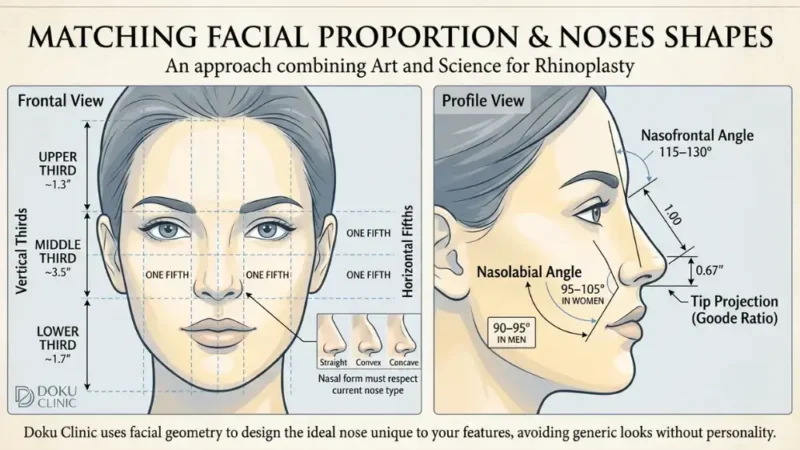
The perfect nose shape does not exist in isolation. It exists only in proportion to your face. That’s why rhinoplasty is as much of an art as it is a science. A plastic surgeon must carve your ideal nose within your face, respecting your unique traits to avoid a generic look without personality. This requires technical skill, to be sure, but also an innate sense of beauty.
At Doku Clinic, Dr. Engin Öcal divides the face into vertical thirds and horizontal fifths, guiding his surgical plan with the use of facial geometry. Within that frame, he measures key angles to establish your best nasal form according to your current type of nose.
The following can be used as general guidelines:
- The nasolabial angle must be ideally 95–105° in women, 90–95° in men
- The nasofrontal angle must be typically 115–130°
- Tip projection must be roughly 0.67 of the nose’s length in the classic Goode ratio
| Nose type | Typical approach |
| Aquiline / humped | Hump reduction, preservation technique |
| Bulbous tip | Tip refinement and reshaping |
| Crooked / deviated | Straightening + septoplasty |
| Wide (platyrrhine) | Narrowing, possible alar base reduction |
| Droopy tip | Tip rotation and support |
| Upturned / short | Lengthening with cartilage grafts |
Best Rhinoplasty Reviews in Turkey

Read thousands of our reviews across Google, Trustpilot, WhatClinic and RealSelf. Doku Clinic can also connect you directly with former patients from your own country to hear about their experience in Turkey.
How is Rhinoplasty Performed?
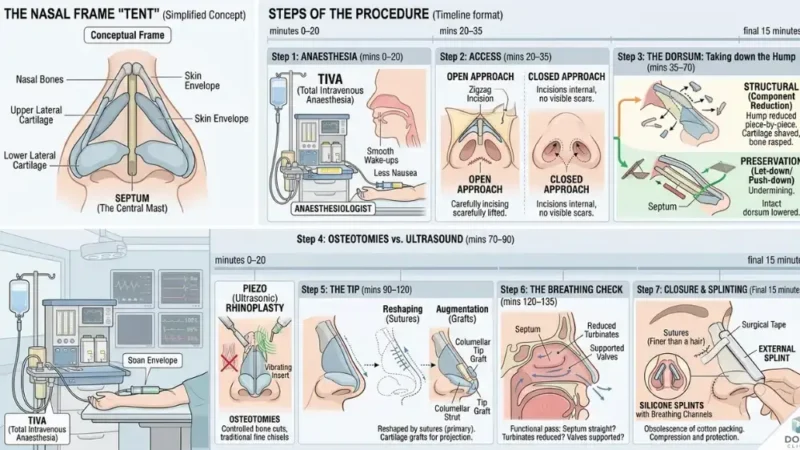
Your nose is a tent held up by a frame: the upper third is bone; the middle and lower thirds are cartilage, and the septum runs down the middle like a central mast. Every decision in the operating room is about one thing: changing the frame without weakening it.
- Anaesthesia (minutes 0–20): At Doku Clinic, you receive general anaesthesia with a dedicated anaesthesiologist present throughout. Two details separate modern practice from the old days: our teams use TIVA (total intravenous anaesthesia), associated with smoother wake-ups and less nausea.
- Access (minutes 20–35): In the open approach, a millimetres-wide, zigzag incision across the columella lets the surgeon lift the skin envelope and see the entire inner nose In the closed approach, all incisions stay inside the nostrils and the surgeon works through them.
- The dorsum: taking down the hump (minutes 35–70). This is where the two great schools of modern rhinoplasty diverge:
- Structural (component reduction): the hump is carefully reduced piece by piece — cartilage shaved, bone rasped or cut.
- Preservation (let-down/push-down): instead of removing the roof, the surgeon removes a strip of septum and bone underneath the bridge, then lowers the entire intact dorsum like a drawbridge.
- Osteotomies or ultrasound (minutes 70–90): To narrow the nose or close the open roof, the nasal bones must be repositioned. Traditionally this means osteotomies — controlled cuts with fine chisels. In piezo (ultrasonic) rhinoplasty, a vibrating insert cuts bone at a frequency that cannot injure soft tissue.
- The tip: sutures before scalpels (minutes 90–120). The tip is refined mostly by reshaping, not removing. Where the tip needs more support or projection, the surgeon harvests cartilage and builds a columellar strut or tip graft.
- The breathing check (minutes 120–135). Before closing, a functional pass: septum straight? Turbinates reduced if they were enlarged? Valves supported?
- Closure and splinting (final 15 minutes). Incisions are closed with sutures finer than a hair. Soft silicone splints with breathing channels go inside the nose (the suffocating cotton packing of the past is obsolete at modern clinics), surgical tape compresses the skin envelope, and a rigid external splint protects the new frame for the first week.
Post-OP Recovery & Aftercare
Dr. Engin Öcal
Pain in the first two weeks after rhinoplasty resolves quickly: congestion and swelling peak around day 3, bruising under the eyes blooms and fades through days 4–10, and the splint comes off at day 6–7.
Day 3 is usually the low point. You’re congested, bruised, far from home and can’t see any result under the cast. This has a name among surgeons: the post-op blues. By week two, however, most patients are back at work, and feeling back to normal.
To ensure safety and the best results, make sure you strictly follow these instructions:
- Sleep with your head elevated (two pillows or a travel pillow) for 2–3 weeks
- No glasses resting on the nose for 4–6 weeks
- No blowing your nose for 2 weeks; sneeze with your mouth open
- No intense exercise for 4 weeks, no contact sports for 3 months
- Protect the nose from sun for 6 months
- Follow your saline spray and taping instructions exactly
Flying After Rhinoplasty
Flying home after rhinoplasty in Turkey is safe as long as your surgeon clears you, normally at day 6–7, once the splint is removed. The reason for the wait is cabin pressure can risk a freshly congested nose.
For the flight itself, we recommend using saline spray regularly (cabin air is extremely dry), chew gum or yawn during descent to equalise pressure gently, and keep your medication in hand luggage. Our long-haul patients from the US or Australia routinely fly at day 7 without issues.
Aftercare From 3,000 km Away
What happens when I’m back home? That’s a key question regarding a nose job in Turkey. Your local doctor can treat an infection or reassure you about swelling, but cannot intervene surgically on another surgeon’s work.Structured telemedicine aftercare is the only answer.
At Doku Clinic, remote follow-up works like this:
- Direct WhatsApp line to your coordinator and medical team: typical response within hours, 24/7 for anything urgent
- Scheduled photo reviews at 1, 3, 6 and 12 months: with angles so the surgeon can track swelling precisely
- Written taping and care instructions: to follow at home
- Coordination with your home GP when something needs in-person eyes
How Long Do Results Last?
Rhinoplasty results are permanent and the patient’s job is not to interfere with the new nose shape while it settles, and to age kindly with it afterwards. Long-term, three habits are necessary to maintain results for life:
- Sun protection (first year)
- Protecting the nose from impact
- Maintaining a stable weight
Risks & Potential Complications
The medical risk of rhinoplasty in Turkey at an accredited, surgeon-led clinic is equivalent to that of any Western country. Additional risk is almost entirely concentrated in clinic selection — which means it is almost entirely under your control.
Common risks of rhinoplasty include:
- Bleeding
- Infection
- Anaesthesia reactions
- Prolonged swelling or numbness
- Breathing changes
- Asymmetry
- Dissatisfaction with the result
- Need for revision surgery
Is Rhinoplasty in Turkey Safe? Licences, Certifications and 2026 Regulation
Yes. At licensed clinics with board-certified surgeons, rhinoplasty in Turkey meets international safety standards. Turkey hosts one of the world’s largest clusters of JCI-accredited hospitals (over 40, among the highest counts outside the USA), and its health tourism sector is state-regulated, with every international case now registered through official channels in the Health Türkiye portal.
That doesn’t mean there aren’t any unethical providers and risky practitioners. For the sake of transparency, let’s discuss key insider knowledge for international patients to evaluate clinics and rhinoplasty surgeons in Turkey.
Are You in Contact With a Broker or a Clinic?
Some websites and social media pages are not clinics at all — they are brokers: marketing agencies that collect your inquiry and sell it to whichever surgeon or facility offers them the best commission. Brokers aren’t all malicious, but they add a layer of opacity: what’s the identity and accountability of the person holding the scalpel?
How to tell the difference:
- A clinic names its surgeons — with full credentials, photos and verifiable registry
- A clinic has a physical address and an operating licence
- Ask directly: “Who exactly will operate on me, and can I video-call them before booking?”
- The paperwork: your quote and consent forms should carry the clinic’s and surgeon’s names
The Key Credentials: TPRECD, EBOPRAS, ISAPS
A surgeon holding TPRECD membership plus European board certification and international society membership — as Dr. Engin Öcal does — has been vetted at national, European and international level. Verifying takes ten minutes on the societies’ public directories, and any legitimate clinic will send you the links without hesitation.
- TPRECD (Turkish Society of Plastic, Reconstructive and Aesthetic Surgery): confirms the surgeon completed the full 5–6 year plastic surgery residency in Turkey.
- EBOPRAS (European Board of Plastic, Reconstructive and Aesthetic Surgery): a demanding European-level board examination; certification signals training benchmarked against EU standards.
- ISAPS (International Society of Aesthetic Plastic Surgery): membership requires peer vetting and adherence to international safety and ethics protocols.
The Health Tourism Authorisation Certificate
Since 2017, Turkish law requires any facility treating international patients to hold a Health Tourism Authorisation Certificate issued by the Ministry of Health. It certifies that the clinic meets facility standards, employs licensed medical staff, and provides international patient services (translation, coordination, documented care).
New for 2026: Mandatory Complication Insurance
As of 2026, Turkish rhinoplasty clinics must arrange medical complication insurance for international patients. The insurance covers medical complications, but not aesthetic taste. If your nose heals safely but you wish the tip were slightly different, that conversation belongs to your clinic’s revision policy, we advise you to ask about revision terms before booking, in writing.
What the 2026 medical complication insurance means for you as a patient:
- Infections, bleeding or other medical complications arising from surgery are covered
- You should receive the policy in writing before surgery; ask for it with your quote
- Clinics unable or unwilling to provide the insurance are, by definition, operating outside the rules
Is Rhinoplasty in Turkey Better Than in the UK & US?
The UK and US advantage is proximity; Turkey’s advantage is cost, speed and surgical volume. For straightforward cases, we would argue the trade-off favours Turkey. For patients with complex medical histories who need frequent in-person care, staying local has real value.
| Factor | Turkey | UK | US |
| All-inclusive price (average) | $2,500–$4,500 | $7,000–$12,000 | $8,000–$15,000+ |
| What the price includes | Surgery, hospital, hotel, transfers, aftercare | Usually surgery + clinic fees only | Itemised: surgeon, anaesthesia, facility billed separately |
| Waiting time | 2–6 weeks | Often 2–6 months | 1–3 months |
| Surgeon volume | Very high (rhinoplasty-focused practices) | Moderate | Varies widely |
| Follow-up | In-person week 1, then structured telemedicine | In-person, local | In-person, local |
| Key trade-off | Distance after you fly home | Price and waiting lists | Price |
Who is the Best Rhinoplasty Surgeon in Turkey?
We would say it’s our general surgeon, Dr. Engin Öcal, but that would be in our benefit. The truth is the title of “best rhinoplasty surgeon in Turkey” is one every clinic makes and no patient can verify. Ask rather: who is the bestsurgeon for your case?
The best rhinoplasty surgeon in Turkey, for you, is the one who combines board certification, results in noses like yours, and direct personal involvement from consultation to follow-up.
At Doku Clinic, rhinoplasty is led by Dr. Engin Öcal, Plastic, Reconstructive and Aesthetic Surgeon, whose profile matches every criterion in this guide:
- Full plastic surgery specialisation (TPRECD)
- European-level board certification and international society membership
- A rhinoplasty-focused practicecovering primary, revision, ethnic and ultrasonic (piezo) techniques
- Personal, in-person consultation before surgery and direct oversight of your 12-month follow-up
Why Choose Doku Clinic?
Doku Clinic was founded on the medical standards developed under Dr. Serkan Aygın, one of Turkey’s most internationally recognised names in medical aesthetics. Our clinic operates under a Ministry of Health licence with full health tourism authorisation. A clinic confident in its credentials will pass every check you run and will encourage you to run them. Don’t hesitate to read about us online and check our patients’ reviews and testimonials for a clear, unbiased picture of our rigor and professionalism.
FAQs
How much does rhinoplasty cost in Turkey in 2026?
Primary rhinoplasty costs $3,000–$5,500 all-inclusive; revision surgery runs $5,000–$8,500. Packages cover surgery, hospital, hotel, transfers and aftercare — typically 60–75% less than US prices.
Is rhinoplasty in Turkey safe?
Yes — at licensed clinics with board-certified plastic surgeons, safety standards match Western countries. The risk concentrates in clinic selection: verify TPRECD credentials, the Health Tourism Authorisation Certificate and the 2026 insurance.
How long do I need to stay in Turkey?
6–7 nights minimum. This covers pre-op tests, surgery, one hospital night, controlled healing and splint removal at day 6–7 — your clearance to fly home.
Does rhinoplasty hurt?
Less than most patients expect. Surgery is under general anaesthesia; afterwards, patients report congestion and pressure rather than sharp pain, managed with standard medication.
When will I see my final result?
About 80% at 3 months; the tip refines last. Full results settle at 12 months — up to 18–24 months with thick skin or revision cases.
Can rhinoplasty fix my breathing too?
Yes. A septorhinoplasty corrects a deviated septum and reshapes the nose in one operation, with no added recovery time. Mention breathing issues at your consultation.
What is ultrasonic (piezo) rhinoplasty?
A technique that sculpts nasal bone with ultrasonic micro-vibrations instead of traditional instruments, sparing soft tissue — meaning visibly less bruising and a faster early recovery.
What’s the difference between open and closed rhinoplasty?
Open uses a tiny incision between the nostrils for full visibility — best for complex work. Closed hides all incisions inside the nose — suited to smaller refinements.
Am I too old (or too young) for a nose job?
Minimum is facial maturity, around 17–18. There’s no strict upper limit — general health matters more than age; candidates in their 50s and 60s operate routinely.
Will people know I had a nose job?
Not if it’s done well. Modern rhinoplasty aims for natural harmony — the goal is “you look great,” never “you look different.”
How do I avoid bad clinics in Turkey?
Verify the surgeon by name in the TPRECD registry, request the clinic’s authorisation certificate, video-call the actual surgeon, and treat prices under ~$3,000 as a warning, not a bargain.
What if I need a revision after flying home?
Revision rates run 5–15% globally. Ask for the clinic’s written revision policy before booking; minor touch-ups typically wait 12 months and many clinics offer preferential terms.
Can I fly long-haul after surgery?
Yes, once your surgeon clears you at day 6–7 after splint removal. Use saline spray onboard and equalise pressure gently on descent — congestion is the only real nuisance.
What can’t I do after rhinoplasty?
No glasses on the nose for 4–6 weeks, no nose-blowing for 2 weeks, no intense exercise for 4 weeks, no contact sports for 3 months, sun protection for 6 months.
Why is Turkey so much cheaper?
Lower operating costs, favourable exchange rates and state-supported health tourism explain the price. At accredited clinics, equipment, protocols and surgeon training match Western standards.
References & Citations
- ISAPS — International Survey on Aesthetic/Cosmetic Procedures, Global Survey 2024 (published 2025). isaps.org
- USHAŞ (International Health Services, Republic of Türkiye) — Health tourism statistics 2024–2025. ushas.com.tr
- Turkish Ministry of Health — International Health Tourism and Tourist Health Regulation; Health Tourism Authorisation Certificate framework. saglik.gov.tr
- American Society of Plastic Surgeons (ASPS) — Rhinoplasty procedure overview and national statistics. plasticsurgery.org
- Joint Commission International — JCI-Accredited Organizations directory, Türkiye. jointcommissioninternational.org
- TPRECD — Turkish Society of Plastic, Reconstructive and Aesthetic Surgery, member registry. tpcd.org.tr
- EBOPRAS — European Board of Plastic, Reconstructive and Aesthetic Surgery, certified fellows directory. ebopras.eu
- ISAPS — Patient safety guidelines for aesthetic procedures abroad. isaps.org/discover/patients-home