


How to Tighten Sagging Arms? Surgical and Non-Surgical Methods
Last Update:2 November 2026
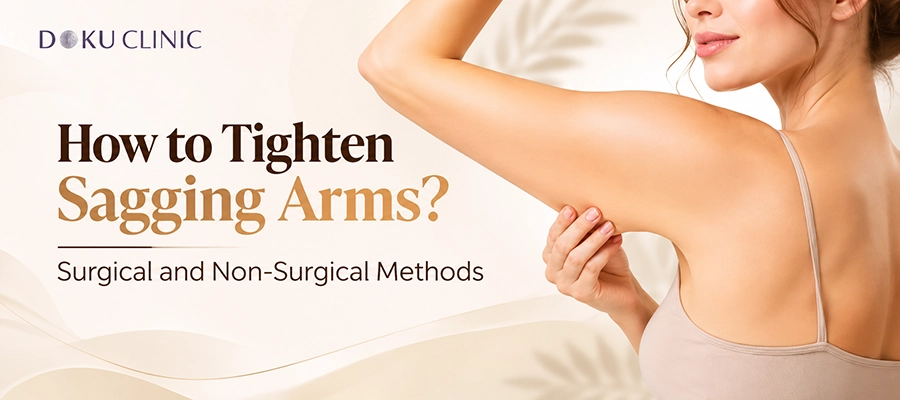
Loose skin, excess tissue, and localized fat deposits on the arms, particularly between the elbow and shoulder, can become more noticeable over time due to weight fluctuations, aging, and genetic factors. When the skin hangs downward as the arms are raised or the upper arms appear wider than usual, many people begin asking how to tighten sagging arms.
However, not every change in arm appearance has the same underlying cause. For some people, the main concern is stubborn fat beneath the skin, while others have a significant amount of excess skin. In other cases, the amount of fat may be limited, but poorly developed muscles can make the arms look softer and less defined. Therefore, rather than choosing a treatment based solely on arm slimming or tightening, it is important to identify which tissue is responsible for the appearance.
Non-surgical body contouring treatments may be considered for mild fat accumulation and limited tissue laxity. When excess skin is more pronounced, arm lift surgery may provide a more comprehensive approach. Liposuction, Emsculpt, CoolSculpting, and certain treatments designed to improve skin quality can also address different concerns.

What Is Arm Sagging?
Arm sagging refers to the appearance that develops when the skin, usually along the inner and lower portions of the upper arm, loses its original firmness and begins to hang downward.
This condition is not exclusively associated with excess body weight. People who maintain their ideal weight may also experience loose skin on their arms.
The appearance of the upper arms is primarily determined by the following structures:
- Skin
- Subcutaneous fat tissue
- Muscle tissue
- Connective tissues
For this reason, two arms that look similar from the outside may have completely different underlying causes.
For example, one person may have firm skin but a substantial amount of fat underneath it. Another person may have very little fat but considerable excess skin following significant weight loss.
In the first situation, fat reduction treatments may be appropriate. In the second, reducing fat alone could make the existing excess skin even more noticeable.
What Causes Sagging Arms?
Several factors can contribute to the development of loose or sagging arms.
Age-related loss of skin elasticity
Collagen and elastin play important roles in maintaining skin firmness.
As people age, the production and quality of these structural proteins may change. When the skin begins to lose elasticity, gravity can make looseness particularly noticeable along the inner and lower portions of the upper arms.
Skin aging does not occur only on the face. The neck, abdomen, legs, and arms can also gradually lose elasticity over time.
Rapid or significant weight loss
One of the most common causes of sagging arms is substantial weight loss.
During weight gain, the skin may stretch to accommodate increased body volume. After weight loss, however, the skin does not always contract to the same extent.
Remaining at a higher body weight for many years, losing a considerable amount of weight, or experiencing rapid weight loss following bariatric surgery can result in excess skin around the upper arms.
In these circumstances, the concern is not simply excess fat. Even after reaching an ideal weight, the skin of the upper arms may continue to hang downward.

Frequent weight fluctuations
Repeated changes in body weight can cause the skin to stretch and contract multiple times.
Over time, this may contribute to reduced elasticity. The effects of weight fluctuations can become particularly noticeable in areas such as the arms, abdomen, legs, and chest.
Genetic factors
The way the body stores fat and the natural elasticity of the skin vary from person to person.
Some individuals tend to accumulate more fat around the abdomen when they gain weight, while others may notice increased volume in their upper arms more easily.
Similarly, age-related skin laxity may develop earlier in some people than in others.
Weak muscle development
Muscle structure influences the overall shape of the upper arms.
In particular, reduced muscle tone in the triceps area can contribute to a softer appearance.
However, it is important to distinguish muscle weakness from actual skin sagging. Exercise can develop muscle tissue, but it cannot remove substantial amounts of excess skin.
Sun exposure and lifestyle habits
Prolonged exposure to ultraviolet radiation can affect the collagen structure within the skin.
Smoking and other lifestyle habits that influence skin health may also contribute to changes in skin quality over time.
How to Tighten Sagging Arms?
The answer to how to tighten sagging arms depends on what is causing the sagging.
The first step is identifying the primary issue affecting the appearance of the arms:
- Excess fat?
- Loose skin?
- Significant excess skin?
- Insufficient muscle tone?
- Cellulite or uneven skin texture?
- A combination of several concerns?
This distinction is important when selecting a treatment.
Non-surgical methods may be sufficient for mild laxity and limited fat deposits. However, when there is a considerable amount of excess skin, surgical arm lifting may provide a more direct solution.
Can Exercise Tighten Sagging Arms?
Exercise is often one of the first options people consider when dealing with sagging arms.
Regular strength training can help develop the arm muscles and create a more defined appearance.
The following exercises may be particularly useful for strengthening the arms and upper body:
- Triceps extensions
- Push-ups
- Shoulder presses
- Triceps dips
- Resistance band exercises
- Dumbbell exercises
As muscle mass increases, the arms may appear firmer and more athletic.
However, there is an important limitation: exercise does not eliminate excess skin.
When significant weight loss leaves skin visibly hanging from the arms, building muscle may improve their appearance to some extent, but the excess skin remains physically present.
Therefore, arms that can benefit from exercise should be distinguished from those requiring surgical skin removal.
Does Losing Weight Get Rid of Sagging Arms?
If excess fat is the main reason the arms appear large, overall weight loss may help reduce their circumference.
However, the body does not lose fat exclusively from a chosen area.
When a calorie deficit is created, fat loss occurs in different parts of the body depending on genetic and hormonal factors.
For this reason, no specific food or arm exercise can produce selective fat loss in the arms alone.
Additionally, in people with significant skin laxity, continued weight loss may reduce arm volume while making excess skin more visible.
Therefore, although approaching a healthy weight is important, losing more weight is not always the solution to sagging arms.
How Can You Tell the Difference Between Excess Fat and Loose Skin on the Arms?
One of the most important aspects of treatment planning is distinguishing between excess fat tissue and excess skin.
When excess fat is the primary issue, the upper arm is generally:
- Thicker
- Fuller
- Characterized by noticeable fatty tissue when grasped
When excess skin is the main issue:
- The skin may hang downward when the arm is raised
- The skin may appear thin and empty
- Skin folds may develop
- Sagging may be noticeable even when the arm has relatively little volume
Some people experience both concerns at the same time.
In other words, excess subcutaneous fat and loose skin may coexist.
In such cases, combined surgical treatment may be necessary rather than liposuction or skin removal alone.
What Is Arm Lift Surgery?
Arm lift surgery, medically known as brachioplasty, is a surgical procedure that removes excess skin from the upper arms and reshapes the remaining tissues.
The primary purpose of arm lift surgery is not weight loss.
Its goal is to improve the upper arm contour and reduce excess skin that cannot be adequately addressed through non-surgical methods.
For patients who also have fat accumulation, liposuction may be planned alongside arm lift surgery.
How Is Arm Lift Surgery Performed?
The surgical plan may vary depending on the severity of the sagging.
Before surgery, the plastic surgeon evaluates the following characteristics of the arms:
- Amount of excess skin
- Amount of fat
- Location and extent of the sagging
- Shoulder and armpit anatomy
When excess skin is significant, the additional tissue is surgically removed.
If fat accumulation is also present, liposuction may be performed during the same procedure. This allows both upper arm volume and excess skin to be addressed together.
The length and location of the incision depend on the degree of sagging.
A shorter incision may be sufficient for limited changes, whereas extensive excess skin along the arm may require a longer incision.
Does Arm Lift Surgery Leave Scars?
One important aspect to consider before undergoing arm lift surgery is the surgical scar.
Because excess skin is removed surgically, a traditional arm lift cannot be performed without making an incision.
The scar is generally positioned along the inner or back-inner portion of the arm to make it as discreet as possible.
Its length depends on the amount of skin that needs to be removed.
During the first few months, the scar may be more noticeable. As healing progresses, it may become lighter and less prominent.
However, expecting a completely scarless arm lift is not realistic.
What Is a Mini Arm Lift?
For individuals whose excess skin is limited to a small area near the armpit, techniques involving shorter incisions may be considered.
This approach is sometimes called a mini arm lift.
However, a mini arm lift is not suitable for everyone.
If the excess skin extends toward the elbow, a short incision confined to the armpit may not provide sufficient tightening.
Therefore, the surgeon must find the appropriate balance between minimizing incision length and removing enough excess skin.
Can Liposuction Tighten Sagging Arms?
Liposuction is a surgical procedure that removes excess subcutaneous fat through thin cannulas to reshape body contours.
However, liposuction is not a skin removal procedure.
It may therefore help slim the arms and improve their proportions in individuals with noticeable fat deposits and good skin elasticity.
In contrast, reducing fat alone may not eliminate sagging in someone with substantial skin laxity.
In some cases, the existing looseness may become more noticeable after fat volume decreases.
For this reason, the skin’s ability to adapt to the new contour should be evaluated before liposuction.
Can Liposuction and an Arm Lift Be Performed Together?
For suitable patients with both localized fat accumulation and excess skin, the two procedures can be included in the same surgical plan.
Liposuction reduces excess fatty tissue, while an arm lift removes additional skin.
This combined approach may be particularly useful after significant weight loss, when both skin and fat contribute to changes in arm appearance.
However, the extent of surgery should be determined according to the individual’s anatomical characteristics.
Is Non-Surgical Arm Tightening Possible?
In cases of mild skin laxity, non-surgical treatments may help improve the appearance of the arms.
However, tightening the arms without surgery is not the same as removing excess skin.
Energy-based treatments and body contouring technologies may aim to:
- Improve skin quality
- Reduce limited fat deposits
- Develop muscle structure
- Create a firmer appearance
When a substantial amount of skin hangs visibly downward, these methods should not be expected to produce the same results as surgical arm lift procedures.

Arm Tightening with Emsculpt
Emsculpt is a non-invasive body contouring technology that uses high-intensity electromagnetic energy to stimulate powerful muscle contractions.
For the arms, the primary goal of Emsculpt is not to remove excess skin.
Instead, treatment may focus on:
- Strengthening the arm muscles
- Increasing muscle tone
- Creating a more athletic arm appearance
- Improving body contours
Therefore, when weak muscle development is the main concern, suitability for Emsculpt treatment may be evaluated.
However, strengthening muscles does not eliminate substantial amounts of loose skin.
Arm Slimming with CoolSculpting
CoolSculpting, also known as cryolipolysis, is a non-surgical fat reduction method that uses controlled cooling to target specific deposits of subcutaneous fat.
It may be considered particularly for individuals who:
- Maintain a relatively stable body weight
- Have limited, stubborn fat deposits beneath the upper arms
- Do not want surgical fat removal
CoolSculpting primarily targets fat cells.
Therefore, it is not an arm lift procedure and does not remove significant excess skin.
When severe arm sagging is mainly caused by loose skin, other treatment methods may need to be considered.

Can Emtone Be Used on the Arms?
Emtone is a non-invasive treatment that combines radiofrequency and mechanical energy technologies.
It may be included in a treatment plan when the main concerns affecting the arms include:
- Uneven skin texture
- A cellulite-like appearance
- Mild skin laxity
- Reduced skin quality
However, Emtone is not a procedure that surgically removes excess skin.
For this reason, it is important to determine which concern is most prominent.
Differences Between Surgical and Non-Surgical Arm Tightening Methods
The goals of different treatments vary depending on the primary problem affecting the appearance of the arms.
| Method | Primary Goal | Surgical? | Main Indication |
| Exercise | Develop muscle structure | No | Low muscle tone |
| Emsculpt | Support muscle development and body contours | No | A firmer, more athletic appearance |
| CoolSculpting | Target localized fat deposits | No | Limited stubborn fat accumulation |
| Emtone | Improve skin texture | No | Mild tissue irregularities |
| Liposuction | Remove excess fatty tissue | Yes | Noticeable localized fat accumulation |
| Arm Lift | Remove excess skin | Yes | Significant skin sagging |
| Liposuction + Arm Lift | Address excess fat and skin together | Yes | Combined fat accumulation and excess skin |
It would not be accurate to say that one treatment is always better than another.
For example, performing an arm lift on someone whose only concern is excess fat may be a more extensive intervention than necessary.
Conversely, recommending only muscle development or fat reduction to someone with significant excess skin may not resolve the underlying problem.
Which Treatment Is Best for Sagging Arms?
Treatment selection depends directly on the severity and underlying cause of the sagging.
For mild arm laxity, non-surgical approaches designed to improve skin quality and muscle tone may be considered.
If stubborn fat deposits are the primary concern, localized fat reduction treatments or liposuction may be evaluated.
When excess skin is significant, arm lift surgery may provide a more comprehensive change because the additional skin can be physically removed.
For this reason, simply stating that the arms are sagging is not enough to determine the appropriate treatment.
The underlying structure responsible for the appearance must first be identified.
How to Tighten Sagging Arms After Weight Loss?
Excess skin on the upper arms is common after substantial weight loss.
After losing weight, a person may choose to wait for a period to allow the body to adjust to its new weight.
However, when a large amount of excess skin has developed, complete natural tightening is not always possible.
An assessment for surgical arm lifting may be necessary, particularly when the skin:
- Is thin
- Appears empty or deflated
- Hangs noticeably when the arm is raised
- Forms a large fold extending toward the elbow
Body contouring procedures are generally planned once body weight has largely stabilized.
Should Someone with Sagging Arms Lose More Weight?
Not necessarily.
If someone is generally overweight, approaching a healthy weight range may be beneficial when planning surgery or body contouring treatments.
However, if the person is already at their ideal weight, further weight loss may not resolve sagging arm skin.
In fact, as the remaining fat tissue decreases, the skin may appear even more deflated.
Therefore, assuming that losing a few more pounds will solve sagging arms is not the right approach for everyone.
Who May Be a Suitable Candidate for Arm Lift Surgery?
Arm lift surgery may be considered particularly for people who:
- Have excess upper arm skin after significant weight loss
- Develop noticeable arm sagging with age
- Are close to their ideal weight but feel uncomfortable because of excess skin
- Have skin laxity that does not improve with exercise
- Understand and accept the recovery process and surgical scars
The treatment decision should be made following an examination by a plastic surgeon.
General health, medications, smoking habits, and expectations regarding surgery are also important factors in the assessment.
Should Your Weight Be Stable Before Arm Lift Surgery?
Achieving a stable body weight before surgery is generally recommended.
Significant weight loss after surgery may cause the skin to loosen again, while substantial weight gain may alter the arm contour.
When an arm lift is being considered after bariatric surgery, it may be advisable to wait until the weight loss process is largely complete.
What Is Recovery Like After an Arm Lift?
Surgical arm lifting involves a more extensive recovery process than non-surgical body contouring treatments.
During the first few days, patients may experience:
- Swelling
- Bruising
- Tightness
- Tenderness
Depending on the surgeon’s recommendations, a compression garment or arm compression sleeve may be used.
Arm movements may need to be restricted during the first few weeks. In particular, patients may be advised to avoid lifting heavy objects or performing movements that place excessive strain on the arms.
Recovery time varies depending on the extent of the procedure and the individual’s healing process.
When Can You Exercise After Arm Lift Surgery?
Returning to exercise should not be determined solely by how well someone feels.
Because healing continues beneath the skin and along the incision line, movements that place significant strain on the arms may not be appropriate during the early recovery period.
Light activities, such as walking, may be resumed in the initial stages under medical supervision.
Patients should wait for their surgeon’s approval before lifting weights, performing resistance exercises, or returning to intense upper-body workouts.
Are Arm Lift Results Permanent?
Excess skin that has been surgically removed does not grow back in the same way.
However, the body continues to change throughout life.
Aging, major weight fluctuations, and changes in skin quality can affect the appearance of the arms again in later years.
Maintaining a stable weight is therefore important for preserving the achieved contour.
It should also be remembered that surgery does not stop the natural aging process.
Are Non-Surgical Arm Tightening Results Permanent?
The longevity of non-surgical treatment results depends on the method used.
For treatments targeting muscle structure, regular exercise and lifestyle habits may influence how long the results are maintained.
Treatments that target fat cells may provide long-lasting body contour improvements. However, gaining weight after treatment can increase the size of the remaining fat cells.
For treatments focused on skin tightening and improving skin quality, maintenance sessions may be needed over time because natural aging continues.
Therefore, no non-surgical arm tightening treatment guarantees that the arms will never change again.

How to Choose Between an Arm Lift and Liposuction?
The most important distinction is based on the amount of excess fat and skin.
When there is excess fat but the skin is firm
Liposuction or non-surgical localized fat reduction treatments may be considered for suitable individuals.
When there is little fat but excess skin
An arm lift may be the more appropriate option.
When excess fat and skin are both present
Liposuction and arm lift surgery may be planned together.
When fat and skin excess are limited but the muscles are weak
Muscle-focused approaches, such as exercise or Emsculpt, may be considered.
This assessment should be made following a physical examination.
Can Sagging Arms Be Prevented?
Aging and genetic factors cannot be completely prevented.
However, certain habits may help maintain skin quality and healthy body composition.
Maintaining a stable weight is important. Repeated substantial weight fluctuations may negatively affect skin elasticity.
Regular strength training helps preserve arm muscles.
A balanced diet containing sufficient protein may support muscle maintenance.
Sun protection can help reduce premature skin aging.
Avoiding smoking is also important for overall skin health.
However, none of these measures can guarantee the complete prevention of excess skin caused by genetic factors or substantial weight loss.
How to Tighten Sagging Arms and Choose the Right Treatment?
The best approach to tightening sagging arms can only be determined after identifying the reason for the sagging.
When assessing the arms, their circumference should not be the only factor considered.
The following characteristics should be evaluated together:
- Skin quality
- Amount of excess skin
- Thickness of fatty tissue
- Muscle structure
- Weight history
- Age
- General health
- Previous procedures
- Personal expectations
Just as an unnecessarily extensive operation should not be performed for a mild concern, it is also unrealistic to expect non-surgical treatments to deliver the same results as surgery when advanced skin sagging is present.
The objective is not to perform as many procedures as possible, but to select the treatment most appropriate for the underlying problem.
Frequently Asked Questions
Can exercise tighten sagging arms?
Exercise can strengthen the arm muscles and help the upper arms appear firmer and more defined.
However, exercise does not remove excess skin. If substantial loose skin or sagging caused by significant weight loss is present, exercise alone may not be sufficient.
How can sagging arms be tightened?
For mild laxity, exercise and non-surgical body contouring treatments may be considered. For localized fat deposits, methods such as CoolSculpting or liposuction may be evaluated, while Emsculpt may be suitable when muscle tone is low.
When excess skin is significant, arm lift surgery may provide a more direct approach.
Is a non-surgical arm lift possible?
For mild tissue laxity, non-surgical treatments may help create a firmer appearance.
However, when a substantial amount of excess skin exists, non-surgical devices cannot physically remove it. Therefore, their results in advanced cases are not equivalent to surgical arm lifting.
Does arm lift surgery leave scars?
Yes. A surgical incision is required to remove excess skin.
The length of the scar depends on the degree of sagging. During surgical planning, the incision is generally positioned along the less visible inner portion of the arm whenever possible.
Can liposuction eliminate arm sagging?
Liposuction primarily reduces fatty tissue.
For people with good skin elasticity, fat removal may result in a smoother arm contour. However, it does not remove significant excess skin.
Can an arm lift and liposuction be performed at the same time?
Yes, for suitable patients.
When both excess fat and loose skin are present, liposuction may be used to reduce the fatty tissue, while arm lift surgery removes the additional skin.
Can CoolSculpting make the arms slimmer?
CoolSculpting may be used to target stubborn fat deposits in the arms of individuals who have an appropriate amount of pinchable subcutaneous fat.
However, it is not a weight loss method or a treatment for advanced arm sagging.
Does Emsculpt tighten the arms?
Emsculpt aims to support muscle development by producing intense muscle contractions.
Improved muscle tone may help the arms appear firmer and more athletic. However, it does not eliminate excess skin.
Does arm skin tighten naturally after weight loss?
The skin may tighten partially, but this depends on age, genetic characteristics, the amount of weight lost, and skin elasticity.
After substantial weight loss, large amounts of remaining excess skin should not be expected to disappear completely on their own.
Why do arms sag more after losing weight?
When fat volume decreases, skin that was previously stretched by the underlying fatty tissue may appear deflated.
If skin elasticity is insufficient for it to adapt fully to the reduced volume, the excess skin becomes more noticeable.
Is arm lift surgery a weight loss procedure?
No. An arm lift is a body contouring procedure. Its primary purpose is not weight loss, but improving upper arm contours by removing excess skin and, when necessary, addressing localized fatty tissue.
Can sagging return after arm lift surgery?
The removed skin does not grow back in the same way, but the natural aging process continues.
Significant weight changes or a gradual reduction in skin elasticity may affect the appearance of the arms again over time.
How long does arm lift surgery take?
The duration of surgery depends on the extent of the planned procedure.
An operation involving only skin removal may take a different amount of time from a combined liposuction and arm lift procedure. The exact duration is determined during surgical planning.
Do you need to wear compression garments after an arm lift?
Depending on the surgeon’s preferences and the extent of the operation, compression garments may be recommended.
These garments may help manage postoperative swelling and support tissue adaptation to the new contour.
Which doctor should you see for sagging arms?
For significant excess skin and an assessment for arm lift surgery, a specialist in plastic, reconstructive, and aesthetic surgery should be consulted.
Before undergoing non-surgical body contouring treatments, it is also important to receive an evaluation from a qualified healthcare professional to determine whether the primary concern involves fat, skin, or muscle tissue.