


Subglandular Breast Implants: Results & Submuscular Comparison
Publish Date:11 August 2026
Medically Reviewed by: Op. Dr. Engin Öcal | Head Plastic, Reconstructive & Aesthetic Surgeon at Doku Clinic
Choosing subglandular breast implants is a balance between rapid recovery and suitability. Positioned directly over the chest muscle, this approach offers a soft, natural breast projection, yet it demands enough tissue to avoid implant visibility. Dr. Engin Öcal insistst that getting world-class results depends on candidate selection, board-certified surgeons, and following safety standards.
Key Takeaways:
- Subglandular placement places the implant above the pectoralis major muscle and behind glandular tissue.
- It’s ideal for patients with natural pinch-test thickness (>2–3 cm) seeking lower post-op pain.
- The technique eliminates animation deformity caused by chest muscle contraction during exercise.
- Requires mandatory verification of surgeon credentials (e.g., ISAPS, EBOPRAS) and accreditation.
What Is a Subglandular Implant?
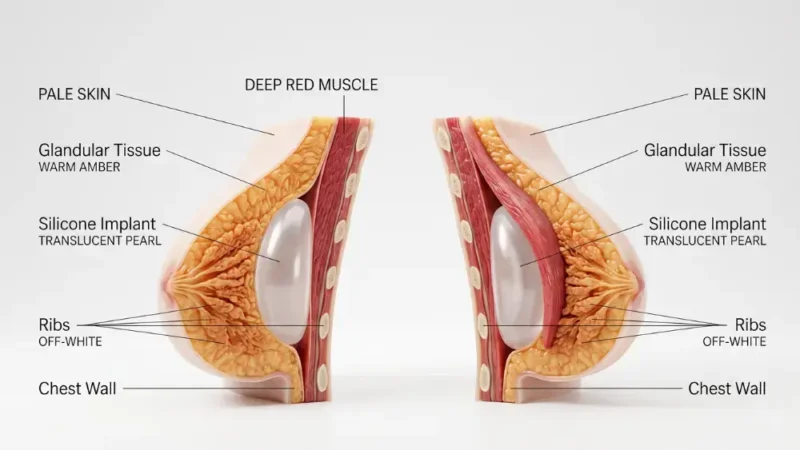
When you choose a subglandular implant, your surgeon places the breast implant directly behind your natural breast tissue and right on top of your chest muscle (the pectoralis major). Your chest muscle isn’t cut, stretched, or lifted during the procedure, so this type of breast augmentation is less invasive with a faster and smoother healing period.
Key advantages include:
- Muscle Preservation: Your chest muscle stays completely intact, with zero loss of chest strength.
- Natural Movement: The implant moves together with your own natural breast tissue when you walk, dance, or lie down.
- No Implant Distortion: When you hit the gym or lift something heavy, your breasts won’t jump or change shape because the muscle isn’t pressing down on the implant.
- Shorter Initial Recovery: Less tissue disruption generally translates to a faster, smoother first week of healing.
Subglandular vs. Submuscular Implants
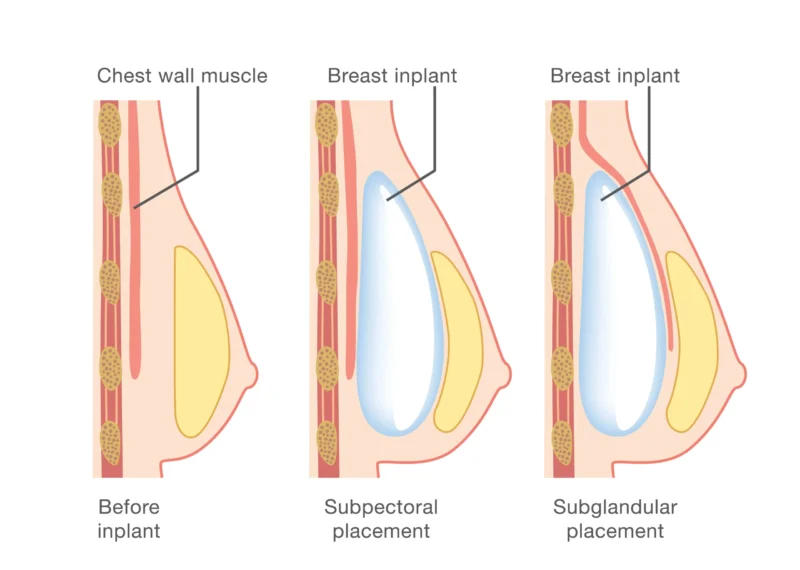
Deciding whether your implant should go over the muscle (subglandular) or under the muscle (submuscular) comes down to your body type, your lifestyle, and the breast appearance you want to achieve.
| Feature | Subglandular (Over the Muscle) | Submuscular (Under the Muscle) |
| Placement | Sitting right behind your breast tissue, above the muscle | Sitting partially or completely underneath the chest muscle |
| Pain & Recovery | Mild to moderate discomfort. Most patients feel ready for light daily tasks in 3 to 5 days. | Moderate to higher discomfort. Muscle stretching requires about 7 to 14 days of solid rest. |
| Upper Breast Look | Fuller, rounder shape at the top of the chest right away. | Smarter, gradual slope with a softer transition at the top. |
| Exercise & Flexing | Zero distortion. Flexing your chest muscles won’t move your implants. | Possible movement. Flexing can temporarily push or squeeze the implants outward. |
| Best Body Type Fit | Women with enough natural breast tissue to cover and hide the top edges of the implant. | Women with very little natural tissue or thin skin who need muscle coverage to hide edges. |
| Rippling Risk | Higher if your skin is thin or if you have very little natural breast tissue. | Lower, because the thick muscle layer covers and smooths out the top edge. |
The Aesthetic Benefits: High Cleavage & Natural Softness
If you have enough natural breast tissue to cover the implant, subglandular placement delivers remarkable benefits:
- Instant Upper-Breast-Pole Fullness: You get a round, youthful cleavage right away without waiting months for a tight chest muscle to drop and release the implant.
- Soft, Natural Feel: Because the implant interacts directly with your natural gland, the breasts feel softer and move more organically.
- Unrestricted Fitness: You can bench press, do push-ups, or practice yoga without ever worrying about your breasts shifting out of place when your chest contracts.
The Risks: Rippling, Scar Tissue & Screenings
No surgical procedure is without downsides. Over-the-muscle placement carries specific risks that every patient must evaluate with their surgeon:
- Implant Rippling & Edges: If your natural tissue is too thin (or if you lose weight later), the edges or subtle folds of the silicone shell can become visible, especially along the sides or bottom.
- Capsular Contracture: Your body naturally forms a layer of scar tissue (a capsule) around any implant. Modern techniques and cohesive gel implants have reduced this risk, but it remains a key factor to discuss with this technique.
- Mammogram Screenings: In the subglandular position, the implant can hide a portion of your natural breast tissue during standard mammograms. Radiologists must use specialized Eklund techniques to push the implant back and capture clear images.
How Much Does a Subglandular Breast Augmentation Cost?
A subglandular (over-the-muscle) breast augmentation typically costs $2,200 – $15,000 USD globally. Overall pricing is dictated by geographical location, surgeon expertise, clinic fees, and whether you choose saline or cohesive silicone implants.
- Western Europe & UK: £3,800 – £8,000.
- United States & Canada: $6,000 – $15,000 USD
- Turkey: $2,200 – $5,000 USD
- Mexico & South America: $3,000 – $7,000 USD.
| Cost Factor | What You Are Paying For |
| Surgeon Expertise & Credentials | Board-certified plastic surgeons with proven experience in retromammary pocket creation. |
| Implant Brand & Quality | Latest-generation cohesive silicone gels (FDA/CE-approved) with lifetime rupture warranties. |
| Facility Accreditation | Fully equipped, certified surgical hospitals with dedicated intensive care units and sterile operating suites. |
| Comprehensive Aftercare | Post-op compression garments, routine check-ups, follow-up imaging, and direct medical contact. |
What the Price Typically Includes
- Surgeon’s Fee: ~$3,000 – $6,500
- Implant Materials: ~$1,000 – $3,000 (Saline sits at the lower end, Silicone/Gummy Bear at the top)
- Anesthesia & Operating Room/Facility Fees: ~$1,500 – $3,500
- Post-Op Garments, Pre-Op Tests & Aftercare: ~$300 – $1,000
Are You a Candidate for Over-the-Muscle Placement?
Subglandular breast augmentation can have life-changing results, but only in the right anatomy. You can always contact us to get a free online consultation with Dr. Engin Öcal: treat the following as a rough guide.
You are likely a candidate for subglandular implants if you have:
- Enough Breast Tissue: At least 2 to 3 cm of pinchable tissue at the upper pole of the breast (to conceal the top border of the implant).
- Good Skin Elasticity: Your skin has good tone and elasticity to support the weight of the implant.
- Active Lifestyle or Athletic Type: You regularly workout (crossfit, swimming, weightlifting, tennis) and want to avoid implant distortion or muscle weakness.
- Mild Pre-Existing Ptosis (Sag): If you have slight breast drooping, a subglandular implant can lift and fill out the skin without requiring a breast lift (mastopexy).
Who Should Avoid Over-the-Muscle Implant Placement?
- Very Petite or Ultra-Lean Patients: If you have minimal breast tissue, thin skin, or visible ribs, over-the-muscle placement will likely expose the shell edges, causing noticeable rippling and a “ball-like” appearance.
- Patients Seeking Large Implants: Heavier implants placed over the muscle rely on skin for support, increasing the long-term risk of tissue stretching and breast sagging.
The Procedure Step by Step
A subglandular breast augmentation typically takes 1 to 2 hours under general anesthesia. Here is how your surgical day unfolds at Doku Clinic in Istanbul, Turkey, from arrival to discharge:
- Pre-Op Testing & Consultation: Upon arrival, you complete routine blood tests and ECG. Your plastic surgeon marks the guidelines and incision lines on your chest in a standing position.
- Anesthesia & Preparation: You are brought to the sterile operating suite, where the anesthesiologist administers general anesthesia.
- Incision & Pocket Creation: The surgeon makes a small incision in the inframammary fold or around the lower half of the areola. They lift the tissue to create a pocket directly over the chest muscle fascia.
- Implant Insertion & Symmetry Alignment: Using a sterile delivery sleeve (like a Keller Funnel), the implant is inserted into the retromammary space. The surgeon evaluates shape, symmetry, and cleavage projection before securing the site.
- Closure & Layered Sutures: The incision is closed using multi-layer dissolving sutures to minimize scarring, followed by surgical tape or skin glue.
- Recovery & Follow-Up: After waking in the recovery room and resting for 2–4 hours, you are fitted with a specialized compression bra and discharged with antibiotics and aftercare instructions.
Recovery Time From Day 1 to Year 1
Recovery from subglandular surgery is generally faster and less painful than submuscular surgery because the chest wall muscles remain untouched. However, strict adherence to post-operative guidelines is vital for healing and scar maturation.
| Timeframe | What You Feel & Experience | Permitted Activities & Care Protocols |
| Days 1 – 3 | Mild tightness, localized swelling, and moderate sore-muscle sensation. | Rest, wear your surgical compression bra 24/7, take prescribed pain management and antibiotics. |
| Days 4 – 7 | Swelling peaks and begins to subside; daily mobility returns to near-normal. | Light walking permitted. Most non-physical desktop workers can return to work. No driving if taking pain medication. |
| Weeks 2 – 4 | Incisions close; bruising fades. Implants begin the early settling process. | Resume light cardio (walking/stationary bike). Avoid heavy lifting (nothing over 5 kg) and high-impact bounce. |
| Weeks 6 – 8 | Internal tissue healing matures. The breast pocket softens. | Cleared for full gym workouts, chest exercises, running, and sleeping on your side/stomach. Transition out of compression bra if cleared. |
| Months 3 – 12 | Final “drop and fluff” phase completed. Incisions fade into thin, faint lines. | Final aesthetic results achieved. Breasts feel soft, natural, and integrated into your body contour. |
Take the First Step Toward Your Ideal Contour
Determining whether subglandular placement fits your unique body type requires a personalized assessment from a board-certified plastic surgeon. A thorough consultation—complete with tissue measurements and 3D imaging—ensures you choose the exact implant plane, size, and shape for a beautiful, long-lasting result.
FAQs
What is the difference between a subglandular implant and a submuscular implant?
A subglandular implant is placed directly behind your natural breast tissue, sitting right on top of your chest muscle (pectoralis major). A submuscular implant (or dual-plane) is placed partially or completely underneath the chest muscle. Subglandular placement usually means a faster recovery and no movement when you flex your chest, but it requires enough natural breast tissue to hide the implant edges.
How long does recovery take for subglandular breast implants?
Because your chest muscle is not cut or stretched during surgery, initial recovery is generally quicker than with submuscular placement. Most patients return to light daily tasks within 3 to 5 days and return to non-strenuous desk jobs in about a week. You can typically resume full exercise and heavy lifting after 6 weeks.
Will my implants move when I flex my chest muscles?
No. One of the biggest advantages of subglandular placement is the complete absence of animation deformity. Since the implant sits above the pectoralis major muscle, flexing your chest during workouts, yoga, or lifting won’t cause your implants to jump, twitch, or distort.
Can you feel the edges of a subglandular implant?
If you have adequate natural breast tissue (a pinch test of at least 2 to 3 cm at the upper pole), the top edges of the implant will be well-cushioned and soft to the touch. However, if you are very thin or lose a significant amount of weight, implant rippling or edge awareness can become visible or feelable along the sides.
Do subglandular implants affect breast cancer screenings and mammograms?
Subglandular implants sit directly in front of the breast gland, so they can obscure a portion of native tissue during standard imaging. However, certified mammography centers perform specialized Eklund displacement views, pushing the implant back against the chest wall to get a clear diagnostic view of your natural breast tissue.
Do subglandular implants sag faster than submuscular implants?
Because subglandular implants rely on your skin envelope and internal breast ligaments for support—rather than the heavy hammock of your chest muscle—they can be more prone to natural sagging over time if you choose very large or heavy implants. Selecting a size proportionate to your natural frame helps maintain your long-term results.
How do I know if I am a good candidate for subglandular placement?
You are generally a great candidate if you have sufficient natural breast tissue, good skin elasticity, an active lifestyle where you want to preserve full chest muscle strength, or mild natural breast drooping. A board-certified plastic surgeon will perform a tissue measurement (pinch test) during your consultation to confirm if over-the-muscle placement is right for your body.
References & Scientific Sources
- American Society of Plastic Surgeons (ASPS): Breast Augmentation Placement Options: Subglandular vs. Submuscular Techniques.
- International Society of Aesthetic Plastic Surgery (ISAPS): Global Survey on Aesthetic/Cosmetic Procedures & Safety Standards.
- European Board of Plastic Reconstructive and Aesthetic Surgery (EBOPRAS): Clinical Guidelines for Breast Implant Safety, Capsular Contracture Prevention, and Patient Assessment.
- Journal of Plastic, Reconstructive & Aesthetic Surgery (JPRAS): Long-term outcomes and patient satisfaction rates in retromammary vs. subpectoral breast augmentation.
- Eklund, G. W., et al.: Mammographic imaging of the augmented breast: The Eklund displacement technique.