


Round Breast Implants: All Sizes, Types & Costs
Publish Date:1 September 2026
Written by the Doku Clinic editorial team. Medically reviewed by Op. Dr. Engin Öcal — Aesthetic, Plastic and Reconstructive Surgeon.
Four out of five breast implants placed worldwide are round. It’s because a round breast implant cannot rotate out of position, cannot lead to asymmetries, and behaves predictably in the hands of an experienced surgeon.
For a spectacular result, it all comes down to profile selection, pocket choice, and whether the person holding the scalpel board-certified.
Key takeaways:
- Round implants hold approximately 80% of the global breast implant market
- Round implants come in low, moderate, moderate-plus, high and extra-high profiles
- Profile, not volume, decides your result
- Implants are not lifetime devices: the FDA’s boxed warning says so explicitly
Round breast implants at a glance
| What they are | Symmetrical, circular silicone or saline implants |
| Typical volumes | 150cc – 500cc, with 250–400cc most common |
| Profiles available | Low, moderate, moderate-plus, high, extra-high |
| Expected lifespan | Rupture risk rises measurably from around year 6 |
| Surgery time | 60 – 90 minutes under general anaesthesia |
| Back to desk work | 5 – 10 days |
| Final shape | 3 – 6 months |
What Are Round Breast Implants?
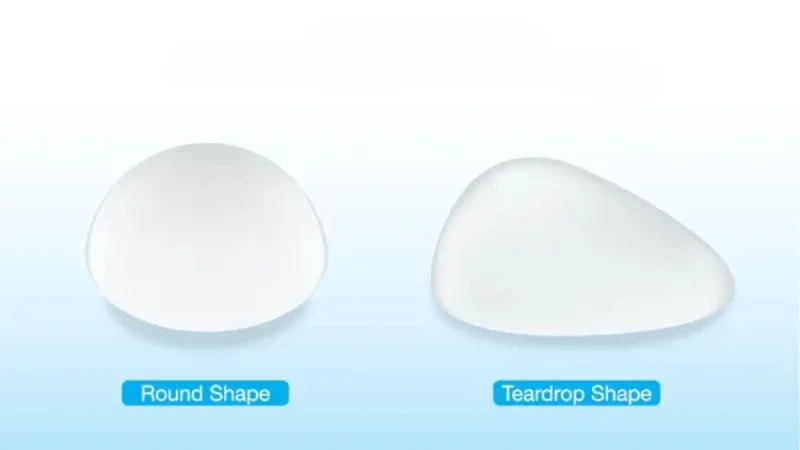
Round vs Teardrop breast implants
A round breast implant is a circular device that distributes volume evenly from the top of the breast to the bottom. It is filled with cohesive silicone gel or sterile saline, and it sits inside a pocket the surgeon creates either above or beneath the chest muscle.
Their Main Advantage: Round Implants Cannot Rotate
Unlike anatomical, teardrop implants, round implants can malrotate, but it doesn’t change anything. Rotate it ninety degrees, or a full turn, and the breast looks identical. For patients weighing round implants for breast augmentation against shaped alternatives, this is the clearest main advantage.
Round Implant Volumes & Profiles
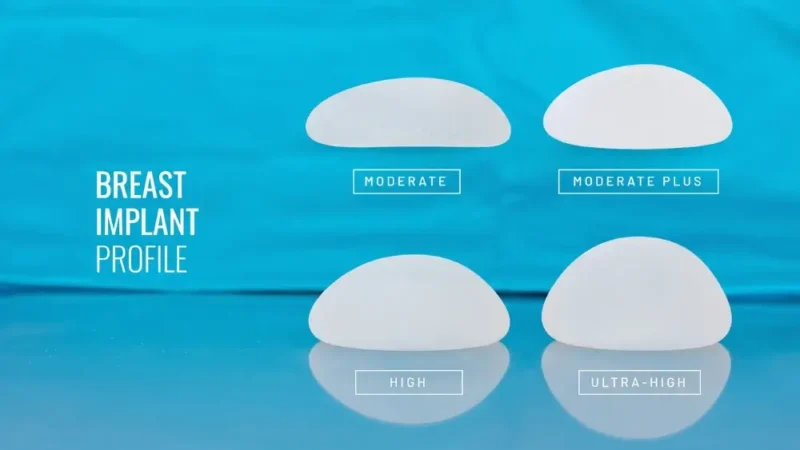
The breast implant profile is the relationship between how wide the implant’s base is and how far it projects forward. Manufacturers package it into a profile ladder, typically running from low through moderate, moderate-plus and high to extra-high.
Bear in mind: profile is constrained by your anatomy. A patient with a 13cm breast base cannot be fitted with an extra-high implant designed for an 11cm base.
Round implant profiles at a glance (fixed volume: 350cc)
The table below summarises how each round breast implant profile behaves at a comparable volume.
| Profile | Base width | Projection | Look | Best suited to |
| Low | ~13.0 cm | ~3.0 cm | Soft, spread, minimal upper-pole fullness | Broad chest walls; volume without projection |
| Moderate | ~12.3 cm | ~3.6 cm | Balanced, natural slope | Average chest width; the conservative default |
| Moderate-plus | ~11.8 cm | ~4.1 cm | Fuller upper pole, still restrained | The most-requested compromise in primary augmentation |
| High | ~11.2 cm | ~4.7 cm | Distinct upper-pole roundness, clear cleavage | Narrow chest walls; visibly augmented contour |
| Extra-high | ~10.6 cm | ~5.4 cm | Maximum projection, unmistakably augmented | Narrow base with a request for dramatic projection |
Silicone vs Saline Round Implants
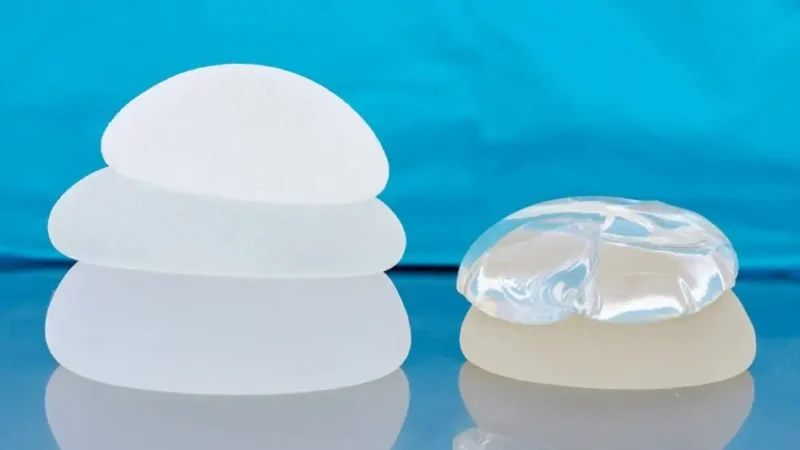
Silicone breast implants account for roughly 80% of demand because the gel’s density and viscosity behave far more like natural breast tissue than saltwater does. That’s their main advantage. However, saline implants come with big advantages of their own: they are inserted empty and filled during surgery, which allows for a smaller incision and less visible scars.
However, the difference most patients care about is feel. Cohesive silicone gel resists gravity, holds its form and transmits pressure softly. Saline sloshes. In a slim patient with minimal breast tissue, silicone is usually the preferred option.
| Silicone round implants | Saline round implants | |
| Feel | Closest to natural tissue | Firmer, more mobile fluid |
| Rippling risk | Lower | Higher, especially in slim patients |
| Incision size | Larger (pre-filled) | Smaller (filled in situ) |
| Rupture detection | Often silent; needs imaging | Visible deflation within days |
| Typical cost | Higher | Lower |
Round Implant Placement: Over the Muscle or Under the Muscle
A breast augmentation with round breast implants can have very different results depending on where the prosthesis is placed. The choice is driven by how much soft tissue you have to cover the implants. Surgeons assess this with a pinch test at the upper breast pole, with thin skin coverage arguing for submuscular placement, because the muscle disguises the implant edge.
There are three working options:
- Subglandular(above the pectoral muscle, behind the breast tissue)
- Submuscular(fully beneath the muscle),
- Dual plane: a hybrid in which the upper portion of the implant sits under the muscle while the lower portion sits behind breast tissue.
How Pocket Choice Compares
For most primary round implants breast augmentation cases, the dual plane approach has become the default, because it delivers muscle coverage where the implant is most likely to show while allowing the lower pole to fill naturally and settle into the fold.
Below, we give a quick comparison at each pocket’s comparative advantages.
| Subglandular | Dual plane | Submuscular | |
| Soft tissue needed | Good coverage required | Moderate | Works with thin coverage |
| Animation deformity | None | Mild | Most pronounced |
| Capsular contracture risk | Higher | Lower | Lower |
| Upper-pole fullness | Maximum | Balanced | Softened |
| Post-op discomfort | Least | Moderate | Most |
| Mammogram visibility | Most obscured | Intermediate | Least obscured |
At Doku Clinic, irrigation protocol, no-touch insertion technique and drain policy are fixed elements of the breast augmentation pathway.
Round Implant Breast Augmentation: From Consultation to Final Shape
Round implants breast augmentation surgery takes 60–90 minutes under general anaesthesia. During the pre-operative stage, bloodwork and anaesthesia work are carried out, with smoking cessation and stopping blood-thinning medication required. Doku Clinic, we also include 3D simulation and a written implant specification before the patient commits.
| Stage | When | What to expect |
| Surgery day | Day 0 | 60–90 min procedure; usually one night observation |
| First days | Days 1–5 | Tightness and swelling peak; light walking encouraged |
| Return to desk work | Days 5–10 | Compression garment worn continuously |
| Early recovery | Weeks 2–6 | Swelling subsides; no upper-body training |
| Settling | Months 2–3 | Implants descend; softness improves |
| Final shape | Months 3–6 | Definitive contour; scars continue maturing to 12 months |
| First screening | Years 5–6 | Ultrasound or MRI for silicone devices, then every 2–3 years |
How Much Do Round Breast Implants Cost?
The ASPS reports an average surgeon’s fee of $4,875 for breast augmentation with implants, which excludes anaesthesia, operating room charges, the implants themselves, medical tests, prescriptions and garments. Once those are added, realistic all-in totals in the United States run from $6,000 to $12,000 or more. Private breast augmentation in the UK typically runs £6,500–£9,500, rising in London and the South East.
| Market | Typical all-in cost | Notes |
| United States | $6,000 – $12,000+ | ASPS surgeon’s fee average $4,875 excludes all other components |
| United Kingdom | £6,500 – £9,500 | Higher in London; NHS coverage only for reconstructive indications |
| Western Europe | €6,000 – €10,000 | Varies widely by country and clinic tier |
| Revision surgery (US) | $8,000 – $15,000 | Implant removal alone averages a $3,979 surgeon’s fee (ASPS) |
How Long Do Round Breast Implants Last?
The FDA’s boxed warning states plainly that breast implants are not lifetime devices. Removal or replacement needs increase with time, with tupture becoming more likely from around year six. This being said, most round implants are still in place and functioning at ten years. A meaningful minority are not. The ten-year Sientra core study recorded rupture in 8.6% of patients and reoperation in 31.5% across all cohorts.
Implant Revision Surgery for Round Implants
In the Sientra ten-year dataset, the leading reasons for reoperation were capsular contracture (18.8%) and style or size change (19.3%). More than half of all reoperations were performed for cosmetic rather than medical reasons.
US revision costs typically run $8,000–$15,000, with implant removal alone carrying an average ASPS surgeon’s fee of $3,979. Manufacturer warranties often contribute toward replacement devices in confirmed rupture, but almost never toward surgical fees, and never toward elective size changes.
Risks and Potential Complications of Round Breast Implants
Capsular contracture is the most common risk associated with round implants. Ten-year rates range from 10.8% to 18.9%. Risk rises with subglandular placement, smooth surfaces, periareolar incisions and post-operative hematoma or seroma.
Rupture affects roughly 8.6% of patients at ten years.
Rippling is more common with saline devices and thin soft-tissue coverage.
Standard surgical risks also apply: infection, bleeding, altered nipple sensation, asymmetry, scarring, and effects on future mammography. Changes to breastfeeding are possible but uncommon.
FAQs
Do round implants look fake?
Not inherently. Blinded assessors identified shaped implants correctly only about half the time, and 3D studies found implant size, not shape, drives the aesthetic outcome. A moderate-profile round implant matched to your base width reads as natural; an extra-high device oversized for your frame does not.
How long do round breast implants last?
There is no fixed lifespan. The FDA states implants are not lifetime devices, with rupture risk rising from around year six. Many last well beyond ten years; roughly a third of patients undergo some reoperation within that window.
Which profile is best for a natural look?
Usually moderate or moderate-plus, sized to your measured base width. Profile must be selected against your anatomy, not chosen from a menu.
Are round implants cheaper than teardrop implants?
Generally yes, shaped devices typically carry a higher unit cost, but the difference is small relative to surgeon, anaesthesia and facility fees.
Can I breastfeed after augmentation?
Most women can. Inframammary and transaxillary incisions with submuscular or dual-plane placement minimise disruption to ducts and nerves.
Will I need imaging even without symptoms?
Yes, for silicone. The FDA recommends ultrasound or MRI at 5–6 years, then every 2–3 years. Saline requires no screening.
What happens if a round implant ruptures?
Silicone ruptures are often contained by the capsule and detected on imaging; saline deflates visibly. Both are managed with removal and replacement.
Round or teardrop: which is safer?
Round implants eliminate malrotation, reported in 0–42% of anatomical cases. Surface, not shape, drives the serious risks.
Sources & References
- U.S. Food and Drug Administration — Things to Consider Before Getting Breast Implants; boxed warning, patient decision checklist and rupture screening guidance (updated 2025).
- U.S. FDA — Medical Device Reports of Breast Implant-Associated Anaplastic Large Cell Lymphoma (current as of 6 February 2025).
- International Society of Aesthetic Plastic Surgery (ISAPS) — Global Survey on Aesthetic/Cosmetic Procedures 2024.
- American Society of Plastic Surgeons (ASPS) — Procedural Statistics Report 2024 and national average surgeon fee data.
- Stevens WG et al. — Ten-Year Core Study Data for Sientra’s FDA-Approved Round and Shaped Breast Implants, Plastic and Reconstructive Surgery.
- Calobrace MB et al. — Risk Factor Analysis for Capsular Contracture: A 10-Year Sientra Study, Plastic and Reconstructive Surgery.
- Spear SL et al. — Natrelle Round Silicone Breast Implants: Core Study Results at 10 Years, Plastic and Reconstructive Surgery.
- MemoryGel Breast Implants: Final Safety and Efficacy Results after 10 Years of Follow-Up, Plastic and Reconstructive Surgery.
- Intraoperative 3D Comparison of Round and Anatomical Breast Implants: Dispelling a Myth.
- Anatomical Breast Implant Assessment Using Ultrasound, International Breast Implant Check Clinic case series.