


Lollipop Breast Lift: Vertical Mastopexy for Natural Rejuvenation
Last Update:30 June 2026
This article was written by Doku Clinic’s editorial team and reviewed, edited and approved by Dr. Engin Öcal, MD.
For patients experiencing moderate (Grade II) breast sagging, vertical mastopexy—commonly known as a lollipop breast lift—is considered the most balanced option. With incisions that avoid the inframammary fold, this procedure lifts the parenchyma, resizes overstretched areolas, and restores projection with minimal downtime. This article explains how the lollipop technique works, its benefits, and how to maintain symmetry for years to come.
What is a Lollipop Breast Lift?
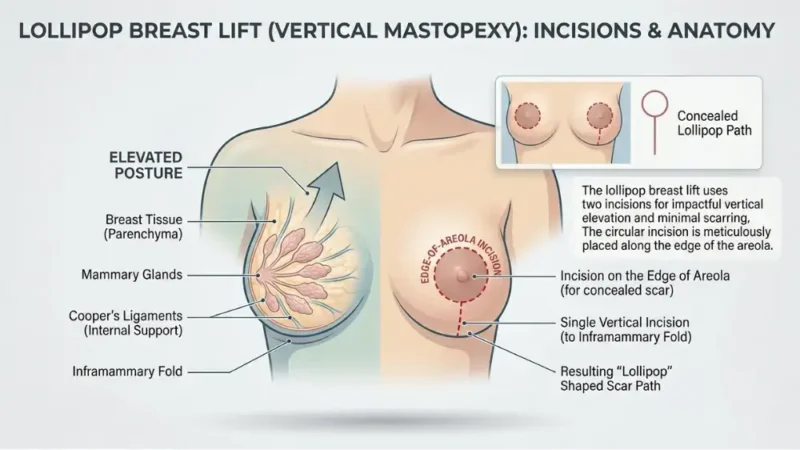
The lollipop breast lift, known as a vertical mastopexy, is a breast aesthetic surgery designed to minimize scarring while noticeably elevating breasts. The procedure utilizes two incisions to access the underlying breast tissue, allowing for impactful results. The first is a circular incision around the nipple-areola complex (NAC). The second is a single vertical incision that runs straight down to the inframammary fold, providing a direct channel to deeper breast structures.
Vertical Mastopexy vs. Alternative Lifting Techniques
A lollipop breast lift is one of 3 main breast lift techniques (often expanded into 4 techniques, when considering the crescent mastopexy). Choosing one breast lift method over the other depends entirely on your anatomy, breast sagginess and surgeon indications. Below is a simple guide comparing and contrasting all available techniques.
| Technique | Degree of Ptosis | Incision | Relative Scar | Operating Duration |
| Crescent Mastopexy | Grade I (Mild) | Upper semi-circle of the areola | Minimal; limited to the upper areolar border | 1.0 – 1.5 Hours |
| Periareolar (Donut) Lift | Grade I to II (Mild-Moderate) | Complete circle around the areolar perimeter | Concentric; restricted to the areolar edge | 1.5 – 2.0 Hours |
| Vertical (Lollipop) Lift | Grade II (Moderate) | Circumareolar circle with a single vertical line | Moderate; limited to the center and lower pole | 2.0 – 3.0 Hours |
| Inverted-T (Anchor) Lift | Grade III (Severe) | Circle, vertical line, plus a full horizontal fold cut | Extensive; covers the areola, lower pole, and crease | 3.0 – 4.0 Hours |
How Does Lollipop Breast Lift Surgery Work?
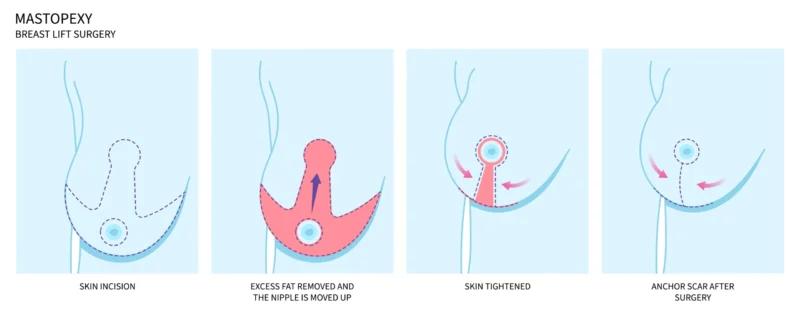
A vertical mastopexy begins with surgical markings. These dictate where the incisions will be made and ensure the final results are symmetrical. After all pre-op tests and screenings are completed and the patient is cleared (X-rays, blood tests), the patient is conducted to the surgery room and the operation starts.
The Surgery: Reshaping, Transposition & Closure
Once the patient is under general anesthesia, the surgical team proceeds through a coordinated series of steps:
- Incision: The surgeon creates the circular incision around the areola and the vertical incision extending down to the chest fold, following the pre-drawn markings.
- Areolar Resizing: If the areolas have stretched over time, they are carefully trimmed down to a standard, aesthetically balanced diameter (typically 4 to 4.5 centimeters).
- Parenchymal Reshaping: The surgeon lifts the deep glandular tissue away from the chest wall, shifts it upward, and secures it to the pectoral muscle using heavy, long-lasting sutures.
- Nipple Transposition: The nipple-areola complex is moved up to its new position. Crucially, it remains attached to its original tissue bed to preserve its blood supply and nerve endings.
- Cutaneous Closure: The surrounding skin is brought together over the newly shaped tissue and closed using deep dermal sutures and fine sub-cuticular stitches, creating a clean, vertical line.
What Kind of Patients Choose a Lollipop Breast Lift?
The vertical or “lollipop” breast lift is specifically for women who need breast elevation but want to avoid scarring as much as possible. The lollipop breast lift does this by eliminating the horizontal incision line along the breast crease of traditional anchor lifts. This reduces overall surgical time to approximately 2 to 3 hours under general anesthesia and drastically cuts down post-operative healing time, while allowing for extensive breast lifting.
Candidates for Vertical Mastopexy
The ideal candidate presents Grade II (moderate) ptosis, where the nipple-areola complex sits at or up to two centimeters below the inframammary fold. Determining whether you are a suitable candidate will require medical tests, screenings and the review of your medical history by a plastic surgeon. Below are the basic indications making you eligible for surgery:
- Diagnosed with Grade II (Moderate) Breast Ptosis
- Adequate skin elasticity to support vertical tightening
- Stable body mass index (BMI) for at least six months
- No active chronical diseases
- Realistic expectations regarding post-surgical scarring
Post-OP Healing and Recovery

Symptoms during the immediate post-operative phase include edema (swelling), mild to moderate bruising, and a sensation of tightness across the chest. During the first 72h post-op, managing pain and stabilizing the surgical area are the primary focus:
- Compression Therapy: The patient is made to wear a compression bra immediately after surgery. This garment must be worn 24 hours a day to minimize fluid retention and support the internal deep sutures.
- Fluid Management: In some instances, surgical drains may be placed beneath the skin to evacuate excess blood or serous fluid.
- Controlled Mobility: While bed rest is advised for the first 12 to 24 hours, patients are encouraged to light walk around their room on day one. This promotes blood circulation and reduces the risk of deep vein thrombosis (DVT).
The First 6-Weeks After Surgery
Following a lollipop breast lift, your body will be healing and changing for months. At first, changes will be very noticeable, whereas as time goes by, they become subtle and almost imperceptible. Final results will only be fully visible 6 to 12 months post-op. The main recovery period are the first 6 weeks post-op, which we summarize as follows:
- Days 7 to 10: Incisions close. Workers who do not perform physical labor can return to light duties.
- Weeks 2 to 3: Swelling begins to subside, and any non-dissolvable sutures are removed. Patients can gradually increase their daily walking, but must avoid lifting anything heavier than 5 kilograms.
- Weeks 4 to 6: The deep internal tissue achieves roughly 80% of its long-term structural strength. After the sixth week, patients can stop wearing the surgical bra and safely resume running, cardio exercise, and strength training.
Long-Term Results & Scar Evolution
Incisions follow a healing process that requires patience and care to surgery practically invisible. In the case of a lollipop breast lift, scar care can be focused entirely on the central axis of the breast:
- Months 1 to 3 (The Inflammatory Phase): The incision lines will appear pink, red, or hyperpigmented, and may feel slightly raised. This is completely normal as the body sends rich blood supply to heal the area.
- Months 6 (The Proliferative Phase): The scars begin to soften and change color, shifting from deep pink to a lighter purple or tan, depending on the patient’s skin tone. The edges of the incision start to flatten.
- Months 12 and Beyond (The Maturation Phase): The scar tissue remodels completely. The lines fade into thin, faint white or silver tracks that are easily hidden beneath standard bras and swimwear. Using topical silicone gels and avoiding direct sun exposure during this first year helps ensure the cleanest aesthetic outcome.
Preserving Results in the Long-Term: The Impact of Aging, Pregnancy, and Weight Fluctuations
A lollipop breast lift permanently removes excess skin and tightens tissue, but it does not stop time or reverse ageing entirely. To maximize your results and make them last the longest, several key lifestyle factors should be maintained (your surgeon will provide a thorough list during the post-op phase). Dr. Engin Öcal remains always at the disposal of former patients for requests, consultations and help:
- Weight Stability: Gaining or losing significant amounts of weight after surgery can stretch the skin envelope once again, leading to secondary sagging.
- No Future Pregnancies: Hormonal changes during pregnancy and breastfeeding cause the breast tissue to expand and contract. Undergo a mastopexy after you have completed your family.
- Consistent Support: Wearing a supportive bra during exercise and daily activities helps reduce stress on the skin and ligaments, preventing premature tissue drop.
Potential Risks & Complications
Like any major surgery, a lollipop breast lift carries risks that patients must understand. Some are common and are easy to solve (often on their own), while other are rare and require immediate attention from your surgeon. Don’t hesitate to contact him or her if you feel any unusual.
Risks and potential complications include:
- Bleeding
- Hematoma
- Seroma
- Infection
- Reduced nipple sensitivity
- Fat necrosis
Lollipop Mastopexy in Turkey at Doku Clinic

Dr. Engin Öcal
Undergoing a breast lift in Turkey requires an advanced clinical environment where patient safety is the absolute priority. At Doku Clinic, all protocols are built around global best practices in plastic and reconstructive surgery. Our strict preparation ensures that patients are ideal candidates for the lollipop technique, reducing risks and paving the way for the best possible outcome.
Dr. Serkan Aygin and Dr. Engin Öcal
The international reputation of Doku Clinic is centered around the authority and excellence of its main medical doctors: Dr. Serkan Aygin and Dr. Engin Öcal. Their commitment to safety, precise surgical planning, and thorough post-operative care shapes the training and performance of the entire surgical team. By combining their experience, scientific knowledge with aesthetic techniques, our clinic ensures that every lollipop breast lift is executed with deep precision, providing patients with natural, long-lasting results.
Combining a Lollipop Lift with Silicone Implants
For patients wanting increased breast volume and not just tissue lifting —often following pregnancy or significant weight loss—, combining the vertical lift with a cohesive silicone gel implant—a procedure known as an augmentation-mastopexy—is the best option. The implant restores volume to the upper breast, while the lollipop lift tightens the skin envelope and raises the nipple to a youthful position. Should you have any questions, don’t hesitate to contact us for a free consultation!
FAQs
What makes the lollipop breast lift different from an anchor lift?
The primary difference lies in the incision pattern and the degree of sagging addressed. The lollipop lift requires two incisions (around the areola and vertically down) and treats moderate sagging. The anchor lift requires a third horizontal incision along the breast fold to remove larger amounts of loose skin in cases of severe sagging.
Will a lollipop breast lift alter my nipple sensitivity?
Changes in sensation are usually temporary. Because the vertical mastopexy preserves the deep tissue attachments and blood supply to the nipple-areola complex, permanent nerve damage is rare. Normal sensation typically returns within a few weeks to months as the local nerves heal.
Can I combine a lollipop lift with breast implants?
Yes. This combination is called an augmentation-mastopexy. It lifts sagging tissue and adds fullness to the upper breast at the same time, addressing both sagging and loss of volume in a single operation.
How long do the results of a vertical mastopexy last?
The structural changes are long-lasting. However, gravity, natural aging, and weight changes will continue to affect your skin over time. You can maintain your results by staying at a stable weight and wearing a supportive bra.
What type of anesthesia is used for this procedure?
A lollipop breast lift is performed under general anesthesia. This ensures the patient remains completely comfortable and asleep throughout the 2 to 3-hour operation.
When can I return to work and exercise after surgery?
Most patients can return to light office work within 7 to 10 days. Strenuous exercise, heavy lifting, and high-impact activities must be avoided for at least 6 weeks to allow the deep internal sutures to heal properly.
Will the scars from a lollipop lift be visible?
Scars are a natural part of healing, but the lollipop technique keeps them discrete by avoiding the horizontal breast crease. The vertical and circular lines fade significantly over 12 months, turning into faint lines that are easily hidden by bras and swimwear.
Is a lollipop breast lift safe if I plan to breastfeed in the future?
Because the vertical technique leaves the milk ducts and nerve connections intact beneath the nipple, many patients can breastfeed successfully after the procedure. However, it is generally recommended to wait until you are done having children to preserve your surgical results.
References
- American Society of Plastic Surgeons (ASPS).Plastic Surgery Statistics Report: Global Trends in Mastopexy and Breast Rejuvenation.
- Regnault, P.Clinical Classification of Breast Ptosis and Surgical Indications. Aesthetic Plastic Surgery Journal.
- LeJour, M.Vertical Mastopexy and Breast Reduction: Technique and Long-Term Results. Plastic and Reconstructive Surgery.