


Breast Implant Rippling: Why It Happens, How to Avoid it & How to Fix It
Last Update:14 August 2026

Written by Doku Clinic’s Editorial Team | Review, Edited and Approved by Dr. Engin Öcal, Chief Plastic, Reconstructive & Aesthetic Surgeon.
Every year, thousands of women run their hands over their chest and feel a sudden, unnatural wave beneath their skin: breast implant rippling. Fixing it means stepping back into the operating room, placing a heavy bet on revision surgery. This bet only pays off with the right implant cohesion, and fat grafting techniques.
Key takeaways:
- Breast rippling implants affect up to 10-12% of patients with older saline devices, though modern cohesive silicone significantly reduces this risk.
- Surgical correction requires precise pre-op tissue mapping, a standard championed by specialists like Dr. Serkan Aygin and Engin Öcal at Doku Clinic.
- Fixing ripples on breast implants often involves a dual approach: implant exchange and targeted lipofilling (fat grafting).
- Verify EBOPRAS and ISAPS credentials before booking any revision surgery—this guide shows you exactly what to look for.
What Is Breast Implant Rippling?
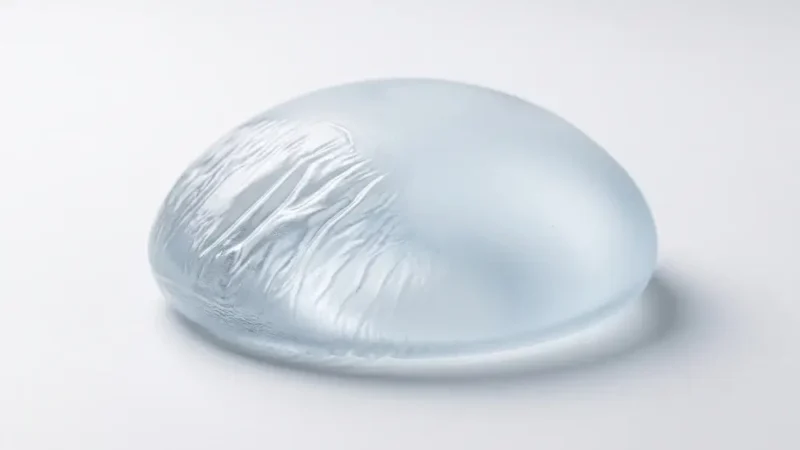
Breast implant rippling takes place when the natural folds of the breast implant become visible through your skin. When an implant is placed inside the breast pocket, it is a gel-filled or fluid-filled envelope. If the envelope folds, and your natural tissue is too thin to conceal it, those folds show on the surface.
The Core Causes Behind Ripples on Breast Implants
Why do some women get flawless, natural results while others struggle with a visible rippling of breast implants? This happens when the foundation of a breast augmentation is weak, or the materials are incorrectly chosen for your body. That’s when the structure shows flaws. Below, we analyze in detail the core reasons why breast rippling implants occur.
1. Patient Anatomy: Tissue Thickness and BMI
Your body composition is the blanket covering the implant. Women with low Body Mass Index (BMI), lacking breast tissue volume, are at higher risk. Without enough fat, there is no buffer to hide the implant’s outer edges.
That’s why, at Doku Clinic, we measure your tissue thickness during consultations. Through a pinch test, we measure whether a large implant is safe for future breast implant rippling.
2. Implant Type and Placement
Older saline implants are notorious for sloshing, deflating, and wrinkling. They are not in circulation at modern clinics.Modern, cohesive silicone implants (often called “gummy bear” implants), hold their shape better and reduce folding.
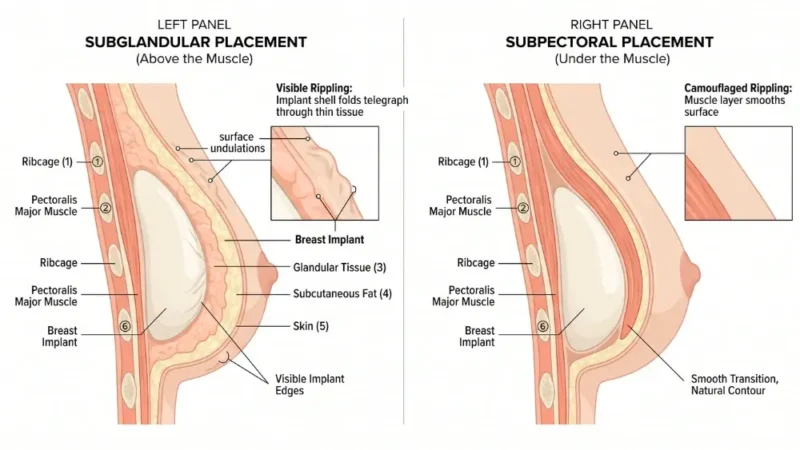
Breast implant placement is equally critical. Placing the implant subglandularly (over the muscle) leaves it moreexposed, covered only by skin and thin breast tissue. Conversely, a submuscular placement (under the pectoral muscle) provides a thick, strong shield that masks ripples on breast implants.
| Decision | High Risk for Rippling | Low Risk for Rippling | Recommendation |
| Implant Fill | Saline (Underfilled or standard) | Highly Cohesive Silicone | Opt for form-stable “gummy bear” silicone implants. |
| Placement | Subglandular (Over the muscle) | Submuscular / Dual-Plane | Muscle coverage provides the best camouflage. |
| Patient Profile | Low BMI / Thin tissue (<2cm pinch) | Moderate BMI / Ample tissue | Use fat grafting (lipofilling) to increase tissue thickness. |
| Implant Profile | Low profile / Wide base | High profile / Narrow base | High profile implants stretch the shell, reducing wrinkles. |
When to Seek Medical Attention for a Rippling of Breast Implant

Dr. Engin Öcal
Noting a slight texture when you lean forward might not be worrisome. However, sudden, visible distortion is alarming. A rippling of breast implant can signal deeper complications that demand immediate attention.
If the rippling is accompanied by pain, firmness, or a sudden change in breast shape, you might be facing capsular contracture or a ruptured saline implant. Such symptoms should never be ignored. Delaying a professional checkcan turn into a highly complex reconstructive surgery.
Advanced Diagnostics
Elite surgical teams refuse to operate blindly based on touch alone. To permanently correct breast rippling implants, at Doku Clinic, we employ advanced diagnostics including high-resolution ultrasounds or MRI scans. They serve to map the integrity of the implant and your surrounding tissue thickness with great accuracy.
Surgical Fixes for Breast Implant Ripples
To correct the issue, revision surgery is often unavoidable, and unfortunately, it is also more demanding than a primary augmentation. A successful operation involves a combination of advanced techniques, addressing the implant itself, the surgical pocket, and your soft tissue coverage. The goal is to engineer a stable foundation that prevents breast implant ripples from ever returning.
1. Implant Exchange
The definitive step in a complex revision is often implant exchange. If you suffer from rippling with older saline or low-profile implants, upgrading to highly cohesive, form-stable silicone is a game-changer. These modern implants maintain their integrity, refusing to collapse or fold under the pressure of your chest muscles.
2. Pocket Modification
However, a new implant alone is not enough if the foundation is flawed. Surgeons frequently perform pocket modification, moving the implant from above the muscle (subglandular) to a safer, deeper position below the muscle (dual-plane breast augmentation). This maneuver provides a rbiological shield, burying the device and masking any ripples on breast implants.
3. Targeted Fat Grafting (Lipofilling) for Smoother Contours
Sometimes, modifying the pocket and changing the implant still leaves the tissue too thin for a flawless result. This is where targeted fat grafting, or lipofilling, comes into play. Surgeons harvest fat from your abdomen or thighs through liposuction, purify it in a centrifuge, and inject it over the breast tissue.
Fat grafting can have surprising effects:
- It creates a thick layer of your own tissue to hide the implant edges.
- Once the fat survives the transfer, the results are long-lasting.
- You achieve body contouring alongside resolving breast implant ripples.
Investing in Expert Correction
Patients quickly realize that fixing breast implant rippling requires a specialized surgeon, and the operation costs more than breast augmentation. Bargain hunting is a terrible idea for such important operation. The cost of a cheap surgery is very likely a third, even more complex operation.
Critical Surgical Credentials
You must never gamble with complex reconstructive procedures. When addressing a severe rippling of breast implant, verifiable medical credentials are your absolute safety net. Always demand to see international board certifications. Elite teams, such as those led by Dr. Engin Öcal and Dr. Serkan Aygin at Doku Clinic, operate under strict safety standards. Look for ISAPS, EBOPRAS, or TPRECD accreditations.
The Importance of Post-Op Aftercare
The operation is only half the battle; your recovery also dictates the outcome. Implementing post-op guidelines diligently ensures that the new implants and fat grafts settle perfectly. This is critical, as it can permanently banish ripples on breast implants .
You must avoid heavy lifting and wear medical compression bras to stabilize the modified breast pocket. By respecting the healing process, you ensure the operation ends with a smooth, natural silhouette.
FAQs
Can breast implant rippling go away on its own?
No, it will not resolve naturally. Breast implant rippling requires medical intervention, such as fat grafting or an implant exchange, to correct the underlying structural mismatch effectively.
Is a rippling of breast implant dangerous?
It is usually a cosmetic issue, but it can be a red flag. Sudden rippling of breast implant might indicate capsular contracture or a shell rupture, requiring prompt medical evaluation.
Does massage help with breast rippling implants?
No, massaging will not fix the structural folding. In fact, aggressive massage on breast rippling implants can irritate surrounding tissues. Surgical correction remains the only definitive, lasting solution.
Which implants prevent ripples on breast implants best?
Highly cohesive silicone implants, often called “gummy bear” implants, are the absolute best choice. Their thick, form-stable gel structure resists the shell folding that causes ripples on breast implants.
How much does it cost to fix breast implant rippling?
Prices vary based on surgical complexity. Fixing breast implant ripples ranges from $5,000 to $12,000+, depending on whether you need targeted lipofilling or a complete implant exchange and capsulectomy.
References
- International Society of Aesthetic Plastic Surgery (ISAPS): Global safety protocols and clinical standards for secondary breast augmentation and complex revision surgeries.
- European Board of Plastic Reconstructive and Aesthetic Surgery (EBOPRAS): Established clinical guidelines for implant selection, tissue pinch thickness evaluation, and submuscular placement techniques.
- Aesthetic Surgery Journal: Peer-reviewed studies on the efficacy of targeted fat grafting (lipofilling) for soft-tissue camouflage in patients with low BMI.
- Doku Clinic Medical Protocols: Pre-operative imaging standards and revision surgery methodologies championed by certified specialists like Dr. Serkan Aygin and Dr. Engin Öcal.