


Breast Augmentation in Turkey: 2026 Doku Clinic Guide
Last Update:8 September 2026
Reviewed and approved by Dr. Engin Öcal, Head Plastic, Aesthetic and Reconstructive Surgeon at Doku Clinic.
From London, Milan or New York, every year, tens of thousands of women travel for a breast augmentation in Turkey. The country has become famous for its experienced surgeons, affordable fees and travel packages. But to avoid risks and surprises, it’s important to know what to ask and what to search for.
In this guide, we provide all insider knowledge to help you make the safest choice. We will go through all breast implant types, how to verify surgeon credentials in Turkey, healing and aftercare standards, and government coverage for international patients.
Key takeaways from this article:
- Breast augmentation in Turkey costs $3,200–$6,500 all-inclusive in 2026
- Since 1 January 2026, complication insurance is mandatory
- You can combine breast implants with body contouring at Doku Clinic
- Breast implant in Turkey are chosen depending on your breast width and tissue quality
The Medical Journey in Turkey at a Glance
| Standard augmentation | $3,200 – $6,500 all-inclusive |
| Stay in Istanbul | 6–7 nights |
| Surgery time | 60–120 minutes, general anaesthesia |
| Usually included | Surgery, implants, hospital, anaesthesia, hotel, transfers, aftercare, complication insurance |
| Not included | Flights, personal meals, optional extra procedures |
| Back to desk work | 7–10 days |
| Final result | 3–6 months |
Before and After Breast Implants in Turkey
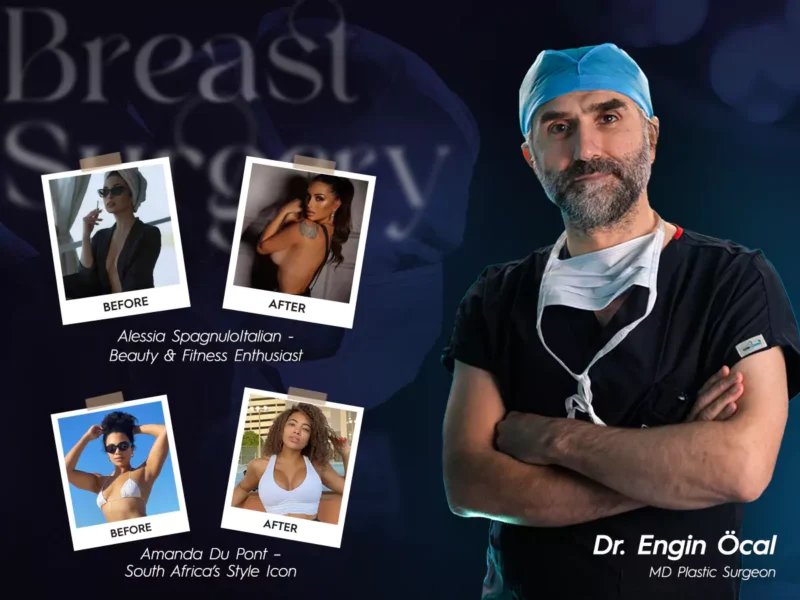
Dr. Engin Öcal
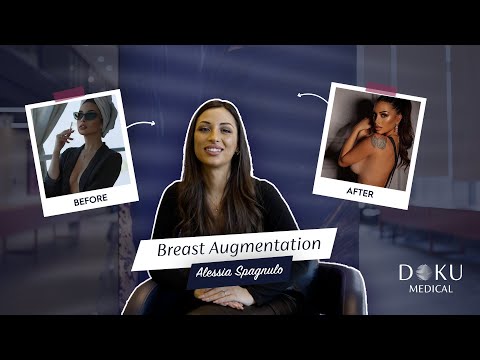
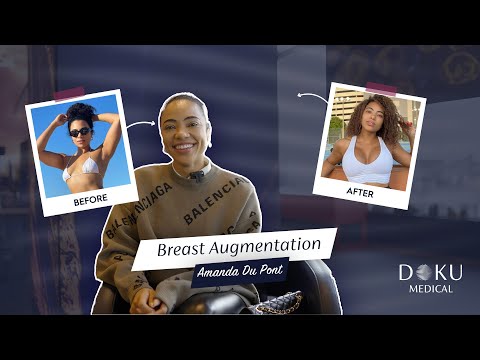
Here is a showcase of Doku Clinic’s breast augmentation in Turkey on 2 public figures, using Mentor and Motiva implants in a variety of shapes and sizes. You can search for similar chest frames to yours to know what you can realistically expect. All operations were conducted by Dr. Engin Öcal at our facility.
Types of Breast Enlargement in Turkey
Mastoplasty is a breast aesthetic surgery that can be performed to correct asymmetries, reconstruct breasts or add volume. Such goals can be achieved through three techniques:
- Breast Implants: breast volume is enlarged with the use of silicone or saline prosthesis.
- Fat Transfer Breast Augmentation: liposuction is performed with fat grafting adding volume to the breasts (with or without additional implants).
- Breast Augmentation and Lift: the breasts are simultaneously lifted to a higher position.
Breast Augmentation in Istanbul at Doku Clinic
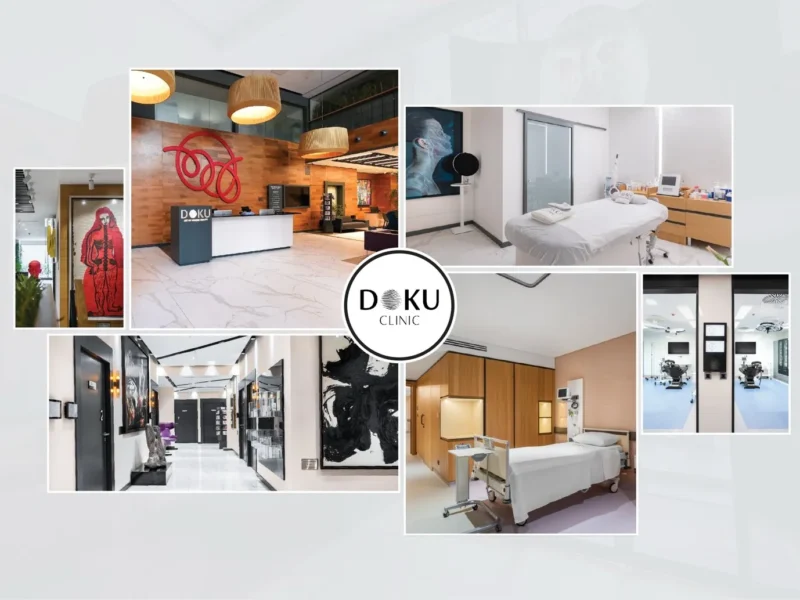
Doku Clinic
Doku Clinic operates as an aesthetic centre with a dedicated breast surgery division covering augmentation, reduction, mastopexy and gynaecomastia. The clinic works under the Turkish Ministry of Health’s regulations, maintaining multiple board-certified Anaesthesia and Reanimation specialists (Dr. Aysun Küçük, Dr. Nilay Aksoy, Dr. Çağatay Metin and Dr. Hakan Haydarlar), alongside Dr. Engin Öcal’s plastic surgery team.
A Message from Our Patients
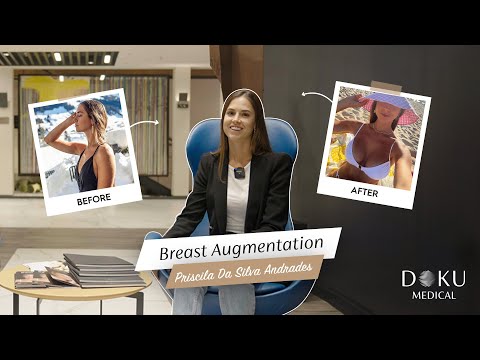
Doku Clinic has been operating in Istanbul for over 10 years. Here are over 1,150 breast augmentation reviews in Turkey, exemplifying our commitment to excellence with a 4.8 star rating.
A key to our success lies in the daily visits our nursing team conducts to medically-equipped hotels, located in the proximity of our clinic. Hosting patients in the vicinity of our medical headquarters guarantees close monitoring and peace of mind.
How Much Does Breast Augmentation Cost in Turkey?
Breast augmentation in Turkey costs an average $3,200 to $6,500 in 2026 for a standard implant procedure, quoted as an all-inclusive package. That normally covers the surgeon’s fee, the implants, hospital and anaesthesia, pre-operative tests, a 5-star hotel stay, VIP transfers and structured aftercare.
Implant brand accounts for much of the spread. A premium fifth-generation implant is more expensive. Surgical complexity is the second driver: correcting asymmetry, working around existing scar tissue or combining augmentation with a breast lift in Turkey.
| Surgery | 2026 price (USD) |
| Standard breast augmentation | $3,200 – $6,500 |
| Augmentation with lift (mastopexy) | $4,200 – $7,500 |
| Fat transfer augmentation | $4,500 – $7,500 |
| Fat transfer only | $3,500 – $6,000 |
| Implant exchange / revision | $4,500 – $8,000 |
What’s Included in a Breast Augmentation Package in Turkey
The appeal of the Turkish model is the all-inclusive package. Before you pay a deposit, ask for the inclusions in writing, itemised, with the implant brand named. The cost of breast augmentation in Turkey should include:
1. Surgery, Hospital and Implants: the surgeon’s fee, the anaesthetist’s fee and the hospital charges, typically one night in a private room. It also covers your implants. It should include pre-operative blood tests, ECG and anaesthesia, plus your post-operative medication: antibiotics, analgesics and a surgical support bra.
2. Accommodation, Transfers and Aftercare: 6 nights in a 4- or 5-star hotel close to the hospital, with breakfast, and private VIP transfers between the airport, hotel and clinic for every appointment. Expect an English-speaking patient coordinator throughout your stay.
Op. Dr. Engin Öcal
Best Surgeon for Breast Enlargement in Turkey
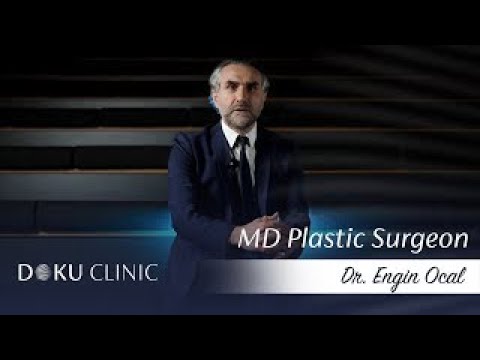
Op. Dr. Engin Öcal is a specialist in Plastic, Reconstructive and Aesthetic Surgery at Doku Clinic in Istanbul. Dr. Öcal graduated from Istanbul University, Istanbul Faculty of Medicine in 2006, and completed his specialisation in Plastic, Reconstructive and Aesthetic Surgery at Hacettepe University Faculty of Medicine between 2006 and 2013 — one of Türkiye’s most demanding academic programmes.
Three credentials carry real weight in Turkish aesthetic surgery. Dr. Engin Öcal possesses all 3:
- TPRECD: the Turkish Board of Plastic, Reconstructive and Aesthetic Surgery.
- EBOPRAS: the European Board of Plastic, Reconstructive and Aesthetic Surgery. A voluntary European quality label earned by passing standardised examinations.
- ISAPS: the International Society of Aesthetic Plastic Surgery.
Choosing Your Breast Implants in Turkey
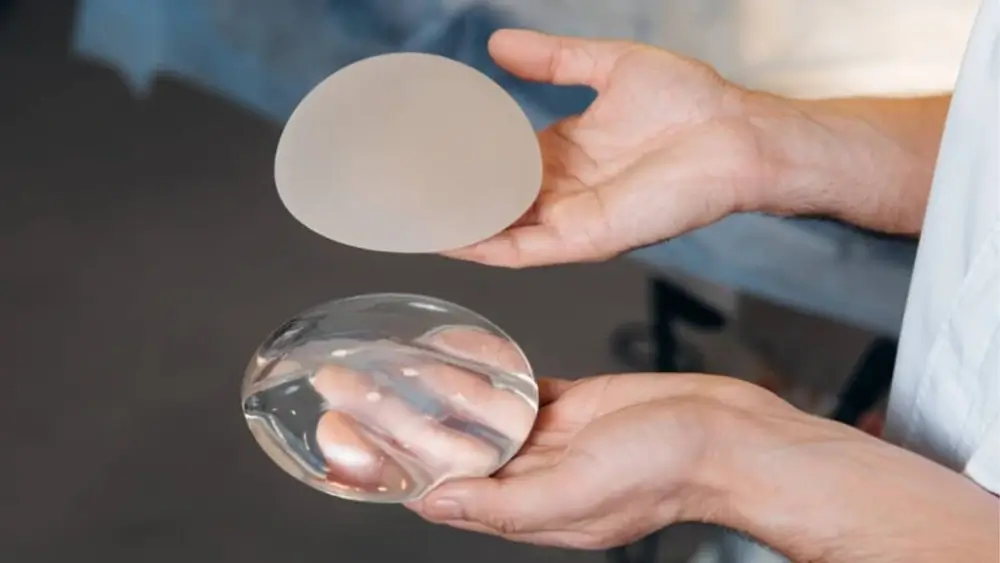
One of the biggest decisions concerning breast augmentation surgery is choosing the type of breast implants you want. The problem is the paradox of choice: there are at least 576 implant combinations depending on volume, shape, material and more.
At Doku Clinic, we work exclusively with Mentor & Motiva implants, established as the best global brands. To help you choose, we will take a detailed look at the following:
- Breast implant volume (100cc to 800cc+)
- Implant shape (round vs teardrop)
- Implant material (silicone vs saline)
- Profiles & projections (low to ultra-high)
- Placement (submuscular, dual plane, subglandular & subfascial)
- Incision (inframammary & periareolar vs. transaxillary)
1. Breast Implant Sizes
Breast implants in Turkey generally fall between 200 cc and 400 cc, with most patients landing around 250–350 cc. As a rough guide, each 150–200 cc corresponds to approximately one cup size.
The final size of your breast implants in Turkey will be agreed with your surgeon after inspecting the prosthesis in various shapes and volumes, at our clinic.
2. Round & Teardrop Shapes
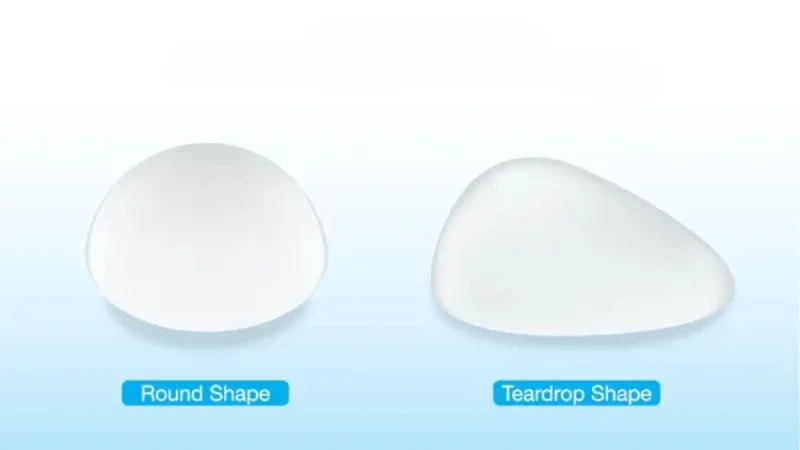
Round vs Teardrop breast implants
Breast implants come in two main shapes: round and teardrop, with round implants accounting for 81% of all procedures in 2025. We will also discuss a hybrid option: ergonomic implants, which get the best of both worlds.
- Round implants: they are symmetrical and achieve more fullness in the upper hemisphere of the breast.
- Anatomical (teardrop) implants: are fuller at the base and tapered at the top, mimicking a natural slope. They require a textured surface to prevent rotation.
- Ergonomic implants: such as Motiva Ergonomix, have a smooth-surface with adaptive gel that behaves like a teardrop upright and rounds when reclining.
3. Silicone Gel vs. Saline Implants
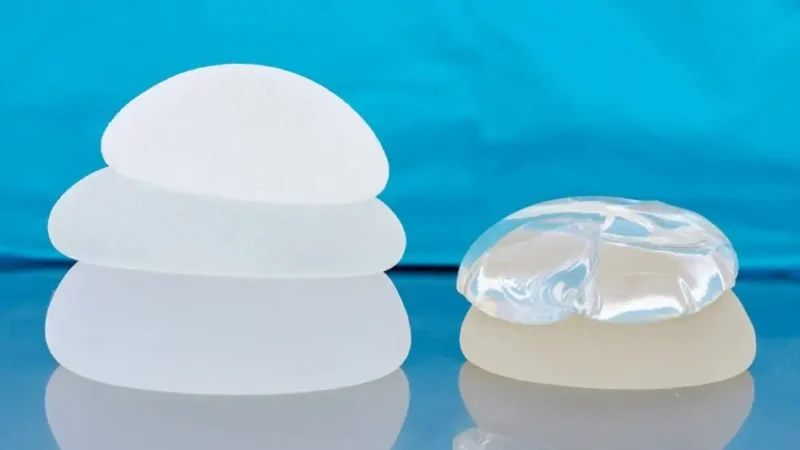
Breast implants are filled with either silicone gel or salt water, with silicone accounting for 90% augmentations worldwide. A third option, structured implants, aims to combine the two.
- Silicone implants: filled with a cohesive gel that closely mimics the weight and movement of natural breast tissue.
- Saline implants: filled with sterile salt water after placement, which allows a smaller incision and volume adjustments during surgery.
- Structured implants: a saline implant built around an internal shell system, designed to feel closer to silicone while keeping the safety profile of a saline fill.
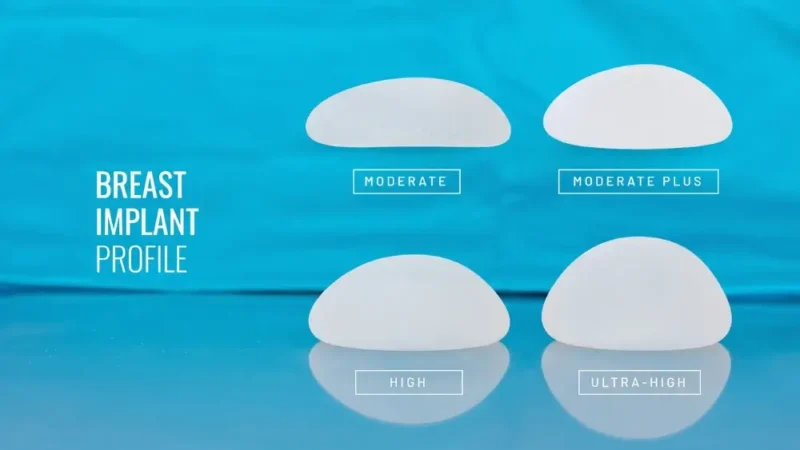
4. Implant Profiles
Profile describes how far an implant projects forward from the chest for a given base width. Two implants of the same volume can look very different depending on this, which is why profile is chosen alongside size.
| Profile | Projection | Best suited to |
| Low / Mini | Minimal | Minimal projection, suited to broader chests. |
| Moderate / Demi | Balanced | Most patients; balanced, for a result that reads natural. |
| High / Full | Pronounced | Greater forward projection, chosen for slimmer chests. |
| Extra high / Corsé | Maximum | Narrow chest wall or a dramatic result |
5. Implant Placement: Submuscular vs Subglandular
Placement refers to the pocket the implant sits in. It affects how natural the result looks, how the breast moves, and how mammogram screening will be later. Tissue thickness, whether you have any sagging, and how active you are — particularly weight training and chest exercise — all feed into this decision.
| Placement | Where the implant sits | Advantages | Trade-offs |
| Subglandular | Above the muscle, behind breast tissue | Shorter recovery, less discomfort, no animation deformity, better for athletes | Higher rippling risk in thin patients; more visible edges; can obscure mammograms |
| Submuscular | Fully beneath the pectoralis major | Best upper-pole coverage, lowest rippling risk, clearer imaging | Longer, more painful recovery; animation deformity when flexing |
| Subfascial | Beneath the fascia over the muscle | Middle ground: some extra coverage without full muscle release | Thin coverage layer; technically demanding; limited long-term data |
| Dual plane | Upper portion under muscle, lower portion behind gland | Muscle coverage where needed plus natural lower-pole expansion | Requires precise release; still some animation effect |
6. Breast Incision Placement
For most patients, the inframammary approach offers the best balance of precision, safety and revisability. Transaxillary suits a narrower group and should be chosen with clear understanding of its limitations.
- Inframammary (IMF): typically 4–5 cm. The most widely used. With the lowest infection rate, it spares the milk ducts, and is the easiest to reopen for future surgery. The scar is hidden in a bra or bikini.
- Periareolar: around the lower edge of the areola. The scar hides well, but it carries a higher risk of capsular contracture and infection, plus a greater chance of altered nipple sensation.
- Transaxillary: leaving no scar on the breast. Appealing, but pocket control is less precise, revision is difficult, and it is generally unsuitable for larger implants or breast lifting.
The Operation Step by Step
Total theatre time is around 60–90 minutes for a straightforward augmentation, extending to 2–3 hours if combined with a lift or fat transfer. You wake in recovery within 30–60 minutes.
you spend one night in hospital, and you are usually walking within hours. The week around it is what requires planning.
1. Consultation, Imaging and Pre-Operative Tests
On arrival in Istanbul, you have your in-person consultation. This is where tyour base width is measured, tissue quality and existing asymmetry assessed, implant volume, profile, placement plane and incision confirmed.
2. Surgery Day
Before surgery, you complete the pre-operative workup: blood tests, ECG and anaesthetic clearance with the anaesthesiologist. You will be asked to stop smoking well in advance, and to pause blood-thinning medication and certain supplements.
Before the operation, the surgeon performs markings while you are standing upright: the inframammary fold position, the midline, the pocket boundaries.
Then, breast augmentation surgery in Turkey such as it is performed at Doku Clinic:
- General anaesthesia is administered
- The incision is made
- The pocket is created.
- Sizers may be trialled to assess symmetry before the final implant is chosen.
- The implant is inserted using a no-touch funnel technique and antibiotic irrigation.
- Closure in layers with dissolvable sutures, followed by dressings and a surgical support bra.
Your First Night in Hospital
You stay one night. Expect tightness, pressure — most patients describe it as similar to an intense chest workout. Pain relief is given along with antibiotics and anti-nausea medication.
You will be encouraged to get up and walk within a few hours. This is one of the most effective measures against blood clots. Most patients eat normally that evening and sleep propped upright at roughly 30–45 degrees, which reduces swelling.
Body Contouring Combined with a Boob Job in Turkey
At Doku Clinic, we perform natural breast augmentation in Turkey, also known as fat transfer breast augmentation. This procedure works by harvesting your own fat through liposuction, and grafting it into the breast (with or without implants).
Grafted fat is partially resorbed, and the final volume shrinks compared to the immediately post-op phase. This procedure has two remarkable advantages compared to a traditional breast augmentation:
- It allows for body sculpting in the tummy, hips, thighs or arms.
- Fat produces a natural breast slope, also masking implant edges and rippling.
Medical Complication Insurance: Included Since 2026
Under the Ministry of Health’s Health Türkiye framework, complication insurance is now mandatory for international patients undergoing surgical procedures, including breast augmentation. Coverage is typically valid for 6 months, and often up to 12 months for plastic surgery.
What It Covers
- Corrective surgery where a complication occurs
- Extended hospital stays caused by a complication
- Diagnostic tests, imaging and medication required to treat it
- Return travel and accommodation for revision
What it does not cover
- Non-compliance with aftercare instructions, including smoking, early exertion or missed follow-up
- Pre-existing conditions not disclosed before surgery
- Treatment at non-accredited facilities
- Treatment outside Turkey
Post-Op Healing and Aftercare
Recovery from breast augmentation in Turkey at Doku Clinic takes roughly one week with daily visits by our nursing staff at your hotel. You will feel largely normal at three weeks and see your actual result at three to six months.
Below, we break down the usual healing timeline.
| Stage | When | What to expect |
| Surgery day | Day 0 | 60–120 min procedure under general anaesthesia; one night in hospital |
| First week | Days 1–7 | Peak swelling and tightness; wound check; short walks; support bra worn continuously |
| Fly-home window | Days 5–7+ | Surgical clearance to travel; compression stockings and in-flight mobility essential |
| Early recovery | Weeks 2–4 | Desk work resumed from days 7–10; discomfort largely resolved; no upper-body exertion |
| Settling | Weeks 4–12 | Implants begin to drop and soften; light exercise reintroduced from ~4–6 weeks |
| Final result | Months 3–6 | Position and shape settle; scars begin maturing (full maturation takes 12–18 months) |
Days 1 to 7
You remain in Istanbul for six to seven nights in total. The first two or three days involve rest, prescribed medication, and short frequent walks. The support bra stays on continuously, including overnight, and you sleep on your back propped up.
Around days 5 to 7 you return for wound review, dressing change and clearance to fly. Restrictions during this week are simple: no lifting above roughly 2 kg, no reaching overhead, no driving, no baths, swimming or submerging the wounds, and no smoking.
When Can You Fly Home Safely?
Clearance to fly is given at 5 to 7 days after breast augmentation in Turkey, although our surgeons may advise waiting around two weeks before short-haul flights and four to six weeks before long-haul travel.
This is a decision to make with your surgeon. Whatever timing you agree, these measures reduce risk:
- Wear graduated compression stockings for the entire flight
- Walk the aisle every hour and perform ankle exercises while seated
- Hydrate continuously; avoid alcohol and excess caffeine
- Wear your surgical support bra throughout the journey
- Keep medication in your carry-on
Risks & Potential Complications
Breast augmentation is one of the most studied operations in plastic surgery and serious complications are uncommon. Even so, every patient should understand what can go wrong before consenting.
1. Capsular contracture: the scar capsule around the implant tightens, causing firmness, distortion or discomfort. It is the most common reason for revision surgery.
2. Implant rupture or deflation
3. Rippling and palpability: folds at the edge of the implant that can be felt or seen
4. Changes in sensation: numbness or heightened sensitivity in the nipple
5. Infection, bleeding and delayed healing: early risks managed with sterile technique, antibiotics and close follow-up.
6. BIA-ALCL: a rare lymphoma associated with certain textured implant surfaces.
Are You a Good Candidate?
Most healthy adults are suitable for breast augmentation. A few conditions make the surgery safer and more predictable:
1. Breast development should be complete, surgery is approved from the age of 182. Stable weight and no uncontrolled diabetes, clotting disorders or active infection, 3. A weight that has held steady for around six months pre-op4. Non-smoker, or willing to stop5. Not pregnant or breastfeeding6. Realistic expectations7. Up-to-date breast screening
If you are unsure where you stand, your photographs and medical history can be assessed remotely before you commit to travelling.
Start Your Journey with Confidence
Choosing to have breast augmentation in Turkey is a significant and exciting decision. With world-class surgeons, advanced techniques, and exceptional patient care, Turkey offers an ideal combination of quality and value for those seeking to enhance their shape and confidence.
At Doku Clinic, we understand that every patient’s journey is personal. From your very first enquiry to your final follow-up, our team is here to guide you with expertise, empathy, and transparency. Whether you’re exploring implant options, considering fat transfer, or simply looking for trustworthy advice, you can rely on our commitment to your safety and satisfaction.
If you’re ready to take the next step, we invite you to book a free online consultation with Op. Dr. Engin Öcal. This is your opportunity to discuss your goals, ask questions, and receive a personalised treatment plan — all from the comfort of your own home.
Contact us today to begin planning your breast augmentation with a trusted expert in Turkey.
FAQs
Is it safe to have breast augmentation in Turkey?
Yes, when you choose carefully. Turkey operates strict health-tourism regulation and hosts many internationally accredited facilities. Prioritise a clinic holding a valid Health Tourism Authorisation Certificate and a surgeon with TPRECD board certification, ideally with EBOPRAS or ISAPS membership.
How much does breast augmentation cost in Turkey in 2026?
A standard augmentation costs $3,200–$6,500 all-inclusive, augmentation with a lift $4,200–$7,500, and hybrid augmentation $4,500–$7,500. Most quotes cover surgery, implants, hospital, anaesthesia, hotel, transfers, aftercare and complication insurance. Flights are extra.
How long do I need to stay in Istanbul?
Plan 6 to 7 nights. You arrive a day before surgery for consultation and pre-operative testing, stay one night in hospital, and are typically reviewed and cleared to fly around days 5 to 7.
How soon can I fly home after breast augmentation?
Clinical clearance is commonly given at 5 to 7 days, though many surgeons advise longer, around two weeks for short-haul and four to six weeks for long-haul.
What implant size will I need?
Most primary augmentations use implants between 200 cc and 400 cc, with roughly 150–200 cc corresponding to about one cup size on an average frame. Your surgeon should measure you in person before finalising volume.
Which is better, Motiva or Mentor?
Neither is universally better. Motiva offers the lowest published complication rates — 0.5% capsular contracture and 0.6% rupture at five years, with zero BIA-ALCL cases. Mentor offers the longest documented track record, FDA-approved since 2006, with extensive ten-year-plus data. Both carry lifetime rupture warranties.
Will I be able to breastfeed after breast implants?
Most women can. Risk to breastfeeding is lowest with inframammary or transaxillary incisions and submuscular or dual-plane placement, since these avoid disrupting milk ducts and glandular tissue.
Do breast implants interfere with mammograms?
They can obscure some breast tissue on standard mammography. Always inform the radiology unit that you have implants so they can use Eklund displacement views. Submuscular placement generally preserves imaging clarity better than subglandular.
How long do breast implants last?
There is no fixed expiry, but they are not lifetime devices. Rupture risk accumulates with age — around 7.8% at ten years in FDA study data — and most surgeons plan for removal or replacement somewhere between 10 and 20 years.
What happens if I’m unhappy with my result?
A medically recognised complication after boob job in Turkey may be covered by the mandatory complication insurance your clinic arranges. Aesthetic dissatisfaction is not covered by that policy — it falls under your clinic’s own revision terms, which you should agree in writing before booking.
Does the clinic staff speak English?
Reputable international clinics provide English-speaking patient coordinators and interpreters throughout, from first consultation through to remote follow-up. Confirm this before booking.
Sources and References
- International Society of Aesthetic Plastic Surgery (ISAPS) — Global Survey on Aesthetic/Cosmetic Procedures, 2024 results (published June 2025).
- American Society of Plastic Surgeons (ASPS) — Plastic Surgery Statistics Report and BIA-ALCL Disease Summary.
- Republic of Türkiye, Ministry of Health — Health Türkiye / USHAŞ health-tourism framework and Health Tourism Authorisation Certificate requirements.
- Turkish Board of Plastic, Reconstructive and Aesthetic Surgery (TPRECD) — certification standards.
- European Board of Plastic Reconstructive and Aesthetic Surgery (EBOPRAS) — certification standards.
- Motiva (Establishment Labs) — Always Confident Warranty and Product Replacement Policy: Terms and Conditions.
- Aesthetic Surgery Journal — hybrid implant and grafted fat breast augmentation outcomes.
- Journal of Plastic, Reconstructive & Aesthetic Surgery — systematic review and meta-analysis of fat grafting volume retention.
- Aesthetic Plastic Surgery — ten-year safety data on silicone gel breast implants; BIA-ALCL epidemiology reviews.