


Subfascial Breast Augmentation: Complete 2026 Patient Guide
Publish Date:7 August 2026
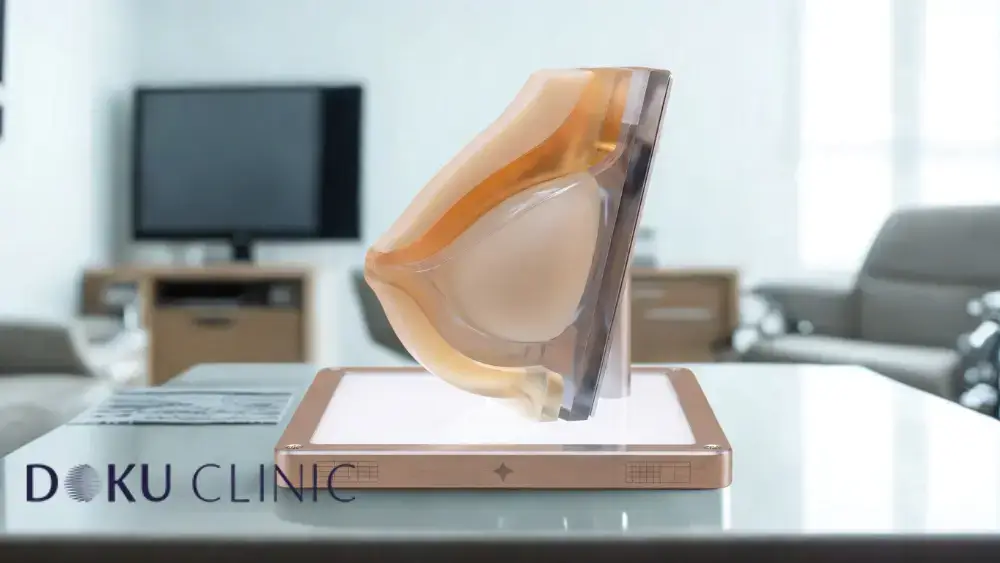
Written by Doku Clinic’s Editorial Team. Reviewed by Dr. Engin Öcal | Head Plastic & Reconstructive Surgeon at Doku Clinic
By utilizing the strong, thin sheet of fascial tissue over the chest muscle, surgeons create a pocket that covers implant borders while avoiding surgical trauma. The result of a subfascial breast augmentation is an elegant, soft silhouette with a faster, les painful recovery. Discover all clinical insights into this vanguard procedure through Dr. Engin Öcal’s personal experience as head plastic surgeon at Doku Clinic.
Key Takeaways:
- Procedure Type: Subfascial placement sits beneath the muscular fascia and above the pectoralis major.
- Aesthetic Benefit: Blunts implant edges in upper poles better than traditional subglandular methods.
- Ideal Candidate: Active women, fitness enthusiasts, and patients with moderate breast tissue.
- Return to Routine: Most patients return to desk work within 3–5 days and light cardio within 2 weeks.
The Anatomy of the Pectoralis Fascia
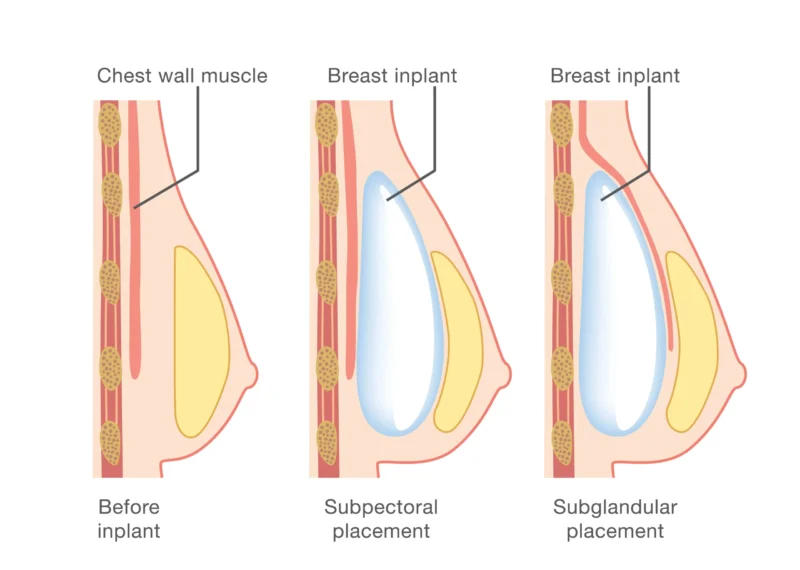
For decades, surgeons debated between placing implants directly under the breast gland or beneath the chest muscle. Subfascial breast augmentation is a middle path using the pectoralis major fascia: a fibrous layer covering the chest muscle.
During a subfascial surgery, your surgeon dissects this anatomical sheet to create a secure implant envelope. By anchoring the breast implant beneath the deep pectoral fascia, the device gains in stability, soft contours, and concealment of implant edges.
How Subfascial Placement Differs from Subglandular and Submuscular
To understand why subfascial breast implant surgery has gained massive popularity in breast augmentation, you must evaluate how surgical planes behave under stress:
- Subglandular: places the implant directly behind the mammillary gland and above the fascia. Avoids muscle trauma, but thin patients often experience visible implant rippling, palpable edges, and higher long-term sag.
- Submuscular: cuts into or elevates the pectoralis major muscle. It causes acute post-operative pain, extended recovery, and potential muscle weakness.
- Subfascial: positions the implant under the fascial membrane but entirely above the muscle tissue. You achieve the camouflage of submuscular placement alongside the gentle recovery of subglandular surgery.
Comparative Pain, Recovery & Disadvantages
The table below summarizes how each pocket plane performs:
| Surgical Plane | Acute Pain Level (1-10) | Average Downtime | Risk of Animation Distortion | Upper-Pole Edge Concealment | Muscle Integrity Preserved |
| Subglandular | Mild (2-3) | 3-5 days | 0% (None) | Poor (in thin patients) | 100% |
| Subfascial | Moderate-Low (3-4) | 4-7 days | 0% (None) | High / Excellent | 100% |
| Dual Plane | High (6-8) | 10-14 days | Moderate (5-10%) | High / Excellent | Partial (Lower edge cut) |
| Submuscular | Severe (7-9) | 14-21 days | High (15-25%) | Maximum | Disrupted / Elevated |
Who Is the Ideal Candidate for Subfascial Augmentation?

Dr. Engin Öcal
Subfascial breast surgery represents a leap forward in cosmetic breast surgery, but patient selection remains vital for optimal outcomes. You are usually an good candidate for subfascial breast enlargement if you have:
- Moderate breast tissue: Enough pinch-test thickness (typically 1.5 to 2 cm) in the upper breast to combine with the fascia for implant
- Athletic or active lifestyle: You regularly lift weights, practice yoga, run, or engage in chest-engaging sports and cannot afford muscle damage or prolonged downtime.
- Primary breast augmentation: You want soft, natural upper-breast cleavage without risking implant displacement when flexing your chest muscles.
- Mild to moderate skin elasticity: Your native skin tone is firm enough to support the implant within the tight fascial pocket.
Why Active Women and Athletes Prefer the Subfascial Approach
For patients with fitness routines, submuscular or dual-plane breast augmentation surgery comes with the big disadvantage of animation deformity. During bench presses, push-ups, or yoga poses, the muscle squeezes the implant outward causing visible breast distortion.
Through subfascial breast augmentation, Dr. Engin Öcal places the implant both above the pectoral muscle and under the pectoralis fascia. This shields the muscle from surgical trauma while isolating the implant from muscle movements.
Why Skinnier Patients Prefer the Subfascial Breast Augmentation
Historically, thin patients were pushed toward submuscular implants to hide implant borders under thick muscle.However, the subfascial approach provided a new solution.
The pectoral fascia is a tight envelope. When stretched over the upper hemisphere of a breast implant, it softens lines, blunts rippling, and holds the upper border in place. This guarantees the soft, natural contours of submuscular placement without requiring muscle dissection.
Benefits and Safety Of Subfascial Breast Implants
The benefits of this specific technique are therefore many. Below, we indicate the most important ones, as praised by our own patients in Doku Clinic.
1. Capsular Contracture Rates and Long-Term Stability
Capsular contracture occurs when the immune system forms a tight scar capsule around the breast implant, causing hardness, discomfort, or distortion. Medical literature confirms a rate of only about 1% during subfascial breast augmentation. By securing the implant in a clean, vascularized fascial envelope above the muscle, surgeons achieve long-term stability while minimizing tissue disruption.
2. Elimination of Animation Deformity
With subfascial implant placement, animation deformity is completely eliminated (0% incidence). This is because the pectoralis major muscle remains untouched. Muscle activation during chest workouts occurs underneath the implant without placing any pressure on it.
This means your breasts maintain a natural shape, soft movement, and complete harmony during exercise or daily movement.
3. Pain Reduction and Faster Recovery
Because subfascial breast surgery preserves 100% of the muscle structure, acute post-oper pain is reduced by 50% to 70% compared to submuscular methods.
- Immediate mobility: Patients experience less surgical shock, allowing them to lift their arms comfortably within 24 to 48 hours.
- Reduced medication reliance: Post-op discomfort is easily managed with mild, non-opioid analgesics.
- Rapid return to work: Most patients comfortably resume remote or light desk work within 3 to 5 days post-surgery.
Subfascial Breast Augmentation Surgery: Step-by-Step

Doku Clinic
A successful breast augmentation surgery relies on surgical precision, anatomical mapping pre-op, and attentive careafter the operation. Below, we explain the typical procedure as it is performed by Dr. Engin Öcal at Doku Clinic.
Pre-Operative Assessment and Implant Selection
A successful subfascial breast augmentation begins before entering the operating room. Pre-op planning ensures that the chosen implant volume, profile, and texture match your proportions and fascial density.
Dr. Engin Öcal conducts the following mapping process:
- Pinch-test: Measuring soft-tissue depth at the upper breast to confirm the fascia provides adequate coverage.
- Chest wall analysis: Evaluating ribcage symmetry, sternal dynamics, and native breast parenchyma volume.
- 3D imaging simulation: Visualizing different implant sizes and profiles (smooth vs. textured, round vs. ergonomic) in real time to establish expectations.
- Medical clearances: Routine blood work, mammography or breast ultrasound screenings, and an absolute review of your surgical history.
During Surgery: The No-Touch Technique and Pocket Creation
On the day of surgery, the procedure is performed under general anesthesia. The surgery is undergone methodically step-by-step, minimizing infection risks and prioritizing patient safety:
- Incisions: Typically made within the infra-mammary fold (IMF) to ensure the scar is hidden in the natural breast crease.
- Fascial plane dissection: The surgeon identifies the border between the breast gland and the pectoralis major fascia, carefully elevating the sheet to create an exact implant
- Hemostasis and irrigation: High-definition electrocautery controls minor bleeding, followed by antibiotic triple-solution pocket irrigation to clear microscopic debris.
- No-Touch Keller Funnel: The breast implant is inserted into the subfascial pocket using a sterile sleeve, eliminating direct skin-to-implant contact and reducing bacterial contamination risks.
- Multi-layer closure: The fascial sheet, subcutaneous tissue, and skin are closed with absorbable sutures to ensure minimal tension.
Post-Op Healing and Medical Aftercare
The immediate hours and weeks following subfascial breast surgery dictate how smoothly your tissues settle around the new implants.
The post-op instructions provided by Dr. Engin Öcal include:
- Wearing a medical surgical bra 24/7 for the first 4 to 6 weeks to stabilize implant position and reduce swelling.
- Light walking is encouraged from Day 1 to promote circulation; however, heavy lifting (over 5 kg) and high-impact sports must be avoided for 4 weeks.
- Applying medical-grade silicone gels or sheeting starting 2 to 3 weeks post-op to ensure soft, flat scar maturation.
- Scheduled check-ins with the medical team atDoku Clinic to evaluate healing progress, stitch absorption, and tissue softening.
Critical Safety, Certifications, and Red Flags
Prioritizing patient safety, surgical credentials, and medical standards is essential when planning a breast augmentation. Ensuring your medical team holds accredited international certifications guarantees that your treatment adheres to rigorous global health and safety.
At Doku Clinic, surgical protocols are designed and reviewed under the guidance of Dr. Engin Öcal and Dr. Serkan Aygin, ensuring every patient receives care aligned with strict European and international surgical standards.
Surgical Licensing and Credentials (ISAPS, EBOPRAS, TPRECD)
Verifying your surgeon’s credentials protects you against unqualified practitioners and unaccredited environments. Board-certified plastic surgeons undergo extensive post-graduate training and rigorous examinations before operating independently.
When reviewing surgical qualifications for subfascial breast augmentation, ensure your surgeon holds active memberships in key professional bodies:
- ISAPS (International Society of Aesthetic Plastic Surgery): The leading global body for board-certified aesthetic surgeons, requiring continuous safety education and adherence to global surgical ethics.
- EBOPRAS (European Board of Plastic Reconstructive and Aesthetic Surgery): Demonstrates that the surgeon has passed standardized European board examinations for specialist plastic surgery.
Essential Questions to Ask During Your Consultation
Asking these questions during your pre-operative assessment helps you confirm your surgeon’s expertise with the subfascial technique and evaluate their commitment to safety.
- How many subfascial breast augmentations do you perform annually?
- What specific criteria determine whether my tissue thickness is suitable for the subfascial plane?
- Which implant brand, profile, and surface texture do you recommend for my proportions, and why?
- What touchless insertion techniques (such as the Keller Funnel) do you use to reduce infection risks?
- What is your specific protocol and coverage policy in the rare event of post-operative complications?
FAQs
How long does recovery take after subfascial breast augmentation?
Most patients return to work in 3 to 5 days and resume full workouts within 4 to 6 weeks. Because the chest muscle remains completely untouched, acute pain is minimal. Heavy lifting and high-impact sports require 4 to 6 weeks of healing.
Will subfascial placement interfere with future mammograms or breast screenings?
No, subfascial implants do not block breast cancer screenings. Radiologists use standard Eklund displacement views to push the implant back and pull native tissue forward. Because the implant sits beneath the fascial layer rather than inside the breast gland, tissue visualization remains clear.
Can I still breastfeed after subfascial breast surgery?
Yes, subfascial placement preserves your ability to breastfeed. The surgical route—especially through an inframammary fold incision—bypasses the breast tissue entirely. The milk ducts, glandular tissue, and nipple nerves remain intact, allowing normal lactation and nursing post-surgery.
How does subfascial placement prevent implant rippling?
The dense fascial sheet covers and smooths the implant’s upper edges. By placing the implant beneath the strong pectoralis fascia, surgeons create a structural layer over the device. This tensioned membrane blunts visible borders and prevents rippling without needing to dissect muscle.
Is subfascial breast augmentation suitable for very thin patients?
Yes, provided you have at least 1.5 cm of upper-pole tissue. During evaluation, a pinch test measures upper-pole thickness. If your natural tissue measures 1.5 cm or more, the fascia provides excellent coverage. Thinner patients may require a dual-plane approach.
Do subfascial implants ever need to be replaced?
Modern implants do not require routine replacement unless a medical complication occurs. Cohesive silicone implants are designed for long-term durability with lifetime warranties against ruptures. You only need revision surgery if you experience capsular contracture, device failure, or desire a size change.