


Periareolar Incision Breast Augmentation: Complete Patient Guide
Last Update:5 August 2026
Reviewed by: Dr. Engin Öcal | Plastic, Reconstructive & Aesthetic Surgeon
For patients who refuse the scar beneath the breast fold, periareolar breast augmentation stands as an attractive plastic surgery. But deciding to reshape your body with breast implants involves balancing your dreams against medical reality. The nipple-areola is the most delicate breast tissue and carries risks from sensation changes to lactation and permanent scarring. We detail all important information from Dr. Engin Öcal’s experience as lead plastic surgeon at Doku Clinic.
Key takeaways from this article:
- Precision Technique: Directly accesses breast pocket tissue through the lower semicircle of the areola.
- Anatomical Requirement: Requires an areolar diameter of at least 3 to 3.5 cm for safe implant delivery.
- Cost: Average costs range from $4,500 to $12,000 depending on region, surgical complexity, and facility accreditations.
- Safety Protocols: Requires board-certified surgical mastery (EBOPRAS, ISAPS) to preserve nipple sensation and lactation.
What Is the Periareolar Incision Technique?
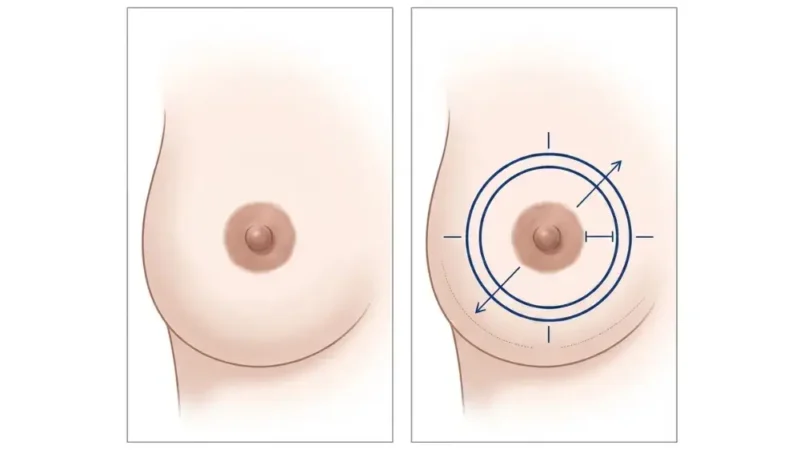
Periareolar breast augmentation is a cosmetic breast surgery where the surgeon creates a semi-circular incision along the lower half of the areola (the darker skin surrounding the nipple). The resulting scar blends into the color line.
Through the opening, our plastic surgeons create a pocket to insert the breast implant. This approach offers exceptional visibility, allowing precise positioning and symmetry.
Who Is the Ideal Candidate?
The physical prerequisite for periareolar breast augmentation is having a big enough areola to accommodate the implant without tearing or distorting the tissue.
A patient must have a natural areolar diameter of at least 3.0 to 3.5 centimeters. If the areola is too small, pushing an implant through the restricted opening can cause micro-tears along the margins, leading to uneven scar.
- Areola Size: Minimum 0–3.5 cm diameter.
- Tissue Elasticity: Skin capable of tension-free closure.
Periareolar vs. Inframammary Fold (IMF) Incision
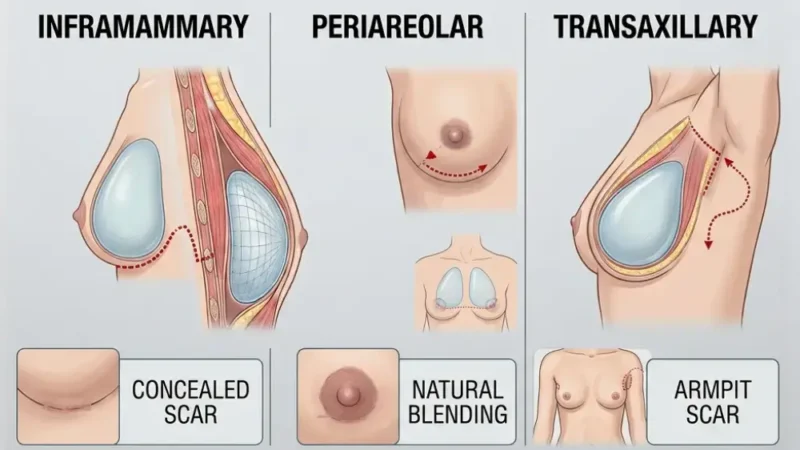
The inframammary fold (IMF) incision is placed in the crease under the breast. It’s the most common approach worldwide because it bypasses glandular tissue, leaving a scar that is invisible when lying flat or wearing bikinis.
In contrast, periareolar incision breast augmentation leaves a more discreet scar. However, because the cut navigates closer to the milk ducts and nerves, it requires higher precision from the surgeon.
Periareolar vs. Transaxillary (Underarm) Incision
The transaxillary incision places the entry point in the armpit, leaving the breast entirely untouched. However, transaxillary procedures are very technically complex, offering limited direct vision of the inner breast.
The periareolar approach offers the surgeon direct line-of-sight to the breast anatomy. This enables better symmetry correction, exact pocket creation, and easier adjustment of the breast crease.
Breast Implant Incision Comparison
| Criteria | Periareolar Incision | Inframammary (IMF) | Transaxillary |
| Scar Concealment | Highest (blends with areolar color boundary) | Moderate (hidden in natural crease) | High (hidden away in armpit crease) |
| Surgical Control | Very High (direct visualization of pocket) | Maximum (easiest pocket creation) | Moderate (requires endoscopic assistance) |
| Nipple Sensation Risk | Slightly Higher (10–15% transient change) | Lowest (bypasses nerves) | Low (bypasses glandular nerves) |
| Glandular Dissection | Yes (navigates through or beside glands) | No (goes directly under tissue) | No (enters via axillary channel) |
| Simultaneous Lift Option | Yes (periareolar lift/mastopexy) | No (requires separate incisions) | No (cannot perform lift simultaneously) |
Dual-Plane vs. Submuscular vs. Subglandular Pocket Placement
The choice of pocket placement determines how natural your implants feel and how they hold up over time. During a periareolar breast augmentation, your surgeon navigates through the entry point to create one of three anatomical pockets:
- Dual-Plane Placement: The upper portion of the implant sits under the pectoralis major muscle, while the lower portion sits directly behind the breast gland. This is the standard for most patients because it provides soft, natural transitions while preventing visible implant edges.
- Submuscular (Subpectoral) Placement: The implant is placed entirely beneath the chest muscle. This provides maximum coverage and is ideal for thin women with minimal natural tissue, reducing rippling risks.
- Subglandular Placement: The implant sits directly behind the breast tissue and above the chest muscle.Recovery is often slightly faster, but it requires sufficient breast tissue to cover the implant.
The Advantages of the Periaerolar Technique
The periareolar technique is often chosen for its aesthetic subtlety and surgical utility:
- Discreet Scarring: The boundary between areolar tissue and lighter breast skin naturally masks healing lines.
- Combined Mastopexy (Donut Lift): For patients experiencing mild sagging (ptosis), surgeons can remove a ring of surrounding skin (periareolar mastopexy) through the same opening to lift the nipple while adding volume.
- Tuberous Breast Correction: It provides direct access to release tight lower-pole constriction bands common in tuberous breast conditions.
Potential Risks & Complications

Doku Clinic
Every surgical procedure involves medical disadvantages as well as risks. The periareolar approach works closer to internal glands, so patients must understand the following:
- Nipple Sensation Changes: Temporary numbness or heightened sensitivity occurs in 10% to 15% of patients during early healing. Permanent sensation loss is rare (under 2%) when performed by experienced board-certified plastic surgeons.
- Breastfeeding & Lactation: The incision crosses near glandular tissue, so there is a small risk of disrupting minor lactational ducts. Women who plan to breastfeed in the future should discuss this thoroughly with their surgeon.
- General Surgical Risks: As with any breast surgery, risks include hematoma formation, asymmetry, or capsular contracture (occurring in roughly 3% to 5% of primary cases over 10 years).
What is the Cost of Periareolar Augmentation?
Periareolar breast augmentation costs between $4,500 and $12,000 in markets like the US and UK, while international clinics like Doku Clinic offer comprehensive procedures ranging from $3,000 to $6,000 in all-inclusive travel packages.
Price Ranges and Value
| Region | Estimated Cost Range (USD) | Included Services |
| United States & Canada | $8,500 – $14,000+ | Base surgical fee, local facility, basic follow-up |
| United Kingdom & EU | $7,000 – $11,500 | Consultations, standard implants, hospital fees |
| Turkey (Doku Clinic) | $3,500 – $6,000 | All-inclusive (implants, hospital, medications, transfers) |
What Factors Influence Price?
The final price of your procedure reflects a combination of factors:
- Surgeon Expertise:The fees of board-certified specialists reflect proven safety track records.
- Implant Brand:Premium micro-textured or ultra-cohesive silicone gel implants backed by lifelong manufacturer warranties carry higher base costs.
- Facility & Anesthesia Standards:Full general anesthesia delivered in accredited hospital suites with intensive care unit (ICU) support increases operating expenses.
- Aftercare Protocols:Post-operative surgical bras, follow-up evaluations, scar treatment therapies, and specialized recovery medications.
Essential Board Certifications to Verify (ISAPS, EBOPRAS, National Boards)

Dr. Engin Öcal
Because periareolar incision breast augmentation requires manipulating delicate nerves and glandulars, surgeon qualifications are critical. Always verify that your surgeon holds recognized board certifications before committing to surgery:
- International Society of Aesthetic Plastic Surgery (ISAPS): The leading global body for accredited aesthetic plastic surgeons, ensuring strict adherence to patient safety protocols.
- European Board of Plastic Reconstructive and Aesthetic Surgery (EBOPRAS): Standardizes high-level surgical qualifications across European medical frameworks.
- National Plastic Surgery Boards: Verify active registration with national medical councils (such as TPRECD in Turkey, ASPS in the US, or BAAPS in the UK).
Implant Types & Modern Placement
Today’s breast surgery standards rely on cohesive silicone gel implants (often called “gummy bear implants”) that maintain their shape even if the outer shell is compromised.
To ensure safety during a periareolar incision breast augmentation, top surgical clinics like Doku Clinic use sterile no-touch delivery funnels (such as the Keller Funnel).
- Reduced Skin Contact: The funnel guides the implant through the small periareolar opening without direct contact with skin flora.
- Lower Infection Rates: Clinical studies show that no-touch sleeve insertion significantly lowers bacterial contamination risks.
- Minimizing Complications: Decreasing surface contamination dramatically reduces the long-term risk of capsular contracture (hardened scar tissue around the implant).
Red Flags to Avoid Before Booking
To ensure your transformation is safe, predictable, and stress-free, look out for these p9o’`¡safety red flags during initial consultations:
- Unverified Facility Accreditation: Avoid clinics operating in outpatient facilities without full hospital accreditation or emergency ICU backup.
- Lack of Pre-Operative Diagnostics: High-standard surgical teams always perform pre-op bloodwork and mammograms or breast ultrasounds before entering the operating room.
- No Direct Consultation with the Surgeon: You should discuss your anatomical goals directly with your operating plastic surgeon, not exclusively with sales reps or coordinators.
- Vague Pricing Packages: Medical estimates should clearly detail surgeon fees, hospital charges, anesthesia, implant warranties, and aftercare kits without hidden extras.
Post-OP Recovery & Aftercare: What to Expect
A successful recovery depends on following your surgeon’s post-op guidelines as much as it does on surgical mastery. Following a clear recovery protocol helps protect your scar lines and ensures implants settle naturally.
- Days 1–5 (Immediate Post-Op): You will wear a specialized compression bra 24/7 to control swelling and stabilize implant positioning.
- Week 2 (Stitch Removal & Daily Activity): If non-dissolvable sutures were used, they are removed during this phase.
- Weeks 4–6 (Exercise & Settling): Light cardio can resume, though heavy lifting and upper-body workouts should be avoided until week 6.
- Months 3–6 (Scar Maturation): The periareolar incision shifts from a faint pink line to a pale, concealed tone. Applying medical-grade silicone gel or sheets helps accelerate scar softening.
Long-Term Maintenance and Implant Longevity
Modern cohesive silicone gel implants are built to last for decades, but ongoing care is essential to preserve your long-term results:
- Annual Breast Health Checks: Schedule routine mammograms or ultrasounds to monitor both implant integrity and natural tissue health.
- Weight Stability: Maintaining a stable weight preserves skin elasticity and long-term symmetry around the periareolar scar.
- Implant Warranty Protection: Keep your manufacturer warranty cards and serial numbers on file for ongoing peace of mind.
Free Medical Consultation
If you are exploring whether periareolar breast augmentation aligns with your aesthetic goals and physical anatomy, expert guidance is essential.
Schedule a Free Consultation Today: Contact our surgical team to receive a confidential assessment of your options, expected outcomes, and cost breakdown.
FAQs
Does periareolar breast augmentation leave a visible scar?
The periareolar incision is designed specifically for maximum scar concealment. Because the incision is placed precisely along the natural boundary where the darker areola meets the lighter breast skin, the resulting line blends into your natural pigmentation over 3 to 6 months, becoming virtually invisible.
Can I still breastfeed after periareolar implant surgery?
Yes, in most cases. Experienced surgeons carefully preserve the underlying lactational ducts and nerve structures. However, because the incision is closer to the breast tissue than an inframammary fold (IMF) incision, there is a minor risk of duct disruption. If breastfeeding in the near future is a primary priority, discuss this with your surgeon during your consultation.
What is the minimum areola size required for this procedure?
An ideal candidate needs a natural areolar diameter of at least 3.0 to 3.5 centimeters. This provides enough clearance for the surgeon to insert the implant smoothly without over-stretching or tearing the delicate surrounding skin edges.
Will I lose sensation in my nipples after a periareolar incision?
Temporary numbness or altered sensitivity is common during early healing, affecting roughly 10% to 15% of patients. Permanent loss of nipple sensation is rare—occurring in less than 2% of cases when the surgery is performed by a qualified, board-certified plastic surgeon.
How long is the recovery period before I can return to work?
Most patients return to light routines within 5 to 7 days. Driving and daily errands are sually safe after 7 to 10 days once pain medication is no longer needed. Strenuous exercise and heavy lifting must be avoided for 4 to 6 weeks.
What is the difference between submuscular and subglandular placement?
In submuscular placement, the implant sits beneath the chest muscle, providing maximum tissue coverage, smoother upper-breast transitions, and lower risks of visible implant edges. In subglandular placement, the implant sits directly behind the breast tissue, offering faster recovery but requiring adequate tissue to cover the implant.
References & Clinical Literature
- International Society of Aesthetic Plastic Surgery (ISAPS).Global Survey on Aesthetic/Cosmetic Procedures. Clinical Data Analysis, 2024–2025.
- Adams, W. P., et al.The Keller Funnel and No-Touch Technique in Breast Augmentation: Infection Rates and Capsular Contracture Reduction. Aesthetic Surgery Journal, 2022.
- European Board of Plastic Reconstructive and Aesthetic Surgery (EBOPRAS).Standard Guidelines for Patient Safety in Cosmetic Breast Surgery, 2025.
- American Society of Plastic Surgeons (ASPS).Periareolar vs. Inframammary Incisions: Comparative Sensation and Scar Assessment Studies, 2023.