


Understanding Breast Ptosis: Clinical Grades and Treatment Options
Last Update:15 July 2026
In body contouring, a staggering 75% of women list sagging breasts as their main concern during consultation. Breast ptosis (sagging breasts) affects up to 80% of women as they age or after pregnancy or weight loss. This undesirable condition is caused by genetics, hormonal shifts, and tissue changes that require a surgical eye to fix.
In this guide, we reveal the causes of sagging boobs, how plastic surgeons map the nipple relative to the inframammary fold, and expert insights from Dr. Engin Öcal’s practice at Doku Clinic.
What is Breast Ptosis? The Science Behind Sagging Breasts
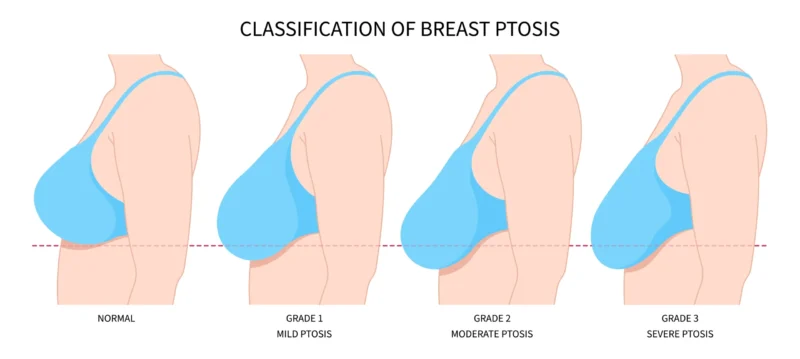
Breast ptosis is the downward displacement of the breast parenchyma (the functional breast tissue) and the nipple-areola complex (NAC) relative to the inframammary fold (IMF). When the structural support fails, the breast migrates downward under the pull of gravity.
At Doku Clinic, evaluating the exact reasons of breast sagginess is the first step in treating this entirely natural conditionwidely studied in modern plastic surgery.
Cooper’s Ligaments and Saggy Boobs
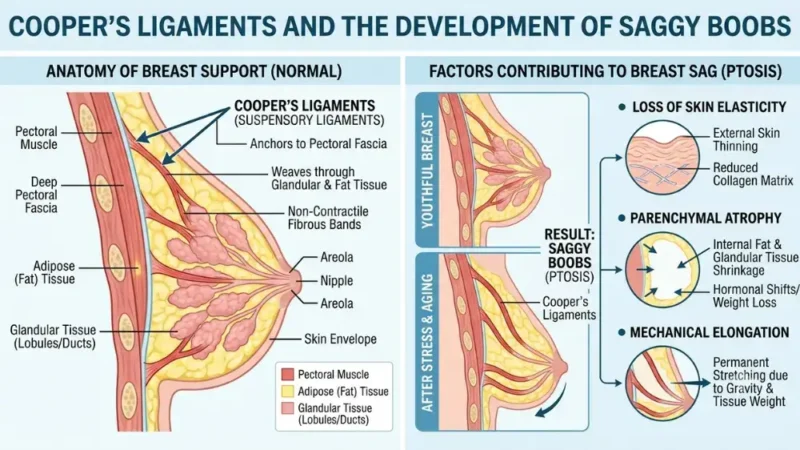
Cooper’s ligaments are fibrous bands that weave through the breast parenchyma, anchoring it directly to the pectoral fascia (the deep chest muscle lining). Ligaments are not contractile; once they are stretched over time, they cannot shrink back to their original size.
When Cooper’s ligaments undergo prolonged stress, a visible change occurs:
- Loss of Skin Elasticity: The external skin envelope thins and loses its collagen matrix, failing to provide external tension against gravity.
- Parenchymal Atrophy: Hormonal shifts or significant weight loss cause the internal fat and glandular tissue to shrink, leaving an empty skin envelope.
- Mechanical Elongation: The continuous weight of the breast tissue causes a permanent stretching of the suspensory ligaments, causing the look of saggy boobs.
The Regnault Classification: Breast Ptosis Degrees
Plastic surgeons worldwide use the Regnault Classification Scale to measures the exact location of the nipple-areola complex (NAC) in relation to your inframammary fold (IMF).
Through the use of this guide, surgeons like Dr. Engin Öcal can determine whether a patient requires a simple lift, structural remodeling, or combined volume restoration.
| Ptosis Grade | Nipple Position Relative to the Inframammary Fold (IMF) | Structural Characteristics of the Breast | Typical Surgical Approach |
| Grade 1 (Mild) | At the level of the IMF (within 1 cm) | The nipple sits exactly at or just slightly below the lower crease line. | Periareolar lift or crescent mastopexy. |
| Grade 2 (Moderate) | 1 to 3 cm below the IMF | The nipple sits lower than the crease, but remains above the lowest contour of the breast tissue. | Vertical (lollipop) mastopexy. |
| Grade 3 (Severe) | More than 3 cm below the IMF | The nipple points completely downward and lies at the absolute lowest point of the breast silhouette. | Inverted-T (anchor) mastopexy. |
| Pseudoptosis | Above the IMF | The nipple remains properly positioned high up, but the lower breast tissue drops and sags underneath. | Auto-augmentation or cohesive implants. |
Grade 1 Ptosis
It represents the earliest stage of sagginess, where the nipple drops within 1 centimeter. Patients at this stage often notice a minor loss of fullness, but the overall breast mass still sits relatively high on the chest wall. It is frequently caused by postpartum changes or slight shifts in tissue elasticity.
Grade 2 Ptosis
We now progress to moderate descent, where the nipple sits between 1 and 3 centimeters below the inframammary fold. This level of descent is common after more significant weight shifts or natural aging.
Grade 3 Ptosis
The most advanced clinical stage of sagging breasts. The nipple falls more than 3 centimeters below the inframammary crease line and points directly toward the floor. At this stage, the nipple sits at the absolute lowest point of the entire breast projection
Causes and Risk Factors for Sagging Breasts
Developing saggy boobs is driven by cumulative strains on the skin envelope and internal tissue. At Doku Clinic, our medical specialists carefully evaluate each patient’s physical history to isolate these underlying causes.
How Pregnancy, Weight Fluctuations, and Aging Alter Elasticity
The natural aging process acts as the catalyst for sagging breasts. Over time, your body undergoes a steady decrease in cellular collagen and elastin fiber. This progressive thinning of the dermal layer leaves the skin envelope increasingly fragile and less capable of counteracting the effects of gravity.
Beyond natural aging, physiological life events introduce profound shifts in your breast anatomy:
- Pregnancy and Lactation Cycles: Hormonal surges during pregnancy cause the glandular tissue to expand rapidly, stretching the skin envelope. When the postpartum phase ends and milk production ceases, this tissue undergoes rapid involution (shrinking), leaving behind an empty, stretched skin sac.
- Massive Weight Fluctuations: When fat is lost quickly, the internal volume disappears, but the overstretched skin envelope cannot contract backward, producing a deflated appearance.
- Smoking: Cigarette smoke releases toxic chemicals that destroy elastin fibers. This reduces skin elasticity by nearly 40% over time, drastically accelerating breast ptosis.
Modern Surgical Techniques for Breast Ptosis

Doku Clinic
When breast tissues stretch permanently, breast surgery becomes the only effective method to lift sagging breasts. This plastic surgery is known as a mastopexy. The primary goal of a mastopexy is to raise the nipple-areola complex, gather loose breast tissue, and reduce the dimensions of an overstretched skin envelope.
Surgeons like Dr. Engin Öcal utilize precise geometric measurements to customize each lift to the patient’s existing anatomy. By reshaping the internal tissue mound, plastic surgery restores a youthful shape and structural firmness that matches your natural body contours.
Mastopexy Incisions: Periareolar, Vertical, and Anchor Styles
The specific incision chosen for your breast lift surgery depends on your ptosis grade. Each approach is designed to balance lifting with minimal scarring.
- Periareolar (Donut) Incision: Ideal for mild Grade 1 ptosis or pseudoptosis, allowing for minor adjustments to the nipple height and slight tightening of the skin envelope.
- Vertical (Lollipop) Incision: The standard approach for moderate Grade 2 ptosis, providing significant lifting and reshaping without requiring a horizontal scar.
- Inverted-T (Anchor) Incision: This technique is reserved for severe Grade 3 ptosis, allowing the surgeon to remove maximum excess skin and reconstruct a heavily dropped breast.
Combining Breast Lift with Implants
A standard mastopexy can reposition tissue, but it cannot create internal volume. For patients who experience severe deflation after weight loss or nursing, a standalone lift may leave the upper portion of the chest appearing flat. To address this issue, a combined procedure known as an augmentation-mastopexy is our recommended option.
By placing a silicone gel implant beneath the chest muscle while simultaneously performing an external skin lift, surgeons can correct saggy boobs and restore youthful fullness at the same time.
Post-Op Recovery and Care
The healing phase following a mastopexy requires careful stabilization of the repositioned breast tissues while protecting the incision lines. At Doku Clinic, our surgical teams provide comprehensive, step-by-step recovery support to all patients. Following these instructions prevents the stretching of new scars and ensures the long-term integrity of your breast lift.
- Support Garments: Patients must wear a medical-grade compression bra continuously for the first 4 to 6 weeks.
- Activity Restrictions: Heavy lifting, overhead reaching, and physical exercises must be avoided entirely for a minimum of 4 weeks.
- Sleeping Positions: Sleeping flat on the back with the upper body slightly elevated is required for the initial 3 to 4 weeks. This posture reduces localized edema (swelling) and prevents accidental pressure or lateral shifting of the healing breast mounds.
FAQs
Can chest exercises or workouts reverse breast ptosis?
No, chest exercises cannot reverse breast ptosis. Exercises like push-ups or chest presses strengthen the underlying pectoral muscles, which can slightly improve the projection of the chest wall. However, breasts are composed of glandular tissue, fat, and connective bands called Cooper’s ligaments, containing no muscle fibers.
How does smoking affect sagging breasts?
Smoking actively destroys collagen and elastin fibers, which are vital for maintaining skin tension. Research shows smoking can reduce skin elasticity by up to 40%, accelerating tissue descent.
What is the difference between breast ptosis and pseudoptosis?
The difference lies entirely in the position of the nipple-areola complex relative to the inframammary fold. In true breast ptosis, both the breast tissue and the nipple drop below the lower crease line. In pseudoptosis, the nipple remains in a normal, youthful position well above the fold, but the lower breast tissue loses internal volume and sags downward, creating an illusion of overall sagging.
Will undergoing a mastopexy affect my ability to breastfeed in the future?
In most cases, modern mastopexy techniques preserve the internal blood supply and nerve connections to the nipple, allowing women to breastfeed successfully. However, if a severe case requires extensive tissue rearrangement or free nipple grafting, some milk ducts may be disrupted.
Is it necessary to combine a breast lift with implants to treat saggy boobs?
It is not always necessary. A standalone mastopexy is very effective if you have enough breast tissue and simply wish to lift and tighten the skin envelope. However, if your breasts have lost significant volume due to massive weight loss or post-pregnancy, a lift alone may leave the upper breast looking flat.
How long do breast lift results last for?
A mastopexy permanently lifts your breasts, but it cannot stop the natural aging process. The longevity of your results depends mostly on skin quality, life habits, and weight stability. Patients who maintain a stable weight, wear supportive bras, and avoid smoking can expect their breast shape to last for many years.