


Skinny BBL: Liposculpture for Lean Bodies – Doku Clinic
Last Update:24 June 2026

The Skinny BBL — a specialised form of glute liposculpture — was built for lean body types: patients who want rounder glutes and an hourglass silhouette, using only 500–800cc of fat per side. On this page, we share our clinical knowledge regarding the procedure, its techniques, healing and recovery.
What Is a Skinny BBL?
The Skinny BBL is a gluteal fat transfer designed for patients with a lean or athletic body type. Using liposuction, surgeons collect small amounts of fat from multiple sites across the body, redistributing them with body sculpting to create a refined silhouette.
Glute Shapes, Body Types & What a Skinny BBL Can Achieve
Understanding your natural body type helps set realistic goals and helps your surgeon design an approach that works with your frame.
The Five Butt Shapes
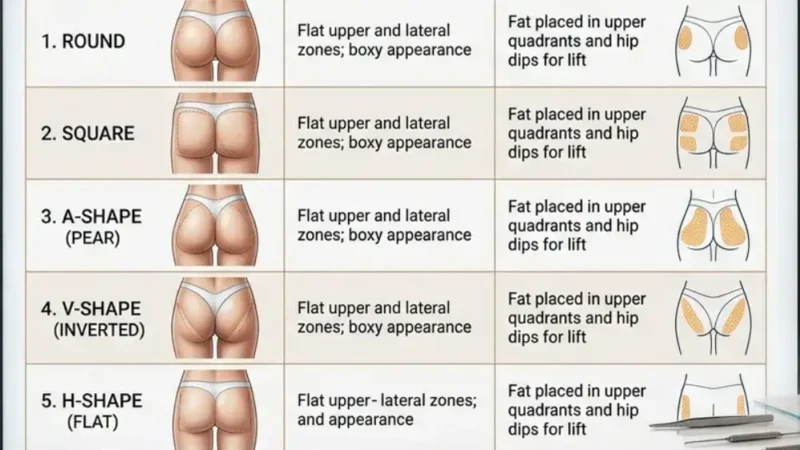
Surgeons assess gluteal shape as part of pre-operative planning. For lean patients, the square, V-shape, and H-shape are most common — and all three respond well to the Skinny BBL.
Each shape responds differently to fat transfer:
| Shape | Characteristics | Skinny BBL Approach |
| Round | Full, even projection — the “ideal” reference point | Maintain and refine; minimal intervention needed |
| Square | Flat upper and lateral zones; boxy appearance | Fat placed in upper quadrants and hip dips for lift |
| A-shape (Pear) | Wider lower buttock; narrow upper zone | Volume added to upper and lateral areas to balance |
| V-shape (Inverted) | Fuller upper zone; narrow lower; common in lean patients | Lower and lateral placement for grounding and roundness |
| H-shape (Flat) | Minimal projection overall; prominent hip dips | Multi-zone placement; hip dip correction prioritised |
The Four Main Body Types
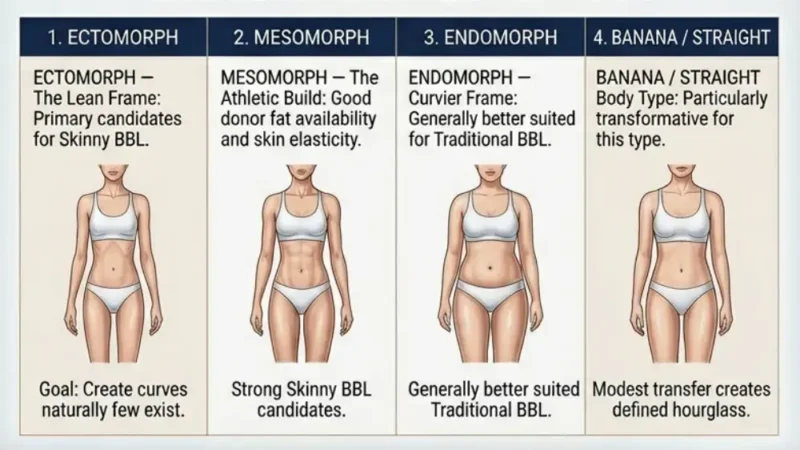
- Ectomorph — The Lean Frame: Ectomorphs are the primary candidates for Skinny BBL — the procedure was essentially developed with this body type in mind. The goal: create curves where the body naturally produces very few.
- Mesomorph — The Athletic Build: Mesomorphs typically have good donor fat availability and excellent skin elasticity, making them strong Skinny BBL candidates.
- Endomorph — Curvier Frame: Endomorphs are generally candidates for traditional BBL rather than Skinny BBL.
- Banana / Straight Body Type: The Skinny BBL is particularly transformative for this body type — even modest fat transfer produces a more defined hourglass line.
Skinny BBL Surgery at Doku Clinic
The Skinny BBL at Doku Clinic is performed under general anaesthesia, in a fully equipped surgical facility, by board-certified plastic surgeons. Understanding what takes place before, during, and immediately after your Skinny BBL helps you arrive prepared, confident, and with realistic expectations of what the process involves.
Initial Consultation
Your first meeting with the surgical team is a two-way conversation. Dr. Öcal will examine your fat distribution across all donor sites — pressing, pinching, and mapping the abdomen, flanks, lower back, inner thighs, and upper arms to assess both volume and tissue quality.
Physical assessment is combined with a review of:
- Your full medical history and any current medications
- Lifestyle factors including smoking status, exercise habits, and weight history
- Your aesthetic goals — what you want to see, what you do not want
Medical Clearance
You will arrive at Doku Clinic fasted (nothing to eat or drink for 6–8 hours prior). The surgeon will map exactly where fat will be removed and where it will be placed. A series of medical tests will take place to ensure you’re safe for the procedure:
- Full blood panel
- Electrocardiogram (ECG)
- Blood pressure, BMI, and general health assessment
- Anaesthesiology pre-assessment
The Operation
Skinny BBL surgery is performed under general anesthesia, with surgery using lasting for 2 to 4 hours. You will be asleep during the entire procedure, which is completely painless. Once you wake up in a hospital room, medication will be administered to ease any discomfort.
1. Anesthesia & Infiltration
Before liposuction begins, right after anesthesia is administed, a tumescent solution is injected inside your body. This makes extraction easier and more precise, it numbs the tissue locally, and it constricts blood vessels to reduce bleeding.
2. Fat Harvesting
Dr. Öcal makes small 3–5mm incisions at each donor site and fat is suctioned using 2mm micro-cannulas. For Skinny BBL patients, this stage demands particular care. With limited fat available, you need enough fat to achieve the desired body shape without over-extracting and causing skin irregularities.
3. Fat Processing
Immediately after harvesting, the fat undergoes purification. At Doku Clinic, only the purified, highest-viability fat cells are prepared for injection. For Skinny BBL patients, maximising the quality of every cubic centimetre is entirely necessary.
4. Sculpting the Donor Areas
While the fat is being processed, the surgeon refines the liposuction result with active body sculpting. The waist is narrowed, the flanks are defined, the lower back is smoothed with a 360° approach.
5. Fat Injection
The purified fat is loaded into small syringes and injected into the buttocks and hips using fine cannulas. Fat is placed exclusively in the subcutaneous layer, above the gluteal muscle. The total volume injected will be 20–30% higher than the intended final result.
6. Closure & Compression
Each donor site incision is sutured and covered with sterile dressings. A medical-grade compression garment is fitted immediately — covering the liposuction areas to support skin retraction, reduce swelling, and maintain the sculpted contour as healing begins.
Recovery & Post-Operative Care at Doku Clinic
Recovery from a Skinny BBL at Doku Clinic is not a lonely process. The clinic’s team walks you through at every stage, from the moment you leave the operating room. What follows is to help you know what to expect, and why each phase matters.
The First 24 Hours
You will wake from surgery in a recovery suite, where nursing staff monitor your vital signs, pain levels, and compression garment.
- You will be positioned face-down or on your side
- A compression garment will already be fitted
- Light, supervised walking is encouraged within hours
- You will remain at the clinic overnight
Week 1
The first seven days are the most critical window for fat cell survival. Transferred fat cells are establishing their blood supply — any pressure, heat, or physical disruption at this stage can destroy them.
- Sleep and rest exclusively face-down or on your side
- Use your BBL pillow at all times when seated
- Wear your compression garment 24 hours a day
- Pain is typically mild to moderate
- Walk gently for 5–10 minutes every few hours
Week 2
By day 7–10, most patients feel meaningfully better. Energy returns, bruising fades, and swelling begins to reduce visibly at donor sites.
- Most patients return to light desk work
- Lymphatic drainage massage
- The compression garment remains on for all waking hours
- Short walks can be extended to 15–20 minutes, two to three times daily
- Mild soreness at donor sites when moving is normal and expected
Weeks 3–4
This is the phase where patients begin to see early results — and also the phase where many are tempted to return to normal life too quickly. Resist that temptation.
- Sitting restrictions begin to ease
- Swelling continues to reduce; the shape of the buttocks and hips becomes more defined
- Light lower-body stretching may be introduced with clearance from your surgeon
- Return to driving is typically possible, provided you use the BBL pillow at all times in the seat
- Sleep position can begin to transition from strictly face-down to side sleeping
Weeks 5–8
The compression garment schedule typically transitions to daytime only by week 6, with nights no longer required. This marks a significant shift in comfort and daily routine.
- Light cardiovascular exercise
- Swelling at donor sites is largely resolved
- Avoid high-impact activities (running, jumping, heavy lifting)
- Continue lymphatic drainage massage as advised
Months 3–6
This is when the real result reveals itself. The fluffing stage — generally between months 3 and 6 — is when residual post-surgical swelling fully resolves and the transferred fat cells complete their integration with surrounding tissue. Many patients notice their results appearing to improve, soften, or fill out during this window.
- Final results are considered stable from month 6 onwards
- Glute-strengthening exercises — squats, hip thrusts, Romanian deadlifts, glute bridges — are actively encouraged from month 3.
- Full return to sport, training, and physical activity is cleared
- The 6-month follow-up with your Doku Clinic surgeon is the definitive result assessment
How Much Fat Is Transferred in a Skinny BBL?
In a traditional BBL, surgeons typically transfer 600–1,200cc per side. In a Skinny BBL, the typical range is 500 to 800cc per buttock, with a focus on proportion and natural shape. Some surgeons recommend gaining between 2 and 5kg to increase fat reserve, though not all patients need it.
When working with a slim patient, even just a few hundred cc’s can make a huge difference. The round and attractive shape that slim women are looking for does not require a high volume of fat to create, and is very achievable at their normal weight.
Surgeons also intentionally overfill by 20–30% at the time of transfer to compensate for the fat reabsorption that occurs during healing — so the immediate post-operative volume will always appear larger than the final result.
| Procedure Type | Fat Transferred Per Side | Typical Candidate |
| Mini / Skinny BBL | 200–400cc | Very lean; subtle enhancement goal |
| Standard Skinny BBL | 400–600cc | Lean with moderate donor fat availability |
| Skinny BBL + 360° Lipo | Up to 700–800cc | Lean with multi-site fat reserves |
How Much Does a Skinny BBL Cost?
The cost of a skinny BBL can greatly vary depending on the clinic, surgeon and country where it takes place. In Turkey, for example, patients can access the best plastic surgeons in the country for $3,500, compared to around $8,000 in the US and £7,500 in the UK.
| Procedure | United Kingdom | United States | Turkey (Doku Clinic) |
| Mini / Skinny BBL (200–400cc) | £6,000–£8,500 | $7,000–$10,000 | €2,800–€3,800 |
| Standard Skinny BBL (400–600cc) | £8,500–£12,000 | $10,000–$13,000 | €3,200–€4,500 |
| Skinny BBL + 360° Liposculpture | £12,000–£16,000 | $13,000–$18,000 | €4,500–€6,500 |
Who Is the Skinny BBL Designed For?
At Doku Clinic, the pre-surgical assessment focuses on what your body can offer, not on what it lacks. A patient with a BMI of 20 and well-distributed fat pockets across the flanks and inner thighs may be a stronger candidate than someone with a higher BMI and poor skin elasticity. Numbers alone tell an incomplete story.
Your Body Needs to Meet These Conditions
- Fat availability across multiple sites
- Skin that can adapt
- Weight that has been stable
- A BMI of 19 or above
- Freedom from nicotine
- Goals grounded in proportion
Potential Risks & Complications
| Risk | Likelihood | How Doku Clinic Minimises It |
| Fat embolism | Rare but serious | Subcutaneous-only injection; ultrasound guidance |
| Infection | Low | Sterile facility; prophylactic antibiotics |
| Asymmetry | Moderate (minor) | Pre-operative 3D planning; surgeon precision |
| Fat necrosis | Low–moderate | Gentle harvesting; post-op pressure avoidance |
| DVT | Low | Early mobilisation; compression stockings |
| Insufficient fat survival | Variable | Advanced processing; strict aftercare protocol |
Modern BBL mortality rates stand at approximately 1 in 14,952 — dramatically improved from 1 in 3,000 in 2017 — a transformation driven entirely by the adoption of subcutaneous-only injection standards now followed at every reputable clinic, including Doku.
How Much Fat Remains Permanently on the Buttocks?
Fat survival rates in Skinny BBL typically range from 60–80%, meaning if 500ml is injected per side, approximately 300–400ml will remain permanently after the body absorbs some transferred cells during healing.
What Influences How Much Stays
| Factor | Why It Matters |
| Processing technique | Closed-system filtration preserves up to 85–92% cell viability before injection |
| Injection method | Micro-deposits maximise surface area contact with blood supply |
| Smoking status | Nicotine reduces vascular supply to healing fat — survival drops by 40–50% |
| Post-op pressure | Sitting directly on the buttocks in the first weeks physically destroys fat cells |
| Weight stability | Significant loss after surgery reduces transferred fat volume proportionally |
| Overall health | Good circulation and nutrition support cell integration |
Op. Dr. Engin Öcal — Plastic Surgeon at Doku Clinic
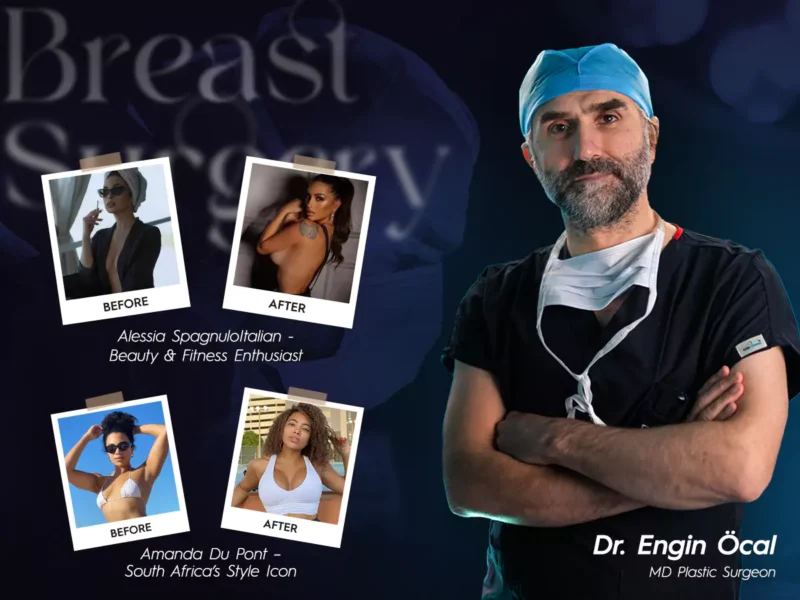
Dr. Öcal also holds a European Diploma in Plastic and Reconstructive Surgery, awarded in Belgium in 2014, and is a European Fellow in Plastic, Reconstructive and Aesthetic Surgery — with written examinations in Brussels and oral examinations in Helsinki.
At Doku Clinic
Dr. Öcal plays a key role in Doku Clinic’s rise to international recognition, with advanced training from Europe and extensive experience in facial and body aesthetics. At Doku, he leads body contouring procedures with a philosophy built on three principles: personalisation, precision, and proportion.
Areas of Specialization:
- Body contouring and liposculpture
- Brazilian Butt Lift (BBL) and Skinny BBL
- Rhinoplasty (primary and revision)
- Breast augmentation and reduction
- Face and body lifting procedures
FAQs
Can I have a Skinny BBL if I’ve lost weight on Ozempic or Mounjaro?
Yes — and you may be an ideal candidate. GLP-1 medications often cause loss of gluteal volume specifically. The Skinny BBL, or AlloClae fat grafting for patients with very limited donor fat, is an increasingly sought-after solution for restoring shape after medication-related weight loss.
How long do I need to stay in Istanbul after my Skinny BBL?
Most patients plan for 7–10 days in Istanbul. This covers the surgical day, one night of clinical observation, and the first post-operative follow-up appointments before flying home.
What happens if not enough fat survives after my procedure?
Some fat reabsorption is expected and accounted for — surgeons overfill by 20–30% at the time of transfer. If results after 6 months are below expectations, a refinement procedure can be discussed. Your Doku Clinic team will monitor your progress at every follow-up.
Is the Skinny BBL suitable for patients who exercise a lot?
Yes — in fact, active patients often maintain results exceptionally well. From month 3 onwards, targeted glute-strengthening exercises (squats, hip thrusts, Romanian deadlifts) are actively encouraged to enhance projection and support long-term shape.
Can a Skinny BBL correct hip dips?
Yes — hip dip correction is one of the most requested outcomes among slim patients and one of the most reliably achievable. Strategic fat placement in the lateral hip zone smooths the contour and creates a continuous, natural curve from waist to thigh.
How soon will I see my final results?
Initial results are visible within weeks, but final outcomes settle at the 6-month mark once swelling has fully resolved and transferred fat has integrated. The period between months 3 and 6 — often called the “fluffing stage” — is when most patients notice their results softening and filling out naturally.
Book Your Free Consultation at Doku Clinic
If you have been wondering whether a Skinny BBL is possible for your body type, the most honest answer comes from a conversation — not a website. Book your free consultation with the Doku Clinic team today, and let Op. Dr. Engin Öcal assess exactly what your anatomy can achieve.