


Inframammary Incision Breast Augmentation: High-Volume Natural Results
Publish Date:4 August 2026
Written by the Editorial Team of Doku Clinic. Reviewed, edited and approved by Dr. Engin Öcal | Plastic, Reconstructive and Aesthetic Surgeon.
Choosing breast augmentation is an emotional investment in confidence, control, and body harmony. Done with precision, the inframammary incision allows from high projection implants, hidden scarring, and precise implant positioning; done carelessly, it can lead to asymmetry, revision surgeries, and bottoming-out risks. This guide explores all medical details with expert insights from Dr. Engin Öcal, head surgeon at Doku Clinic.
Key points:
- Over 80% of global breast augmentations use the inframammary incision due to direct visual access and pocket control.
- Scars sit precisely within the natural inframammary fold (IMF), rendering them virtually invisible.
- Safety & EEAT:Protocols backed by leading surgical authorities like EBOPRAS and ISAPS ensure rigorous safety standards.
What Is the Inframammary Incision in Breast Augmentation?
The inframammary incision is the most popular surgical technique for placing breast implants. In this type of breast surgery, the surgeon makes a horizontal cut 3 to 5 centimeters long within the lower crease of the breast. The incision aligns with the fold underneath the breast, so the scar is invisible to the naked eye.
Suitability and Patient Selection
The inframammary approach is suitable for a vast majority of patients. However, a medical consultation with our plastic surgeons is required to establish your suitability.
- Ideal Candidates: Patients with enough breast tissue to hide the scar beneath the inframammary fold, those seeking medium to high-volume implants, and candidates undergoing revision mammoplasty.
- Special Considerations: Very young patients with extremely tight skin or minimal natural breast tissue projection may require special incision placement to ensure the scar settles in the crease as the breast matures.
Advantages of the Inframammary Approach

Dr. Engin Öcal
Choosing the inframammary fold (IMF) technique for breast augmentation comes with clear advantages. These will explain to you clearly why the inframammary incision is the most popular technique employed by surgeons worldwide:
1. Direct Visual Access
Inframammary incisions grant the plastic surgeon an unobstructed, line-of-sight view of the chest wall. This is crucial during breast surgery for several key reasons:
- Micro-accurate pocket creation: Surgeons can craft the exact pocket required for silicone gel implants or saline implants, ensuring they stay centered.
- Meticulous cauterization: Direct vision allows control of small blood vessels, decreasing post-op hematoma and seroma
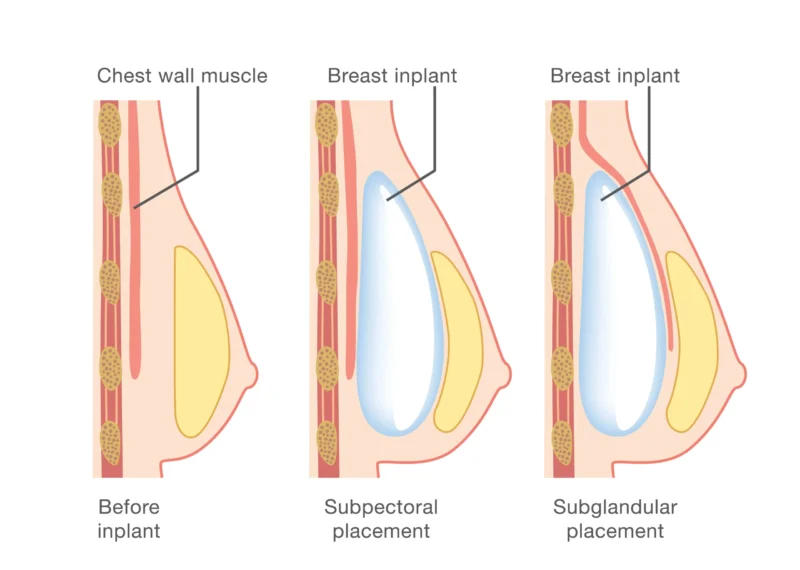
- Dual-plane flexibility: It allows seamless access for positioning implants either subglandularly (over the muscle) or subpectorally (under the pectoral muscle).
2. Symmetrical Positioning
Direct line of sight allows the surgeon to measure and create the lower breast border with mathematical symmetry, preventing improper drop-and-fluff.
3. Maximum Safety
Surrounding chest structures, muscle attachments, and lymphatic drainage channels remain uncompromised.
Inframammary vs. Periareolar vs. Transaxillary Incisions
Selecting the right incision is one of the most critical decisions in breast augmentation. Alternatives exist (such as periareolar and transaxillary), yet the inframammary incision remains the standard for patient safety, predictability, and doctor control.
| Criteria | Inframammary Incision | Periareolar Incision | Transaxillary Incision |
| Direct Visual Access | Maximum (100%) | Moderate (50–60%) | Limited (Requires Endoscope) |
| Pocket Creation Precision | Millimeter-Accurate | Moderate | Lower Control |
| Scar Hideability | Hidden in Natural Crease | Edge of Areola | Armpit Fold |
| Nipple Sensation Risk | Minimal (<1%) | Higher (10–15%) | Minimal (<2%) |
| Capsular Contracture Risk | Lowest Rate | Higher (Bacterial Flora) | Low-Moderate |
| Implant Size Capacity | Full Range (Including High Volume) | Restricted by Areola Size | Restricted by Tunnel Access |
| Revision Surgery Access | Direct & Simple | Difficult / Scarring | Extremely Difficult |
Why the Inframammary Fold Outperforms its Alternatives
The inframammary incision is often considered superior because it offers clear benefits in regards with other alternatives. Here is a more detailed look at these.
1. Preserved Lactation & Nipple Sensation
The inframammary approach bypasses the glandular breast tissue and nipple-areolar complex. The surgeon alsoavoids the nerve pathways responsible for nipple sensation. In contrast, periareolar incisions cut through breast tissue, increasing the likelihood of permanent numbness or altered sensitivity.
2. Lower Capsular Contracture Rates
Capsular contracture is an abnormally tight scar tissue capsule that forms around a breast implant, leading to firmness, discomfort, and/or distortion. The inframammary incision avoids contact with glandular tissue, socontamination is reduced to almost zero.
3. Versatility for Modern Implants
Modern techniques use cohesive silicone gel implants, ergonomic gels, or high-volume profiles. The inframammary incision allows surgeons to utilize No-Touch tools (such as the Keller Funnel), which protects the implant case, preserves sterility, and enables the most precise possible placement of high-volume implants without overstretching skin.
Healing Time & Post-Op Care
At Doku Clinic, we accompany our patients throughout the entire process, ensuring the inframammary fold scar matures into a thin, barely noticeable line while the implants settle into their natural position.
Phase 1: Days 1 to 7
The first week focuses on protecting the surgical site, managing swelling, and ensuring proper tissue adhesion. Most patients return to desk work and light daily routines within 5 to 7 days.
- Compression Garment: Patients must wear a surgical bra 24/7 to keep implants stabilized in their pockets.
- Wound Dressings: The inframammary incision is kept protected under sterile waterproof tape, allowing gentle showering.
- Activity Restrictions: Heavy lifting (over 5 kg), driving, and raising arms above shoulder height must be strictly avoided.
Phase 2: Weeks 2 to 6
During this middle stage, internal tissues adapt to the implant volume, and external wound healing completes. Light walking can resume at week 3, but weight workouts and high-impact sports must wait until week 6 (at least).
- Suture Removal / Dissolution: Most closures use absorbable sutures, eliminating the need for painful stitch removal.
- Silicone Therapy: Starting around week 3, medical-grade silicone gel or silicone sheets are applied directly to the inframammary scar to prevent hypertrophic scar formation.
- Drop-and-Fluff Process: Implants gradually descend into the lower pole, allowing the inframammary fold to settle softly over the incision.
Phase 3: Months 3 to 12 (Final Outcome)
By month 3, swelling has fully resolved, revealing the true projection and softness of your breast implants:
- Scar Blending: The scar turns from a light pink to a pale, flesh-toned mark that hides in the breast
- Final Positioning: Muscle tissue around the implant relaxes, creating natural movement and a soft tear-drop silhouette.
- Long-Term Follow-up: Annual ultrasound evaluations ensure implant integrity and capsule health.
How Much Does an Inframammary Breast Augmentation Cost?
An inframammary breast augmentation costs between $3,500 and $7,500 in leading medical tourism hubs (like Turkey, all-inclusive) and $8,500 to $15,000+ in the US or UK. Final pricing depends on your surgeon’s credentials, the implant brand (e.g., Motiva, Mentor), and whether facility, anesthesia, and post-op care fees are included.
| Country | Average Cost | Typically Covered |
| United States | $8,500 – $15,000+ | Facility & Surgeon Fee (Anesthesia & Garments Often Extra) |
| United Kingdom | $7,500 – $12,500 | Consultation & Surgery (Aftercare Duration Varies) |
| Western Europe | $7,000 – $11,500 | Standard Surgical Package & Basic Follow-up |
| Doku Clinic (Turkey) | $3,500 – $7,500 | All-Inclusive (Hospital Stay, Garments, Medications & VIP Transfers) |
What Determines the Total Cost of Surgery?
- Implant Technology: Modern ergonomic cohesive gel implants (such as Motiva Ergonomix or Mentor MemoryShape) command higher costs due to lifetime durability and natural movement.
- Surgeon Credentials & Experience: Master surgeons who hold board accreditations, publish peer-reviewed clinical research, and maintain thousands of documented success cases charge reflecting their worth.
- Surgical Facility & Anesthesia: Full-scale accredited surgical centers equipped with intensive care access and board-certified anesthesiologists cost more but guarantee maximum safety.
- Comprehensive Post-Op Package: Complete care protocols (including compression bras, post-surgical lymphatic massage therapy, ultrasound follow-ups, and scar treatments), add upfront value and prevent costly revision procedures.
Potential Risks & Complications

Doku Clinic
The inframammary incision carries the highest success rate in cosmetic breast surgery, but no invasive procedure is completely free of risk. Here are the main potential complications and how we prevent them at Doku Clinic.
- Bottoming-Out Effect:
- If the inframammary ligament is dissected too aggressively without control, the implant can slide too low beneath the crease.
- Prevention:Our board-certified surgeons use internal suturing to reinforce the natural IMF ligament, locking the implant securely within its pocket.
- Hypertrophic Scarring or Keloids:
- Patients prone to thick scar formation may develop raised or red lines along the incision line.
- Prevention:Applying multi-layer dermal closures (tension-free suturing), followed by post-operative medical silicone sheeting and laser scar-refinement therapies.
- Implant Displacement or Malposition:
- Lateral shifting or over-separation of implants caused by improper muscular pocket division.
- The Prevention:Precise millimeter-based mapping pre-op and strict adherence to post-surgical protocols.
Verifying Medical Authority
At premier centers like Doku Clinic, surgical protocols are overseen by experts such as Dr. Engin Öcal and co-founder Dr. Serkan Aygin. We adhere directly to international safety and verification standards.
Before committing to any surgical team, verify that your operating surgeon holds active memberships with recognized international aesthetic and reconstructive plastic surgery organizations:
- ISAPS (International Society of Aesthetic Plastic Surgery): The leading global body for board-certified plastic surgeons, requiring strict adherence to international safety standards.
- EBOPRAS (European Board of Plastic Reconstructive and Aesthetic Surgery): Ensures the surgeon has passed rigorous European qualification examinations in plastic surgery.
- National Plastic Surgery Associations: Look for full registration with official national boards (such as TPRECD, ASPS, or equivalent national medical councils).
Red Flags to Avoid Before Booking
When researching clinics or surgical options, watch out for these dangerous compromises that jeopardize patient safety:
- Lack of 3D Pre-Operative Imaging: Clinics that select implants by guessing rather than analyzing tissue elasticity, chest wall asymmetry, and base diameter with advanced imaging.
- Omitting No-Touch Insertion Methods: Surgeons who insert cohesive gel implants manually without a sterile sleeve like the Keller Funnel, multiplying bacterial risks.
- Unclear Surgeon Accreditation: Operating teams without verified international board certifications (such as EBOPRAS, ISAPS, or national plastic surgery boards).
- Missing Implant Warranty: Reputable practices always provide official manufacturer tracking passports (e.g., Motiva, Mentor, or Polytech) containing lifetime product replacement serials.
- Brief Consultation Times: Rushing patients through consent without thoroughly explaining incision placement, potential revision rates, or recovery timelines.
FAQs
Will my inframammary scar be visible in a bikini or bra?
No. When placed accurately by a skilled plastic surgeon, the inframammary fold scar rests directly inside the crease underneath the breast tissue. In standing or laying positions, the natural overhang of the breast conceals the line, keeping it completely hidden in swimwear, bras, and low-cut tops.
Is the inframammary incision more painful than other approaches?
Generally, no. In fact, many surgeons find that the inframammary incision causes less post-operative pain than the transaxillary approach because it does not involve tunneling tissue through the axilla (armpit). Discomfort is well-managed with standard prescribed pain medication during the first 48 to 72 hours.
How long does it take for the inframammary fold scar to fade?
Incision maturation takes between 6 to 12 months. During the first 2 to 3 months, the scar may appear slightly pink or raised as collagen heals the area. With consistent medical silicone gel treatment and sun protection, the scar fades into a thin, silvery line that blends with your skin tone.
Does an inframammary incision affect breastfeeding?
No. Because the inframammary approach enters below the mammary glands without cutting through milk ducts or disrupting nerve pathways to the nipple-areolar complex, your ability to lactate and breastfeed remains entirely intact.
References and Scientific Sources
- Grieco, M. P., et al. (2025).“Capsular contracture and incision: correlation and influence in submuscular breast augmentation.” Plastic Reconstructive and Regenerative Surgery Journal, 127(4), 22-29.
- International Society of Aesthetic Plastic Surgery (ISAPS).“Global Survey on Aesthetic and Cosmetic Procedures: Surgical Trends and Incision Preferences.” ISAPS Medical Guidelines.
- Adams, W. P., et al. (2021).“The Process of Breast Augmentation: Four-Year Follow-Up and Surgical Precision of the Inframammary Approach.” Plastic and Reconstructive Surgery, 133(4), 567e-578e.
- European Board of Plastic Reconstructive and Aesthetic Surgery (EBOPRAS).“Safety Standards and Surgical Pocket Creation Protocols in Primary Augmentation Mammoplasty.” EBOPRAS Clinical Framework.